


TL;DR:
- Fast-paced board games feature quick turns, real-time mechanics, and high energy for instant fun.
- Examples include Blink, Taco Cat Goat Cheese Pizza, Dutch Blitz, and 5-Minute Dungeon.
- These games suit all ages, emphasize social interaction, and are perfect for lively group gatherings.
Forget everything you think you know about board games taking forever. Not every game night needs a three-hour strategy marathon where half the table falls asleep before the final round. Fast-paced board games are a completely different animal, and once you experience one, you’ll never look at your dusty old game shelf the same way. These games create instant energy, get everyone laughing within minutes, and are easy enough for almost anyone to jump right in. Whether you’re hosting a party, a family night, or just a casual hangout, the right fast-paced game can turn a quiet evening into something genuinely memorable.
Table of Contents
- What makes a board game fast-paced?
- Top examples of fast-paced board games
- Physical vs. verbal speed games: Which suits your group?
- Tips for hosting a successful fast-paced game night
- Why the best fast-paced games aren’t always the ones you expect
- Discover more quick-play games for your next event
- Frequently asked questions
Key Takeaways
| Point | Details |
|---|---|
| Fast-paced games defined | These games feature quick rounds, real-time play, and high replayability for lively gatherings. |
| Game types and examples | Physical, verbal, and cooperative variants offer options for every group, with popular choices like Blink and Taco Cat Goat Cheese Pizza. |
| Choosing for your crowd | Consider group size, energy, and preferred play style to match the right fast-paced game to your event. |
| Hosting tips | Prepare your space and mix different game types to ensure everyone has fun and stays engaged. |
| Expert insights | Reflexes and pattern recognition usually matter more than strategy, making these games accessible to all. |
What makes a board game fast-paced?
Not every game with a timer counts as truly fast-paced, and not every quick game is worth your time. So what actually separates a fast-paced board game from a regular one? A few defining features set them apart, and understanding these helps you pick the right game for the right crowd.
The most obvious feature is turn speed. In fast-paced games, you don’t sit around waiting for one player to agonize over their next move for five minutes. Turns are short, sharp, and often simultaneous. Many of these games use real-time mechanics, meaning everyone plays at the same moment. There’s no downtime, no analysis paralysis, and no awkward silences. The energy stays high from the first card flip to the last.
Another core feature is simple rules with high intensity. The best fast-paced games take about two minutes to explain but feel incredibly exciting once you’re in the middle of one. The learning curve is almost flat, which means new players aren’t sitting there confused while everyone else races ahead.
Here’s a quick breakdown of what typically defines a fast-paced board game:
- Playtime: 2 to 15 minutes per round, with high replayability that makes quick losses feel like instant rematches
- Mechanics: Real-time play, simultaneous turns, reflex-based actions, or rapid card matching
- Skills required: Pattern recognition, quick reactions, verbal speed, or physical dexterity
- Player count: Usually 2 to 8 players, making them flexible for different group sizes
- Replayability: High, because rounds are short and rematches are irresistible
| Feature | Fast-paced games | Traditional games |
|---|---|---|
| Playtime per round | 2 to 15 minutes | 45 to 180+ minutes |
| Turn structure | Simultaneous or real-time | Sequential turns |
| Rules complexity | Low | Medium to high |
| Energy level | High | Low to medium |
| Replayability | Very high | Moderate |
“The best fast-paced games don’t need complexity to be exciting. The chaos IS the fun.”
Some fast-paced games lean heavily into physical dexterity (think flicking, slapping, or grabbing). Others focus on verbal speed and quick thinking, like shouting out answers or chanting phrases. Tools like SpeedQuizzing Live show how real-time competitive formats can electrify a crowd even without traditional game components. It’s worth checking out a party games for families comparison to see how different game types stack up for your specific group.
Top examples of fast-paced board games
With the criteria clear, let’s talk about the actual games we love and recommend. These are the ones that consistently deliver big laughs, fast rounds, and zero boredom.
Blink is one of the purest speed games out there. Two players race to match cards by color, shape, or number, and the whole thing lasts about 10 minutes. It’s almost meditative once you get into the zone, but it can also get hilariously frantic when you’re neck and neck with someone equally fast. It’s a great one-on-one showdown game.
Spit (also called Speed) is another two-player classic. Players simultaneously build sequences on central piles in ascending or descending order, and the first person to empty their hand wins. Rounds last just a few minutes each, which means you can fit in a dozen games before anyone gets bored. No special deck needed, just a standard pack of cards.
Taco Cat Goat Cheese Pizza is an absolute crowd favorite, and we mean that sincerely. Two to 8 players flip cards while chanting the words on each card in sequence. When the spoken word matches the flipped card, everyone slaps the pile, and the last person to slap picks up the cards. Special action cards like narwhals and gorillas throw in wild physical actions that keep everyone cackling. It takes about 10 minutes and works for almost any age group.
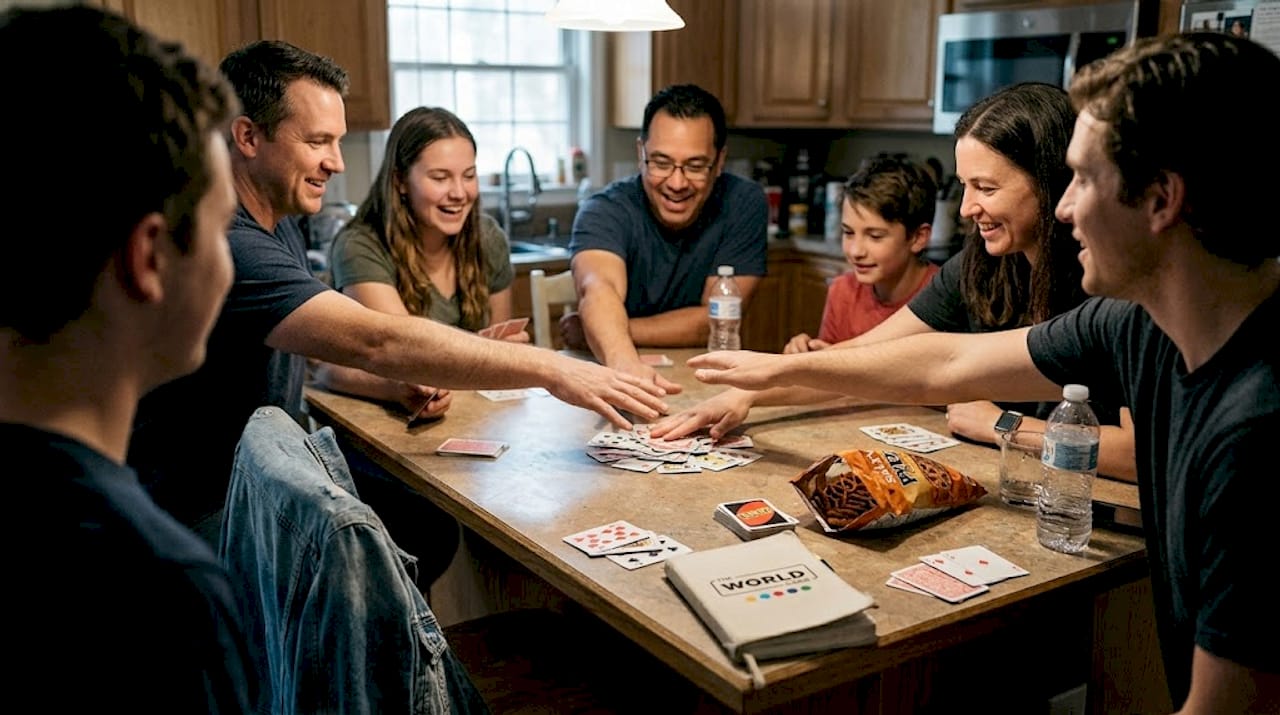
Dutch Blitz is one of those games that feels calm for about 30 seconds before absolute mayhem erupts. Players race to play cards in ascending order onto center stacks in real time, and everyone plays simultaneously. It’s frantic, competitive, and deeply satisfying when you finally empty your blitz pile before anyone else.
Nerts works similarly to Dutch Blitz but uses standard playing cards. It’s essentially multiplayer solitaire at full speed, with everyone racing to build sequences while sharing central piles. The simultaneous play creates this wonderful tension where one person’s progress directly blocks another player’s move.
5-Minute Dungeon takes a different approach with cooperative real-time play. Players work together to defeat dungeon challenges before a literal five-minute timer runs out. It rewards communication and teamwork under pressure, making it a great choice for groups who prefer working together over competing.
Here’s a handy comparison of these top picks:
| Game | Players | Time | Style | Best for |
|---|---|---|---|---|
| Blink | 2 | 10 min | Speed matching | Head-to-head competition |
| Taco Cat Goat Cheese Pizza | 2 to 8 | 10 min | Verbal + physical | Large mixed groups |
| Dutch Blitz | 2 to 4 | 15 min | Real-time racing | Competitive families |
| 5-Minute Dungeon | 2 to 5 | 5 min | Cooperative | Friends who like teamwork |
| Nerts | 2 to 8 | 10 min | Simultaneous solitaire | Larger groups |
Pro Tip: Mix a competitive game like Dutch Blitz with a cooperative one like 5-Minute Dungeon during the same game night. It shifts the energy perfectly and gives everyone a break from the tension of head-to-head play.
For more ideas and direct comparisons, check out our roundup of board games for parties to find what fits your specific crowd best.
Physical vs. verbal speed games: Which suits your group?
Knowing which games exist is one thing. Knowing which style fits your group is where things get really useful. Fast-paced games generally split into two broad camps: physical speed games and verbal speed games. Each creates a different kind of energy, and the right choice depends on who’s in the room.
Physical speed games involve dexterity, movement, or quick reflexes that go beyond just thinking fast. Blink is the mental version of this, where your eyes and hands work together to process and play cards faster than your opponent. Dutch Blitz gets your whole upper body involved as you grab, sort, and slap cards onto piles. KLASK is on a whole other level: a magnetic dexterity game where two players flick a striker across a board to score in the opponent’s goal, with each round lasting only seconds. It looks like foosball crossed with air hockey, and it creates an instant spectator crowd.
Physical games work especially well for groups with high energy and competitive spirits. They’re also great for younger kids who love the tactile, active element of play.
Verbal speed games rely on your mouth, your memory, and your ability to stay composed while your brain short-circuits. Taco Cat Goat Cheese Pizza is the king of this category, with its chanting mechanic creating a beautiful kind of confusion that makes people laugh until they cry. Other verbal games involve shouting answers, completing phrases, or calling out patterns faster than everyone else.
Verbal games tend to shine in mixed-age groups because they don’t require physical speed or agility. Grandparents, teens, and little kids can all compete on a relatively even playing field. They’re also fantastic for quieter spaces where knocking pieces around might not be ideal.
Here’s a quick reference for choosing based on your group:
- High-energy, competitive friends: Go physical. Dutch Blitz, KLASK, Blink
- Mixed ages, family-friendly vibes: Verbal is your best bet. Taco Cat Goat Cheese Pizza, Nerts
- Large groups (6+ people): Taco Cat Goat Cheese Pizza or team-based verbal games
- Smaller groups (2 to 3 people): Blink, Spit, or 5-Minute Dungeon
- Party with varied energy levels: Mix one physical and one verbal game throughout the night
Some games blend both categories, which makes them incredibly flexible. Check out what we consider quick board games for parties and compare them with a comparison of family party games to match your group’s vibe. And if you want to explore how frantic party games work in event settings, there are some genuinely wild formats worth considering.
Tips for hosting a successful fast-paced game night
You’ve got the games picked out. Now let’s make sure the night itself runs smoothly and everyone leaves with at least one great story to tell.
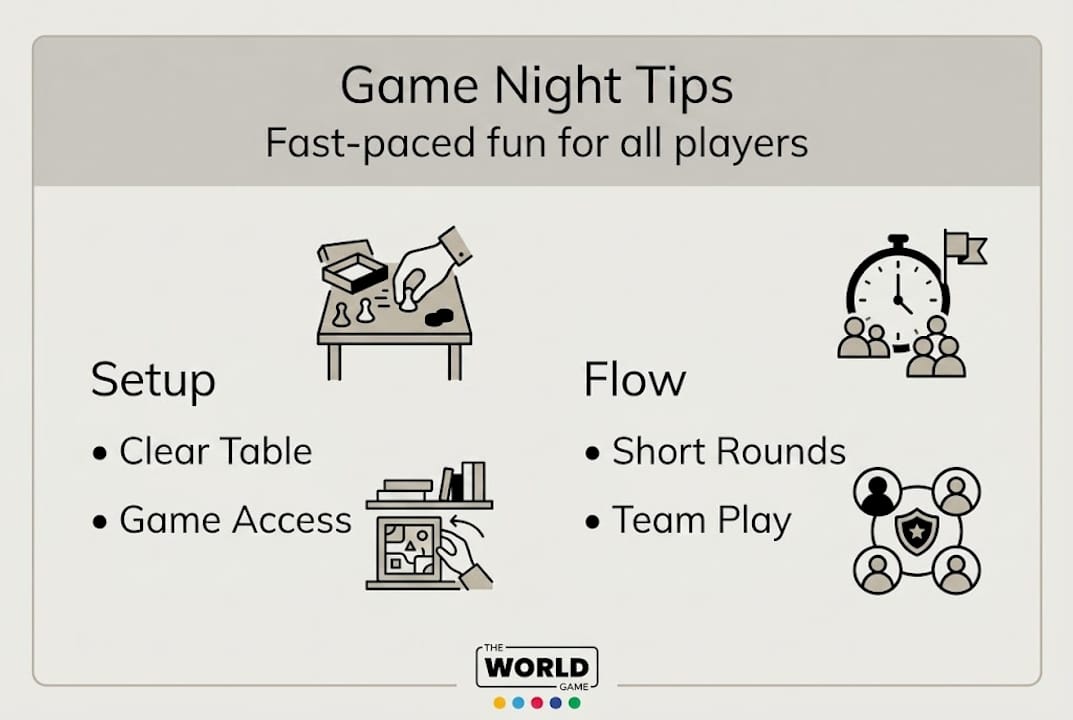
1. Set up your space before anyone arrives. Clear the table, have all games within reach, and keep extra chairs available. Fast-paced games move quickly, and fumbling around for missing cards or rule books kills the momentum instantly. Pre-organize each game so it’s ready to play within 60 seconds of someone sitting down.
2. Start with the most accessible game. Don’t open with your most chaotic title right away. Start with something easy and quick, like Taco Cat Goat Cheese Pizza, so everyone warms up and feels comfortable before you move to something more intense like Dutch Blitz.
3. Keep rounds short and rematches instant. The beauty of fast-paced games is that losing feels like an invitation to play again immediately. Encourage immediate rematches. The energy builds with each round, and even the person who came in dead last will want to try again straight away.
4. Mix game styles throughout the night. Alternate between physical and verbal games to keep things fresh. After a physically intense round of KLASK, switch to something that makes everyone laugh with a verbal game. Variety keeps everyone engaged and prevents fatigue from any single game style.
5. Focus on fun over rules. Success in fast-paced games comes from reflexes and pattern recognition, not complex strategy. Don’t over-explain rules. Give a 90-second summary, play a practice round, and then jump into the real thing. Over-explaining is the fastest way to lose your audience before the game even starts.
6. Use teams for bigger groups. Some games support team play, which adds a social dimension that changes the energy completely. Teams encourage communication and shared wins, making the experience feel more collaborative even within competitive formats. Check out the quick-play instructions for ideas on how real-time game formats can be structured for larger crowds.
Pro Tip: Keep a running scoreboard on a whiteboard or piece of paper across all games throughout the night. A cumulative leaderboard adds stakes to every round and gives people a reason to care even about games they’ve never played before.
You can find even more hosting ideas in our list of best party board games and our guide to help you compare family party games for different group sizes and styles.
Why the best fast-paced games aren’t always the ones you expect
Here’s a take that might surprise you: we think fast-paced games are often underestimated precisely because they look simple. People assume that if a game takes 10 minutes, it can’t possibly be as meaningful or memorable as a long, strategic one. We disagree completely.
The games that generate the most laughter, the most “okay one more round” moments, and the most genuinely shared memories at our game nights are almost always the fast ones. Taco Cat Goat Cheese Pizza sounds like a silly kids’ game on paper, but we’ve watched groups of adults lose themselves in absolute chaos for an hour straight without realizing it. That’s not shallow. That’s brilliant game design.
What makes a great fast-paced game isn’t just speed. It’s the social electricity it creates. It’s the way a perfectly timed slap makes the whole table erupt. It’s the collective groan when someone accidentally triggers an action card. You can find that sweet spot when you explore balanced family party games that prioritize both accessibility and genuine fun. Don’t sleep on the quick games. They’re often the ones people talk about long after the night ends.
Discover more quick-play games for your next event
We’ve covered a lot of ground here, and hopefully you’re already thinking about which game belongs on your table this weekend. The good news is there are dozens more where these came from.

At Playworldgame.com, we’ve curated a collection of fast, social card and board games built specifically for game nights, parties, gifts, and gatherings where energy matters. Whether you want something laugh-out-loud chaotic, something cooperative, or something that works beautifully for mixed ages, we’ve got you covered. Browse our full lineup and find the game that fits your crowd perfectly. Your next unforgettable game night is closer than you think.
Frequently asked questions
Which fast-paced board games work best for large groups?
Taco Cat Goat Cheese Pizza and Nerts both support up to 8 players, making them go-to picks for larger gatherings where everyone wants in on the fun.
Are fast-paced board games good for kids and families?
Absolutely. Most fast-paced games are designed for all ages and reward reflexes over strategy, which keeps the playing field level and the laughter flowing for kids and adults alike.
How long does a typical fast-paced board game take?
Most run between 2 and 15 minutes per round, with extremely high replayability so you can easily squeeze in five or six games in a single evening without anyone checking their phone.
Do you need special skills to play fast-paced board games?
Not really. These games mainly call for quick reflexes and pattern recognition rather than deep strategic thinking, which is exactly what makes them so accessible for players of all experience levels.
What’s the difference between real-time and turn-based board games?
In real-time games, all players act simultaneously with no waiting for your turn, which creates a more energetic, unpredictable experience compared to traditional turn-based formats.