


Every parent faces that moment when screens tempt their children more than curiosity about the world. Studies show that over 60 percent of families want more interactive ways to spark learning at home. Exploring geography and cultures becomes far more engaging when approached through family games, especially as American and international families alike search for playful methods to connect and learn. Discover how thoughtful family games can transform home activities into global adventures that teach, entertain, and inspire.
Table of Contents
- Defining Family Games And Their Core Role
- Types Of Family Games And Key Distinctions
- How Family Games Foster Learning And Bonding
- Cultural And Educational Benefits For Children
- Common Mistakes To Avoid In Game Sessions
Key Takeaways
| Point | Details |
|---|---|
| Family Games Enhance Development | Family games serve as powerful learning tools, fostering essential life skills such as communication, problem-solving, and emotional regulation in a fun, engaging manner. |
| Variety in Game Types is Essential | Different types of family games offer varied educational and bonding experiences, from board games to digital formats, catering to diverse cognitive and social development needs. |
| Focus on Fun, Not Competition | It is crucial to maintain a supportive and enjoyable atmosphere during game sessions to maximize learning and family bonding while minimizing stress. |
| Cultural Learning Through Play | Family games provide opportunities for children to understand cultural narratives and traditions, enhancing their sense of identity and belonging. |
Defining Family Games and Their Core Role
Family games represent more than simple entertainment activities - they are powerful learning platforms that foster critical developmental skills through interactive experiences. Family games encompass a diverse range of activities designed to engage multiple family members simultaneously, creating opportunities for collaborative learning and connection. These interactive experiences range from traditional board games and card challenges to digital multiplayer experiences that encourage teamwork and strategic thinking.
Research demonstrates that family games play a significant role in child development, serving as structured environments where children learn essential life skills. Researchers have found that family games support effective communication and family cohesion, creating shared experiences that strengthen interpersonal relationships. Through gameplay, children develop cognitive abilities like problem solving, learn complex social dynamics of turn-taking, and practice emotional regulation in a supportive environment.
The core function of family games extends beyond mere recreation. They represent sophisticated learning tools that help children acquire academic and social competencies. Studies indicate that these interactive experiences support academic skill development including math reasoning, reading comprehension, and strategic thinking. By transforming learning into an engaging, collaborative activity, family games motivate children to explore new concepts and challenge themselves in low-pressure, enjoyable settings.
Pro tip: Select family games that match your children’s developmental stage and rotate game selections to maintain excitement and learning momentum.
Types of Family Games and Key Distinctions
Family games represent a diverse ecosystem of interactive experiences, categorized by their unique characteristics and developmental purposes. Game formats range widely, encompassing physical, digital, cooperative, and competitive platforms that engage family members in different cognitive and social learning environments. Systematic research reveals multiple distinct categories of family games that serve varied educational and bonding objectives.
These game types can be broadly classified into several key categories. Physical games include outdoor activities, sports, and movement-based challenges that promote physical fitness and motor skill development. Board games offer structured learning experiences focusing on strategic thinking, rule comprehension, and turn-taking. Digital games provide interactive digital environments that can connect family members through collaborative or competitive gameplay. Card games represent another crucial category, emphasizing mathematical skills, pattern recognition, and rapid decision making.
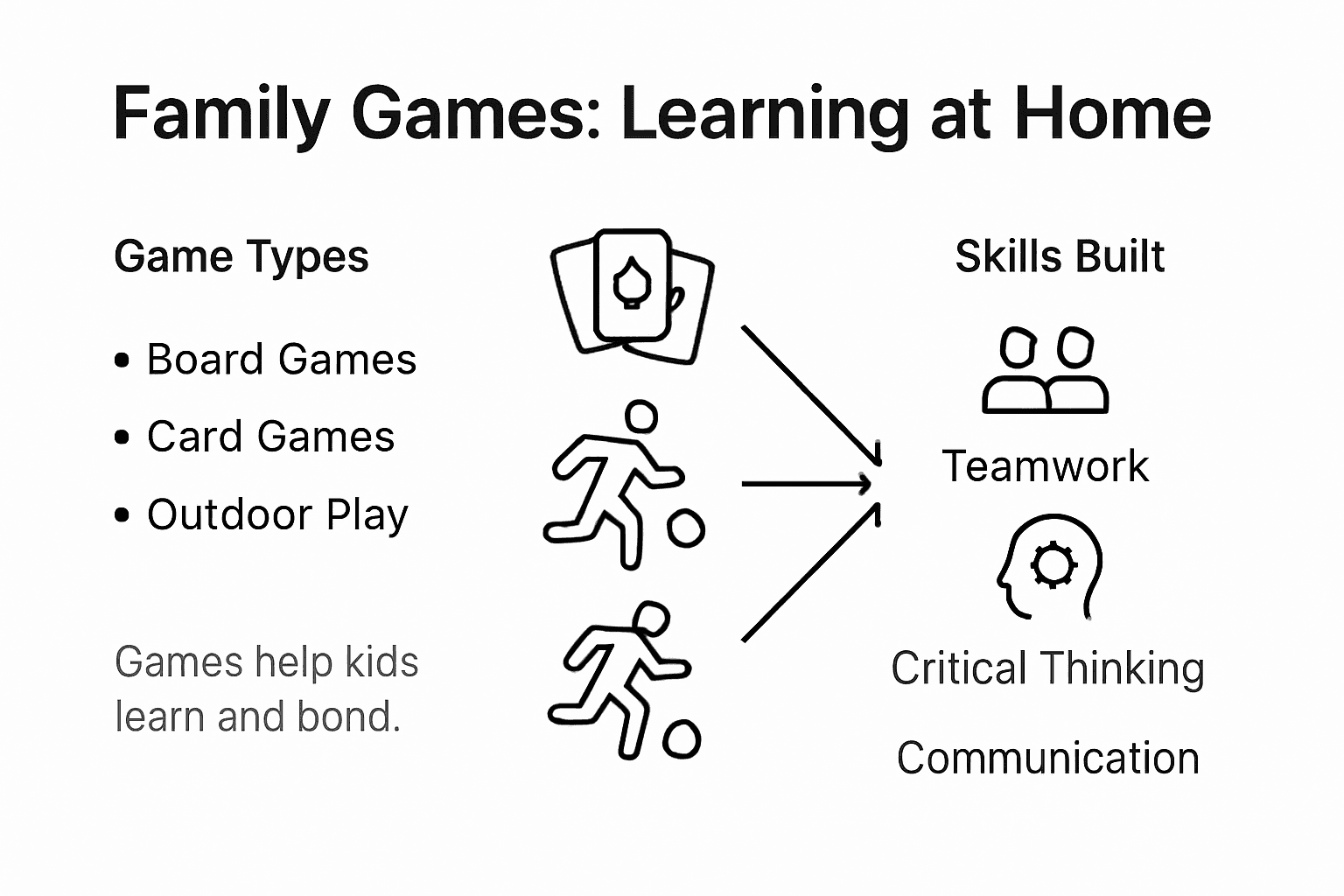
Family game research indicates significant variations in game design that impact learning outcomes, particularly in cooperative versus competitive formats. Cooperative games encourage collective problem solving and mutual support, while competitive games teach individual performance skills and emotional regulation. The selection between these formats depends on family dynamics, children’s ages, and specific developmental goals families wish to address through gameplay.
Pro tip: Rotate game types to maintain engagement and expose children to diverse learning experiences, ensuring no single game format dominates your family’s interactive time.
Here’s a comparison of key family game types and the skills they help develop:
| Game Type | Primary Skills Developed | Ideal Age Range |
|---|---|---|
| Board Games | Strategic thinking, math | 5-14 years |
| Physical Games | Motor skills, teamwork | 3-12 years |
| Card Games | Pattern recognition, decision-making | 7-16 years |
| Digital Games | Collaboration, tech literacy | 6-18 years |
How Family Games Foster Learning and Bonding
Family games are potent catalysts for creating meaningful connections and educational opportunities within households. These interactive experiences transcend simple entertainment, serving as dynamic platforms where learning and emotional bonding intertwine seamlessly. Family game interactions transform traditional parent-child dynamics into collaborative learning environments, enabling shared experiences that strengthen relationships while simultaneously supporting cognitive development.

The learning mechanisms embedded in family games are multifaceted and profound. Through gameplay, children develop critical social skills like cooperation, communication, and emotional regulation. Strategic games challenge problem-solving abilities, while cooperative games teach teamwork and collective goal achievement. Mathematical reasoning emerges naturally during board games, reading comprehension improves through narrative-based challenges, and critical thinking skills are honed through strategic decision making. These educational benefits occur organically, without the pressure of traditional academic settings.
Research demonstrates that family games create contexts for open communication and enhanced interpersonal understanding, making them powerful tools for family bonding. By engaging together in playful, low-stakes environments, family members develop deeper empathy, learn to navigate competitive and collaborative scenarios, and build shared memories. The emotional connections formed during these experiences extend far beyond the immediate gameplay, creating lasting positive associations that support long-term relationship development and mutual understanding.
Pro tip: Choose games that match your family’s interests and skill levels, rotating between competitive and cooperative formats to maximize learning and enjoyment.
Cultural and Educational Benefits for Children
Family games represent powerful conduits for cultural learning and educational development, offering far more than simple entertainment. Serious game-based learning techniques effectively engage children cognitively, socially, and emotionally, creating immersive environments where knowledge acquisition happens naturally and enjoyably. These interactive experiences serve as sophisticated educational tools that bridge academic learning with cultural understanding, helping children develop critical skills while maintaining their intrinsic motivation.
Through strategic gameplay, children encounter complex social scenarios that teach nuanced interpersonal skills. They learn fundamental concepts like rule following, turn-taking, and collaborative problem solving, which extend far beyond the immediate game context. Mathematical reasoning emerges organically during number-based challenges, while narrative games enhance reading comprehension and critical thinking. Family games provide unique opportunities for practicing cooperation, resilience, and emotional regulation, creating safe spaces where children can experiment with different social strategies and develop robust emotional intelligence.
In culturally diverse households, family games assume an even more significant role. They become powerful mechanisms for intergenerational knowledge transfer, helping children understand and internalize family traditions, values, and cultural narratives. By engaging in games that reflect familial or cultural backgrounds, children develop a stronger sense of identity and belonging. These shared experiences create meaningful connections, allowing family members to communicate complex cultural concepts through playful, accessible interactions that transcend traditional teaching methods.
Pro tip: Select games that reflect your family’s cultural heritage and rotate between educational and culturally significant gameplay to maximize learning and cultural connection.
Common Mistakes to Avoid in Game Sessions
Family game sessions can quickly become challenging when parents and children misunderstand the fundamental purpose of play. Parental misconceptions and biased expectations frequently disrupt healthy game interactions, transforming potentially enriching experiences into sources of tension and frustration. Understanding these potential pitfalls is crucial for maintaining a positive, educational, and enjoyable gaming environment that supports family bonding and learning.
One of the most significant errors parents make is introducing unnecessary competitive pressure or emotional intensity into game time. Neglecting to maintain a supportive atmosphere can lead to conflicts and undermine the core benefits of family games. Common mistakes include becoming overly focused on winning, displaying impatience with younger players’ learning curves, and failing to choose age-appropriate games that match children’s developmental stages. These missteps can transform what should be a collaborative, fun learning experience into a stressful interaction that diminishes children’s motivation and enjoyment.
Navigating game sessions successfully requires a delicate balance between guidance and freedom. Parents must learn to moderate their involvement, avoiding micromanagement while providing gentle support. This means allowing children to make mistakes, learn from their experiences, and develop problem-solving skills organically. Recognizing that the primary goals of family games are connection, learning, and enjoyment - not perfect performance - helps create an environment where children feel safe exploring, taking risks, and growing through play.
Pro tip: Establish clear, positive ground rules before starting any game, focusing on fun and learning rather than winning, and be prepared to adjust your approach based on your children’s reactions and engagement levels.
This table summarizes common pitfalls in family game sessions and tips for a positive experience:
| Common Mistake | Impact on Family | Recommended Solution |
|---|---|---|
| Excessive competition | Causes stress | Focus on fun, not winning |
| Age-inappropriate games | Frustrates players | Match games to child’s abilities |
| Parental micromanagement | Reduces autonomy | Offer guidance, allow mistakes |
| Lack of ground rules | Leads to conflict | Set clear positive expectations |
Discover the Power of Educational Family Games for Lasting Connections
Family games offer more than fun moments at home They build essential skills like communication teamwork and cultural understanding as highlighted in the article But finding the right games that engage your children while matching their developmental needs can be a challenge Our selection of interactive board and card games focuses on geography general knowledge and cultural learning creating memorable experiences that promote both education and family bonding

Explore our range of thoughtfully designed games at Playworld Game and bring learning to life through play Whether you want to strengthen your child’s math reasoning or encourage collaborative problem solving each game offers fun educational benefits backed by research Don’t wait to transform game night into a meaningful opportunity Join our community today and find the perfect game to match your family’s goals at Playworld Game for an unforgettable learning adventure
Frequently Asked Questions
What are the educational benefits of family games?
Family games foster critical social and cognitive skills such as problem-solving, communication, and emotional regulation, while also supporting academic competencies like math reasoning and reading comprehension.
How can family games enhance bonding among family members?
Family games create shared experiences that promote open communication and deepen emotional connections, transforming traditional parent-child dynamics into collaborative learning opportunities.
What types of family games are most effective for learning?
Board games promote strategic thinking, physical games enhance teamwork and motor skills, card games develop pattern recognition, and digital games foster collaboration and tech literacy, catering to various developmental needs.
How can I ensure a positive gaming experience for my family?
To foster a positive experience, establish clear ground rules that prioritize fun and learning over winning, select age-appropriate games, and provide guidance while allowing children to explore and make mistakes.