


Geography has a reputation problem. A lot of families assume it’s just memorizing capitals and coloring maps, which sounds about as exciting as watching paint dry. But here’s the thing: geography skills build spatial awareness, critical thinking, and global understanding that shape how kids see the entire world. When you weave geography into family game night, it stops being a school subject and starts being something everyone actually wants to do. This article breaks down the science, the strategies, and the games that make early geography learning one of the best investments you can make for your kids.
Table of Contents
- What does it mean to have strong geography skills?
- Early geography learning: Cognitive and academic power-up
- Geography games: Family fun with proven impact
- Beyond game night: Lifelong effects of early geography skills
- How families can build geography skills today
- Where to find engaging geography games for your family
- Frequently asked questions
Key Takeaways
| Point | Details |
|---|---|
| Start geography education early | Early exposure to geography builds foundational skills for school and life. |
| Use games for maximum impact | Family geography games are proven to boost learning, retention, and fun. |
| Promote global understanding | Building geography skills supports empathy, decision-making, and environmental awareness. |
| Simple activities drive results | Integrating maps, games, and discussions into daily life makes learning natural and lasting. |
What does it mean to have strong geography skills?
Now that we’ve reframed geography, let’s clarify what these valuable skills actually entail. Most people picture geography as a map with country names to memorize. Real geographic thinking is a whole different animal.
Strong geography skills include:
- Spatial reasoning: Understanding how places relate to each other in space
- Map reading: Interpreting symbols, scales, and directions on physical and digital maps
- Cultural awareness: Recognizing how geography shapes the way people live, eat, and communicate
- Digital mapping: Using tools like Google Maps or satellite imagery to navigate and analyze the world
- Environmental thinking: Connecting climate, terrain, and human activity
The difference between memorizing locations and real geographic thinking is huge. Memorizing that France is in Europe is trivia. Understanding why France’s coastal geography shaped its cuisine, trade routes, and history? That’s geographic literacy. As importance of geographic literacy research confirms, this kind of thinking is foundational for children’s cognitive development.
| Skill type | Memorization approach | Geographic thinking approach |
|---|---|---|
| Countries | Name and locate on a map | Understand borders, neighbors, and history |
| Climate | Define weather terms | Connect climate to culture and daily life |
| Landforms | Label mountains and rivers | Explain how terrain shapes human settlement |
| Navigation | Follow directions | Read maps and adapt to new environments |
The benefits of geography games go far beyond the game table. Kids who develop real geographic thinking make better decisions, understand global news, and connect more deeply with people from different backgrounds. Geography is a life skill dressed up as a school subject.
“Geographic literacy empowers children to think critically about the world, make informed decisions, and engage as global citizens.” — Real-life applications of geography in primary education
Early geography learning: Cognitive and academic power-up
With a clear sense of geography’s skill set, let’s explore why starting early offers such dramatic academic and developmental boosts.
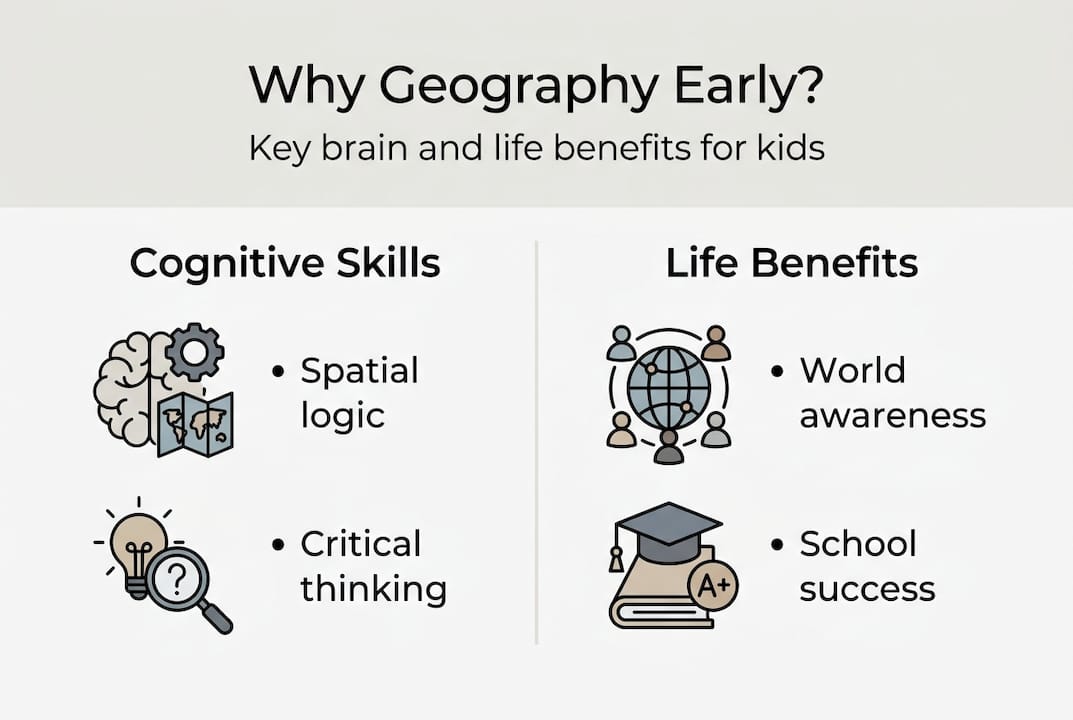
Geography is sneakily foundational for reading. When kids understand context, setting, and cultural background, comprehension improves across every subject. Early geography education has been shown to improve academic performance, including reading comprehension, especially for English language learners. That’s a big deal.
Here’s a simple age-based progression to keep in mind:
- Ages 3 to 5: Explore neighborhood maps, globes, and picture books set in different countries
- Ages 6 to 8: Introduce continent puzzles, flag matching games, and simple map activities
- Ages 9 to 10: Add country trivia, capital cities, and basic climate zone discussions
- Ages 11 to 12: Explore current events, geopolitical relationships, and digital mapping tools
| Age range | Key geography milestone | Best learning method |
|---|---|---|
| 3 to 5 | Recognizes home, neighborhood, and globe | Picture books, globes, simple puzzles |
| 6 to 8 | Identifies continents and major countries | Map games, flag cards, puzzles |
| 9 to 10 | Names capitals and basic climate zones | Trivia games, quizzes, card games |
| 11 to 12 | Understands geopolitics and current events | Digital tools, news discussions, strategy games |
According to NAEP geographic literacy data, only about 27% of U.S. students score at or above proficient in geography. Starting early and making it fun is the clearest path to closing that gap.
The geography card game benefits are especially strong for younger kids who learn best through hands-on play rather than worksheets.
Pro Tip: During storytime, pull up a simple map and point to where the story takes place. It takes 30 seconds and quietly builds both literacy and spatial awareness at the same time.
Geography games: Family fun with proven impact
Knowing how impactful early exposure can be, it’s time to meet the real-life hero: geography games that make family time both fun and educational.
Games work because they create low-stakes repetition. Kids don’t feel like they’re studying. They feel like they’re competing, laughing, and winning. Play-based learning through games and interactive methods like mapping and quizzes genuinely enhances retention in ways that flashcards simply can’t match.
Here’s what the research shows: kids who play geography games regularly can achieve 75 to 85% map accuracy after just a few weeks of consistent gameplay. That’s a dramatic improvement compared to traditional study methods.
Popular types of geography games and what they build:
- Map quiz games: Speed, accuracy, and spatial memory
- Flag and country card games: Visual recognition and cultural curiosity
- Geography trivia: Broad knowledge and competitive fun
- Puzzle maps: Hands-on spatial reasoning and fine motor skills
- Digital geography games: Engagement, interactivity, and real-time feedback
The mapping and games connection is well-documented. When kids interact with maps in a game context, they build mental models of the world that stick around long after the game is over.
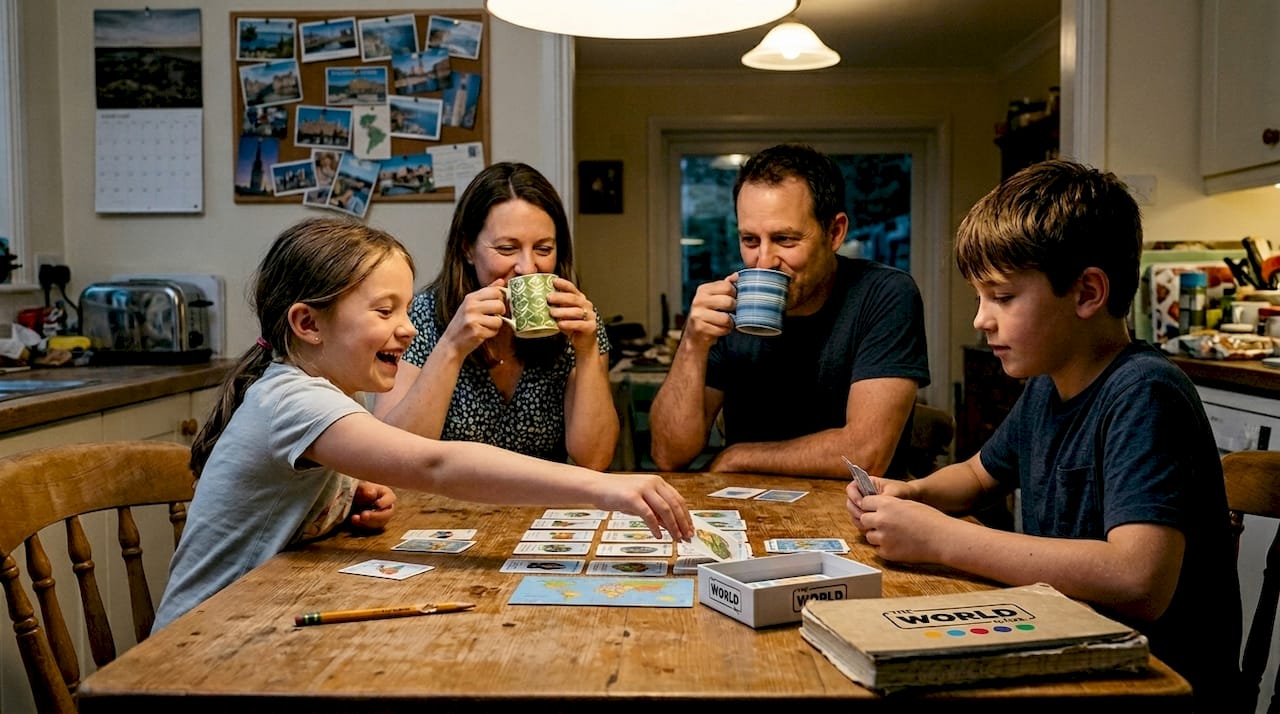
We love how geography games naturally spark conversations. Someone asks “Wait, where even IS Uzbekistan?” and suddenly the whole family is leaning over the map together. That’s the magic.
Pro Tip: Rotate your geography games weekly. One week focus on flags and capitals, the next on physical geography like mountains and rivers. Targeting different sub-skills keeps things fresh and builds a more complete geographic picture.
For more on why games are the best teaching tool, check out teaching geography through games for a deeper breakdown.
Beyond game night: Lifelong effects of early geography skills
But the value of geography isn’t just for this month’s game night. The ripple effects last well beyond childhood.
Spatial reasoning develops progressively from early childhood and is foundational for STEM success and lifelong skills. Kids who build strong spatial reasoning early are better positioned for careers in engineering, architecture, data science, medicine, and environmental science. Geography is quietly one of the best STEM prep tools available.
The long-term benefits of early geography skills include:
- STEM readiness: Spatial reasoning is a core skill in math, science, and technology fields
- Global citizenship: Understanding other cultures builds empathy and reduces bias
- Environmental awareness: Kids who understand geography are more likely to care about climate and conservation
- Better decision-making: Geographic context helps people evaluate news, politics, and global events more critically
- Problem-solving: Navigating complex geographic relationships builds flexible thinking
Geographic literacy empowers global citizenship, environmental awareness, and informed decision-making in ways that extend far beyond the classroom. And the real benefits of geography are increasingly tied to the UN Sustainable Development Goals, which require globally literate citizens to address climate change, inequality, and resource management.
“Early intervention in geographic literacy addresses long-standing gaps and sets children up for a lifetime of informed, empathetic global engagement.”
The bottom line: geography isn’t just about knowing where things are. It’s about understanding why the world works the way it does. And that understanding starts with a game on a Friday night.
How families can build geography skills today
Inspired by geography’s impact, here are specific and simple strategies every family can use right away.
You don’t need a classroom or a curriculum. You just need a little intention and the right tools. Interactive methods like games, quizzes, and mapping activities engage families and enhance retention through play-based learning.
- Start with map puzzles: Floor puzzles of the U.S. or world map are perfect for ages 3 and up. They build spatial awareness without any pressure.
- Introduce country and flag card games: These are fast, visual, and surprisingly addictive. Even adults get competitive.
- Use online geography quizzes: Sites like Seterra or GeoGuessr make map practice feel like a game. Set a timer and compete as a family.
- Bring geography into daily conversations: When a country comes up in the news, find it on a map together. When you eat at a new restaurant, look up where that cuisine comes from.
- Read books set in different countries: Fiction and nonfiction both work. Pair the book with a map to ground the story in a real place.
- Plan a virtual trip: Let your kids pick a country, research it, and “plan” an itinerary. It’s hands-on, creative, and deeply geographic.
The biggest barrier most families face is time. The good news: most of these activities take five minutes or less. You don’t need a dedicated geography hour. You just need to weave it into what you’re already doing.
Pro Tip: Involve your kids in planning your next real or imaginary trip. Let them pick the destination, find it on a map, and research one fun fact about it. That single activity covers geography, research skills, and critical thinking all at once.
For more ideas on getting started, geography card games for kids is a great place to explore options that work for different ages and skill levels.
Where to find engaging geography games for your family
Ready to elevate your game nights and skill-building? We’ve got you covered.
At Playworldgame.com, we curate fast, social games designed for real family game nights, not stuffy classrooms. Our geography and world games are built to be picked up quickly, played with mixed ages, and genuinely enjoyed by everyone at the table.

Whether you’re looking for your first geography card game or want to add something new to your rotation, our collection makes it easy to find something that fits your family’s vibe. These are family-tested, crowd-pleasing games that make geography feel like the highlight of the night, not homework. Browse family geography games and find your next favorite game night addition today.
Frequently asked questions
What age should children start learning geography?
Children can begin exploring geography as early as age 3 through puzzles, globes, and picture books. Spatial reasoning develops progressively from early childhood, so earlier exposure always helps.
Are geography games more effective than traditional memorization?
Yes, absolutely. Play-based learning boosts understanding, retention, and enjoyment far beyond what rote memorization can achieve, and kids actually want to keep playing.
How does early geography learning help with other school subjects?
Geography strengthens reading comprehension, critical thinking, and spatial awareness. Early geography education has been directly linked to improved academic performance across multiple subjects.
Is it easy to bring geography learning into family routines?
Very easy. Interactive geography methods like card games, map puzzles, and quick online quizzes can be dropped into daily life without any major planning or prep time.