


Most people assume educational entertainment means boring lessons dressed up in a costume. You know the type: a math worksheet with a cartoon mascot slapped on it. We’d argue that’s the wrong picture entirely. Real educational entertainment is something families and social groups are already doing on game nights without even realizing it. When a trivia card sparks a debate, when a geography game sends everyone scrambling to remember capitals, or when a party game teaches you something surprising about your friends, that’s the magic at work. This article breaks down what educational entertainment actually is, how it’s built, what the research says, and how to make it work for your next gathering.
Table of Contents
- What is educational entertainment?
- How educational entertainment is designed
- The impact of educational entertainment
- Limits and pitfalls of educational entertainment
- What most experts miss about educational entertainment
- Discover engaging educational games for your next gathering
- Frequently asked questions
Key Takeaways
| Point | Details |
|---|---|
| Edutainment blends fun and learning | Educational entertainment uses games and activities that engage while teaching new concepts. |
| Design matters for impact | Quality frameworks and well-planned objectives make games effective and enjoyable. |
| Research supports real benefits | Studies show measurable improvements in attention, academic skills, and health from edutainment. |
| Reflection amplifies results | Discussing outcomes after games turns fun moments into lasting education. |
| Pitfalls can be avoided | Families should balance entertainment and learning, use structure, and avoid superficiality. |
What is educational entertainment?
Edutainment, also known as educational entertainment, is defined as entertainment designed to be educational. That’s the clean dictionary version, but the real-world meaning is a lot more interesting. It’s the sweet spot where genuine fun and genuine learning overlap, and neither one cancels out the other.
You’ll find educational entertainment across a huge range of formats:
- Card and board games that teach geography, history, science, or social skills
- TV shows and documentaries designed for kids and adults alike
- Mobile apps and video games with built-in learning mechanics
- Interactive activities like escape rooms, trivia nights, and storytelling games
For families and social groups, this matters because the context of play changes everything. When you’re laughing around a table with people you care about, your brain is relaxed and receptive. Information sticks differently than it does in a classroom or a lecture. That’s not just a feel-good idea. It’s backed by how memory and engagement actually work.
Educational entertainment also differs from traditional learning in a few key ways. Traditional learning is often structured around a teacher delivering content to a passive audience. Educational entertainment flips that. The learner is active, making choices, reacting to challenges, and experiencing consequences in real time. That shift from passive to active is a big deal.
It’s also worth noting that educational entertainment isn’t just for kids. Adults benefit just as much, whether they’re picking up trivia facts, sharpening strategic thinking, or learning something new about a topic they thought they already knew. We’ve seen adults genuinely surprised by what they learn during a well-designed game night.
“The best educational games don’t feel like school. They feel like the best part of your evening.”
If you want a deeper look at how games fit into this space, check out this educational gaming overview that breaks down the category in more detail.
How educational entertainment is designed
Now that you know what educational entertainment is, let’s explore how it’s actually created and designed. This part is surprisingly practical for families who want to choose better games or even create their own.
Designing effective educational entertainment isn’t just about making something fun and hoping learning sneaks in. Edutainment design methodologies involve frameworks like LM-GM (Learning Model to Game Model), 4DF (Four-Dimensional Framework), iterative prototyping, mapping learning objectives, and pedagogy-driven patterns. That sounds technical, but the core idea is simple: start with what you want people to learn, then build the game mechanics around that goal.

Here’s a quick comparison of two common design approaches:
| Approach | Focus | Best for |
|---|---|---|
| Learning-first design | Starts with the educational goal | Academic skills, knowledge retention |
| Fun-first design | Starts with game mechanics | Engagement, social play, motivation |
The best games blend both. A trivia game that’s all facts and no laughs will lose players fast. A party game with zero substance leaves you entertained but empty. The sweet spot is intentional design where the fun is the learning mechanism.
Mapping game elements to learning objectives is one of the most useful things designers do. For example, a geography card game might use visual cues, repetition, and competitive pressure to help players remember country locations. Each mechanic serves the learning goal without feeling forced.
One thing we’ve noticed in our experience: games that include a natural moment of reflection or discussion tend to stick with players longer. Whether it’s a built-in debrief round or just a question printed on the card, that pause to think and talk is where real learning anchors itself.
Pro Tip: When choosing games for your group, look for ones with clear scoring or feedback built in. Games that tell you why an answer is right (not just whether it’s right) are doing the educational heavy lifting.
For a closer look at how this process works from start to finish, the educational game creation guide is worth a read.
The impact of educational entertainment
Understanding the design is only part of the story. Let’s see how educational entertainment actually affects learners, because the numbers here are genuinely impressive.
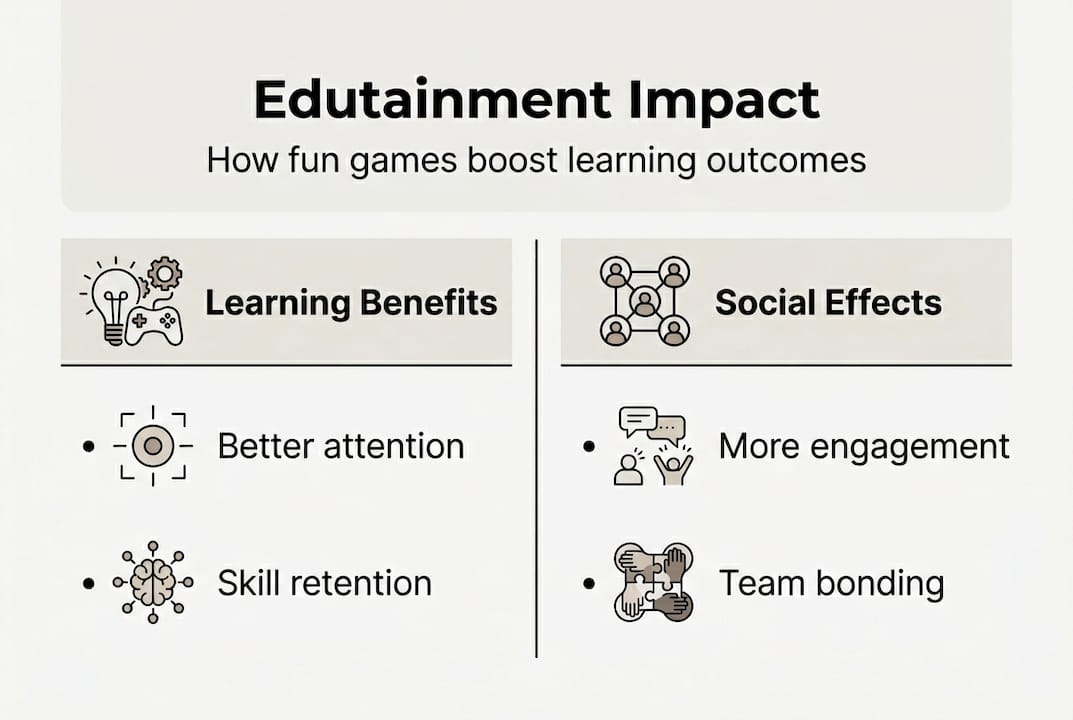
A meta-analysis of edutainment interventions found positive effects across health outcomes, academic performance in children with ADHD, oral health knowledge, and overall learning, with an effect size of d=0.566. In research terms, that’s a medium-to-large effect. It means educational entertainment isn’t just a nice idea. It moves the needle in measurable ways.
Here’s a summary of key findings:
| Area of impact | Measured improvement |
|---|---|
| Academic skills (reading, math) | 26 to 53% improvement |
| Attention and focus (ADHD children) | Significant positive effect |
| Health knowledge (oral health) | Measurable gains post-intervention |
| Overall learning effect size | d=0.566 (medium-large) |
Key research takeaways for families:
- Gamified apps improve reading and math scores in school-age children when used consistently.
- Edutainment videos boost health knowledge and behavior change more effectively than pamphlets or lectures.
- Interactive games improve attention and task completion in children with attention challenges.
- Social game formats (played in groups) tend to produce stronger retention than solo play.
- Repetition within game mechanics (like card matching or trivia rounds) reinforces memory more efficiently than rereading.
What we love about these findings is that they apply directly to game nights. You don’t need a classroom or a curriculum. A well-chosen card game played with family on a Friday night can deliver real gaming benefits that show up in everyday life.
The effect size of d=0.566 is worth highlighting because it’s comparable to many traditional educational interventions. That’s not a small thing. It means a fun game night can be as effective as structured study sessions for certain types of learning.
Limits and pitfalls of educational entertainment
While impacts can be impressive, it’s important to note there are limits and potential drawbacks. Knowing these helps you make smarter choices for your group.
The most common pitfall is when fun completely overshadows learning. Edutainment works best for procedural knowledge (the “how-to” stuff) and is less effective when it comes to core conceptual knowledge or when the entertainment element drowns out the educational one. Think of it this way: a game that teaches you how to identify flags is great. A game that tries to explain why geopolitical borders exist through card mechanics alone is probably going to fall short.
Here are the most common pitfalls to watch for:
- Over-relying on repetition without adding new challenge or context
- Skipping the debrief so players finish the game but don’t process what they learned
- Choosing games that are too easy or too hard for the group’s skill level
- Expecting games to replace structured learning for complex or abstract topics
- Playing once and moving on rather than revisiting games to reinforce knowledge
Critics of educational entertainment also raise valid concerns. Some argue that edutainment can dilute learning, create unrealistic expectations about how engaging education should always be, or fail to provide substantive knowledge without proper guidance. These are fair points, especially when games are used as a substitute for deeper engagement rather than a supplement to it.
“Educational entertainment works best as a spark, not a substitute.”
The edge case worth knowing: games that focus on procedural skills (memorizing facts, practicing sequences, building vocabulary) tend to outperform games designed to teach abstract reasoning or critical thinking. That doesn’t mean the latter is impossible, it just requires more intentional design and follow-up.
Pro Tip: After any educational game night, spend five minutes asking the group what surprised them or what they’d want to know more about. That short conversation turns a fun evening into a genuine learning moment. Check out common game creation pitfalls if you’re thinking about designing your own.
What most experts miss about educational entertainment
Here’s where we want to share something that most guides skip right over. The research on educational entertainment focuses heavily on game mechanics, design frameworks, and measurable outcomes. And that’s all valuable. But in our experience, the single biggest factor in whether a game night actually teaches something is what happens after the game ends.
Expert frameworks emphasize open-world models, integrated assessment, and structured debriefs for a reason. The debrief is where learning moves from short-term memory to long-term retention. Without it, even the best-designed game fades like any other fun evening.
We’ve seen this play out repeatedly. A family plays a geography trivia game, laughs a lot, and moves on. Two weeks later, nobody remembers a single fact. But when someone asks “what was the most surprising thing you learned tonight?” the conversation that follows is where the learning actually locks in. That’s not a classroom trick. It’s just how memory works.
The takeaway for families and social groups is this: don’t just pick a great game. Build a tiny ritual around it. A two-minute conversation after playing is worth more than an hour of passive gameplay. Explore expert game design insight to see how the best designers build this into their games from the start.
Discover engaging educational games for your next gathering
Ready to turn knowledge into action? We’ve put together a collection of games that do exactly what this article describes: they’re genuinely fun, built with intention, and designed to leave your group with something to talk about long after the cards are packed away.

At Playworldgame.com, we curate family-friendly educational games that work for all kinds of groups, from curious kids to competitive adults. Whether you’re after trivia, geography, conversation starters, or skill-based challenges, we’ve got options that deliver real fun and real learning. Browse our collection and find the perfect game for your next night in.
Frequently asked questions
How is educational entertainment different from traditional entertainment?
Educational entertainment blends learning with fun, while traditional entertainment mainly aims to amuse without explicit educational goals. The key difference is intentional design around learning outcomes.
Can quick games really teach meaningful skills or knowledge?
Yes. Gamified learning can improve attention, reading, math, and health outcomes measurably, especially when games are well-designed and include structured follow-up.
What are the main drawbacks of educational entertainment?
The biggest risks are learning being diluted by fun and games lacking guidance or structured follow-up. Critics also note that edutainment can risk superficiality without intentional reflection built in.
How do families maximize the learning value of game nights?
Choose games with built-in structure, include a quick debrief afterward, and revisit favorite games every few months. Post-game reflection is the most underrated tool for converting fun into lasting learning.