


TL;DR:
- Well-designed get-to-know-you games use structured mechanics to foster genuine connections quickly among adults. They include self-disclosure activities and cooperative challenges that provide clear roles and reduce social pressure, making interactions more meaningful. Adapting game choices to group size, energy, and comfort levels enhances engagement, with focus on natural conversations emerging beyond the game.
Most people assume icebreaker games for adults are either cringe-worthy or pointless. You know the ones: awkward silences, forced smiles, someone asking “What’s your spirit animal?” while everyone stares at their shoes. But well-designed get-to-know-you games actually use simple, bounded mechanics like prompt cards, yes/no guessing, and structured mingling to create genuine connection faster than open conversation alone ever could. We’ve seen it happen at parties, date nights, and casual hangouts, and the difference between a flat gathering and a memorable one often comes down to having the right structure in place.
Table of Contents
- What defines a get-to-know-you game for adults?
- How classic games use structure to build connection
- Adapting games for group size, comfort, and energy level
- Cooperative vs disclosure-focused games: Choosing what works for your audience
- Beyond introductions: The surprising power (and limits) of well-defined games
- Find your next favorite get-to-know-you game
- Frequently asked questions
Key Takeaways
| Point | Details |
|---|---|
| Structure boosts engagement | Games with clear rules and prompts make adults more comfortable and willing to participate. |
| Adapt to your group | Adjusting game style and rules for group size and vibe is crucial for genuine connection. |
| Self-disclosure vs cooperation | Both personal question games and cooperative challenges help people bond but work best for different audiences. |
| Respect comfort zones | Allowing passing and matching depth to energy level make games enjoyable for everyone. |
| Follow-up is key | Keep games simple and use them as springboards for continued fun and conversation. |
What defines a get-to-know-you game for adults?
With a common understanding of what makes these games worthwhile, let’s break down their defining features.
A get-to-know-you game is any activity that intentionally creates a reason for people to share something about themselves in a low-pressure, structured setting. The key word is intentional. Casual small talk at a party is fine, but it rarely goes anywhere meaningful. Games give that conversation a framework, a reason to go a little deeper, a built-in excuse to ask questions you’d normally never ask.
These games generally fall into two broad categories. Self-disclosure games use prompts, cards, or questions to encourage personal sharing. Think: “What’s one thing most people here don’t know about you?” or a classic round of Two Truths and a Lie. Cooperative challenge games build connection through joint activity, like group quizzes, matching games, or team puzzles. Both styles work because they give participants a role and a reason to engage, which is the secret ingredient most unstructured socializing lacks.
Research backs this up strongly. Cooperative gameplay can reduce intergroup animosity and increase group enjoyment, meaning that shared challenges don’t just entertain, they actually soften social friction. That’s a big deal when you’re mixing new people or blending friend groups who haven’t met before.
“The best get-to-know-you games are less about asking big questions and more about giving people permission to engage.” This framing shifts the host’s job from interrogator to facilitator.
Here’s a quick breakdown of what separates a solid game from a forgettable one:
| Feature | Weak game | Strong game |
|---|---|---|
| Structure | Open-ended, no rules | Clear turns and prompts |
| Pressure level | High (random sharing) | Low (passes allowed) |
| Scalability | Works for one size only | Adjusts to group size |
| Energy match | One fixed tone | Adapts to vibe |
| Outcome | Awkward silence | Follow-on conversation |
If you’re thinking about organizing icebreaker events for the first time, start by matching the game’s structure to your group’s energy level. That single decision removes most of the guesswork. You can also browse Calm’s curated question prompts for ready-to-use ideas across different moods and occasions.
How classic games use structure to build connection
Now that we know what defines the genre, let’s see how classic options bring these elements to life in actual events.
Classic get-to-know-you games have stayed popular for a reason: their mechanics are tight and proven. They don’t rely on everyone being outgoing or naturally funny. They rely on structure, and structure does the heavy lifting for you.
Human Bingo is a perfect example. Players use 5x5 cards filled with traits and life facts, then mingle to find real people who match each box. “Has been to a concert this year.” “Speaks more than one language.” “Owns a cat.” The mingling format forces movement and short, easy conversations. Nobody has to perform. They just have to check off boxes. This is why it works so well for mixed groups and events where people don’t know each other yet.

Two Truths and a Lie takes a different approach but hits the same goal. For a group of 10 to 15 people, you can divide into teams, and the whole thing takes only 15 to 20 minutes. The guessing mechanic creates immediate investment because everyone becomes a detective trying to spot the lie. This turns passive listening into active engagement, which is the fastest route to actual connection.
Here’s a comparison of how these two classics stack up across different event needs:
| Game | Best group size | Prep needed | Energy level | Introvert-friendly |
|---|---|---|---|---|
| Human Bingo | 15 to 50 people | Medium (print cards) | High (mingling) | Moderate |
| Two Truths and a Lie | 6 to 20 people | Low (no materials) | Medium | High |
| Question card games | 2 to 12 people | Low to none | Low to medium | Very high |
| Group trivia | 10 to 40 people | Medium to high | High | Moderate |
A few things both classics have in common that make them work:
- Bounded topics. Players know the scope of what they’re sharing, which reduces anxiety.
- Built-in turns. Everyone gets a moment, so no one dominates (and no one gets left out).
- Structured listening. The game gives people a reason to pay attention to each other.
- Optional depth. You can keep it light or go a little personal, and both are totally valid.
Pro Tip: Always demo the game yourself first. If you’re the host, share your own Human Bingo card or give your own Two Truths and a Lie example before anyone else goes. It models the tone you want and immediately lowers the room’s guard.
For gatherings where you want something more intimate, card games for deeper questions are a natural next step once the initial ice is broken. They work beautifully for date nights and smaller friend groups. For more info on group size adaptations and how to modify classics for bigger or smaller crowds, we’ve got you covered there too.
Adapting games for group size, comfort, and energy level
But not all groups are the same, so here’s how to adapt your game choice no matter who’s there.
Group size strongly affects how you define and run a get-to-know-you game operationally. What works beautifully for 8 people around a dinner table can completely fall apart with 40 people in a backyard. Matching your game to the group isn’t a nice-to-have. It’s essential.
Here’s a simple framework we use when planning game nights or parties:
- Count your crowd. Under 10 people? Go for deeper self-disclosure games where everyone speaks. 10 to 25 people? Use team-based formats or mingling games. Over 25? Stick to large-group mechanics like Human Bingo or structured trivia.
- Read the energy before you start. Is the group chatty and loud, or are people still warming up? Match your opener to where they are, not where you want them to be eventually.
- Always explain the “pass” option. Allowing participants to pass on a question or prompt dramatically increases comfort and overall participation. Make this clear before the game begins, not after someone freezes up.
- Rotate facilitator duties. For longer game sessions, let different people read prompts or call out bingo items. It prevents one person from dominating and keeps the energy fresh.
- Build in a natural pause. After a round or two, let people grab a drink and have a quick unstructured chat. The game sparks conversations that continue outside the game, and that’s the whole point.
We’ve found that the biggest mistake hosts make is running the game too long. One strong round of a well-chosen game does more for group bonding than two hours of forced activities. Less is genuinely more here.
The introvert factor is worth calling out specifically. Not everyone wants to be in the spotlight, even at a party they chose to attend. Offering question variety (lighter questions mixed with more personal ones) and always mentioning that passing is totally fine removes the pressure that can shut quieter guests down entirely.
Statistic callout: Research consistently shows that perceived pressure during group activities is one of the top reasons people disengage. Removing that pressure even slightly can double participation rates in casual settings.
Check out our guide on adapting for group size for a full breakdown of how to scale different game types across every crowd configuration you’re likely to encounter.
Cooperative vs disclosure-focused games: Choosing what works for your audience
Having mastered the basics and adaptation, let’s explore the nuances of which style or mixture best fits your gathering.
There’s a real and meaningful difference between a game that asks you to share about yourself and a game that asks you to accomplish something together. Both build connection, but they get there by different roads, and the emotional texture of each is distinct.
Self-disclosure games work by creating mutual vulnerability. When someone shares something real, even something small, the group responds with recognition and warmth. This is why question card games can feel surprisingly powerful even in a casual party setting. But these games carry different emotional weight than cooperative formats, and a heavy-handed facilitator can accidentally push the group into territory that feels uncomfortable or performative. The solution? Keep early-round questions light. Build toward deeper ones only if the energy naturally allows.
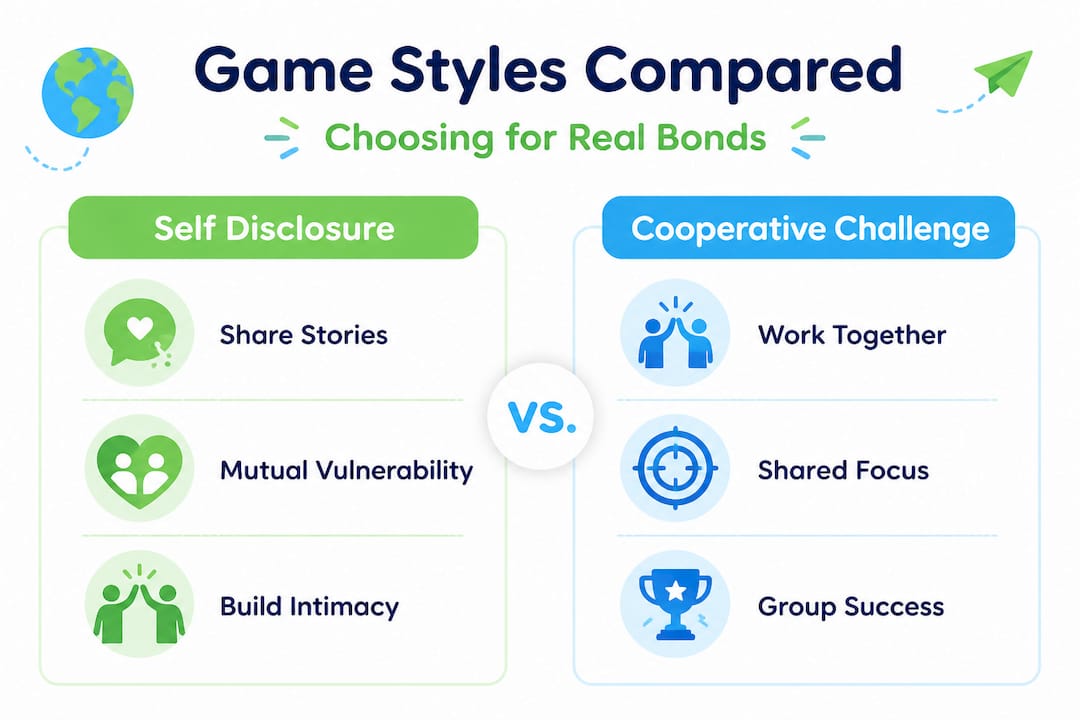
Cooperative challenge games sidestep vulnerability entirely by making the challenge the shared focus, not the person. A group trivia round, a drawing relay, or a music guessing game all create bonds through shared laughs, shared wins, and shared groans over wrong answers. Nobody has to bare their soul. They just have to play.
Here’s a quick reference for matching game type to occasion:
| Occasion | Best game type | Why it works |
|---|---|---|
| Date night | Self-disclosure question game | Creates intimacy and personal sharing |
| Casual party | Cooperative challenge or mixed | Keeps energy high, lowers pressure |
| Work event | Lightly structured mingling game | Professional but still personal |
| Girls’ night | Mix of disclosure and challenge | Covers depth and fun in one evening |
| New friend groups | Team-based or mingling mechanics | Reduces pressure, builds energy |
Facilitator control over question depth and pass options reduces pressure significantly in disclosure-style games. This is especially important for work events or gatherings where the group doesn’t know each other well.
Our advice: mix both types across a single evening. Start with a cooperative challenge to get people laughing and comfortable, then shift into a lighter disclosure game once the room has warmed up. That sequence gives you the broadest shot at real, lasting connection for everyone in the room.
For couples or close friend groups, question game ideas for couples take this blend to a more personal and meaningful level.
Beyond introductions: The surprising power (and limits) of well-defined games
With all the technical advice in mind, it’s worth pausing for a broader, more realistic reflection.
Here’s something we’ve noticed after running a lot of game nights: the real value of a get-to-know-you game is not the game itself. It’s the conversations that happen because of it. The goal isn’t to extract information from people or to run through all your question cards. It’s to create a moment where two strangers find common ground and decide to keep talking after the game ends.
Most hosts focus too much on the mechanics and not enough on the aftermath. They run a perfect round of Human Bingo and then immediately jump into the next activity, killing the momentum. The better move? Pause after a round, let people comment on what they just heard, and give the organic conversations space to breathe.
There’s also a real risk of over-structuring. We’ve been to parties where the host had a printed schedule of seven games back to back, all very thoughtfully chosen, all very well-intentioned, and all exhausting. People started sneaking off to the kitchen just to have an unscripted moment. The best nights we’ve had used one or two games as launchpads, not as the whole program.
The other thing hosts often miss is that some of the best bonding moments happen when someone breaks the game’s rules in a funny or creative way. That’s not failure. That’s the game doing its job. Structure creates safety, but warmth comes from the people inside it. Our lessons in game facilitation go deeper into this balance between structure and spontaneity, because getting it right is genuinely what separates a forgettable party from one people talk about for months.
Find your next favorite get-to-know-you game
Ready to put these strategies to work and liven up your next party?
At Playworldgame.com, we’ve built a lineup specifically designed for real social gatherings, not theoretical team-building exercises. Whether you’re planning a date night, a girls’ night, a casual birthday party, or just a Friday with friends who need a reason to put their phones down, we have something that fits.

Our couples conversation games are perfect for self-disclosure style play, and our party game lineup covers cooperative challenges for larger crowds and high-energy group formats. Every game in our collection is designed to be fast to learn, easy to run, and genuinely fun to play, because no one wants to spend 20 minutes reading a rulebook before the fun starts. Browse our full collection at playworldgame.com and find the right fit for your next gathering.
Frequently asked questions
What is the main goal of a get-to-know-you game for adults?
The main goal is to make socializing easier and more meaningful by giving people a structured reason to share and connect. Simple, bounded mechanics like prompt cards and group guessing make that happen faster than unstructured conversation alone.
How can I make these games more comfortable for introverted guests?
Build in a clear pass option from the start, use structured turns so no one is put on the spot unexpectedly, and mix lighter questions with deeper ones. Allowing guests to pass on any prompt respects personal boundaries and keeps participation levels high.
Which games work best for large groups?
Human Bingo and team-based Two Truths and a Lie are both excellent choices because they scale naturally with larger crowds. Both games adapt well to groups of 15 or more without creating delays or leaving people waiting too long for their turn.
Do cooperative games really improve group bonds?
Yes, and the research is clear on this. Cooperative gameplay reduces intergroup animosity and increases warmth and enjoyment, even among people who didn’t know each other before the game started.
Where can I find more structured question prompts and game guides?
Calm’s question game guides offer well-organized prompts sorted by mood and occasion, and curated game platforms like Playworldgame.com offer physical card and board games designed around the same principles for in-person play.