


Every parent knows the challenge of making Geography exciting for kids, especially in a world where screens are everywhere. With the growing popularity of educational gaming, learning Geography can become a family adventure that sparks real curiosity and brings continents, countries, and capitals to life. This guide will help you discover smart strategies and engaging games designed to boost your child’s world knowledge and make every map lesson a memorable experience.
Table of Contents
- Defining Educational Gaming And Its Purpose
- Types Of Educational Games Explained
- How Educational Games Enhance Learning
- Key Benefits And Common Misconceptions
- Risks, Challenges, And What To Avoid
Key Takeaways
| Point | Details |
|---|---|
| Educational Gaming Enhances Engagement | Integrating game mechanics into education fosters increased student motivation and promotes active learning. |
| Types of Educational Games Serve Diverse Needs | Serious games, game-based learning, and gamified platforms each offer unique benefits that address specific learning objectives. |
| Personalization is Key | Educational games can adapt to individual skills, allowing for tailored challenges that maximize student learning potential. |
| Mind the Risks | Be aware of challenges like cognitive overload and inequities in access, ensuring games support learning without overwhelming students. |
Defining Educational Gaming and Its Purpose
Educational gaming represents a dynamic approach to learning that transforms traditional educational methods by integrating interactive game mechanics into the learning process. Strategic integration of game principles enables educators to create more engaging, motivational learning experiences that go beyond conventional classroom techniques.
At its core, educational gaming encompasses video games and game-like activities specifically designed to enhance learning outcomes. Serious games designed for educational purposes aim to develop critical skills such as problem-solving, strategic thinking, and subject-specific knowledge through immersive, interactive experiences. These games leverage students’ natural inclination toward play and challenge, turning educational content into an exciting journey of discovery.
The primary objectives of educational gaming include increasing student engagement, promoting active learning, and making complex concepts more accessible. By transforming traditional educational activities into game-like experiences, educators can stimulate learners’ autonomy, build competence, and create meaningful connections with academic material. This approach recognizes that motivation and enjoyment are crucial elements in effective learning.
Pro tip: When selecting educational games, prioritize those that align closely with specific learning objectives and provide measurable skill development opportunities.
Types of Educational Games Explained
Educational games represent a diverse and sophisticated approach to learning, categorized into distinct types that serve unique pedagogical purposes. Digital educational game classifications help educators strategically select the most appropriate game types to support specific learning objectives.
Serious games are purpose-built learning tools designed with explicit educational goals. These games simulate complex scenarios across various disciplines, allowing students to practice skills and explore concepts in a controlled, interactive environment. Examples include medical training simulations, historical reconstruction games, and professional skill development platforms that provide immersive learning experiences without real-world risks.
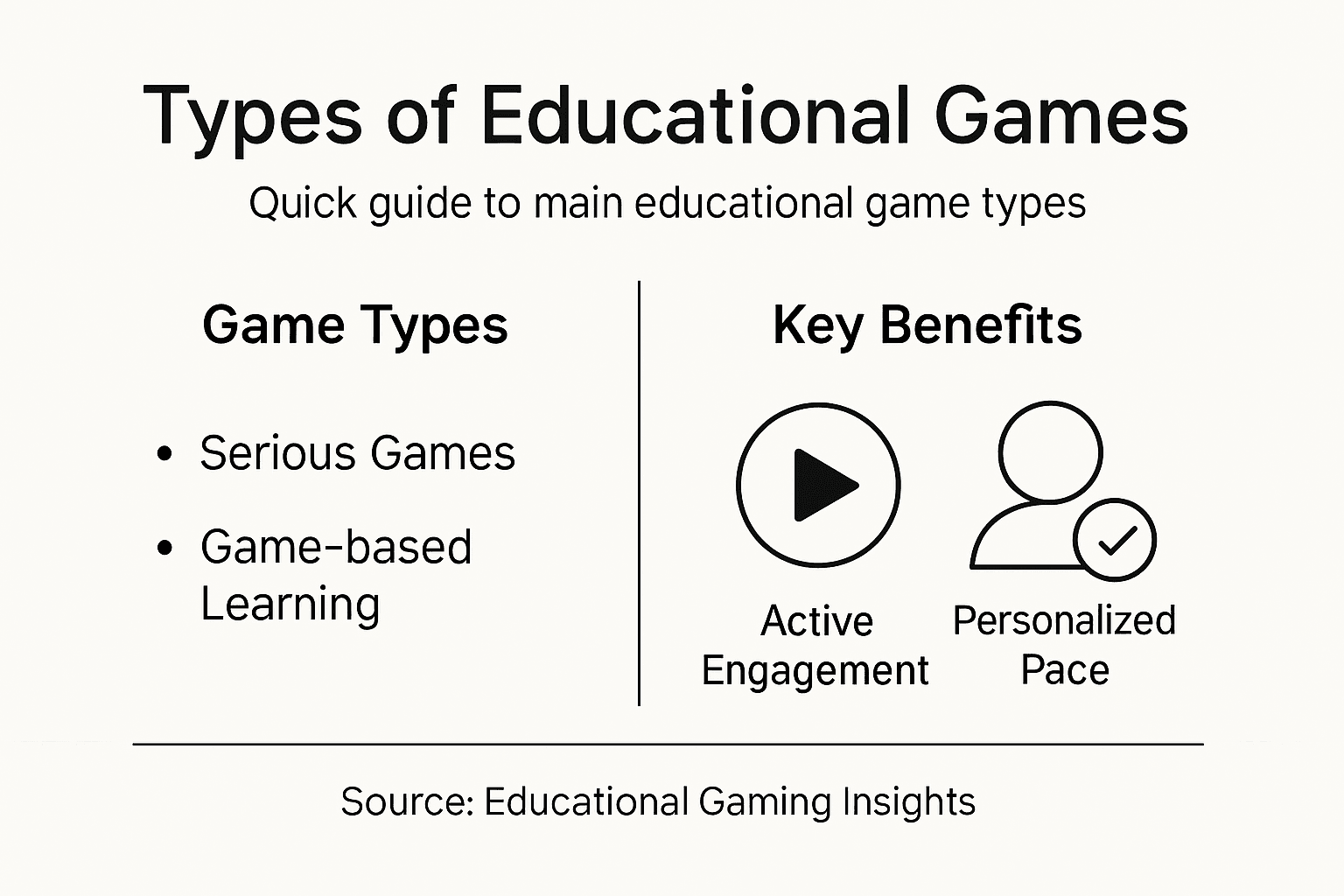
Game-based learning involves integrating commercial video games into educational contexts, leveraging existing game mechanics to teach specific skills or concepts. Classification of learning game strategies reveals three primary approaches: serious games, gamification, and adapting commercial games for educational purposes. This method allows educators to transform popular entertainment titles into powerful learning tools by designing targeted learning activities around game experiences.
The final category, gamified platforms, incorporates game design elements into traditional learning environments. These platforms use point systems, achievement badges, leaderboards, and progression mechanics to enhance student motivation and engagement. By transforming educational activities into game-like experiences, these platforms make learning more interactive and enjoyable.
Pro tip: When selecting educational games, analyze the specific learning outcomes and choose games that directly align with your curriculum and student skill development needs.
Here’s a comparison of the main types of educational games and their educational impacts:
| Type of Game | Typical Use Case | Key Learning Benefit | Example Application |
|---|---|---|---|
| Serious Games | Simulating real-world scenarios | Safe skill practice | Medical training simulations |
| Game-Based Learning | Adapting commercial games | Concept understanding | Math via strategy games |
| Gamified Platforms | Enhancing traditional curriculum | Increased engagement | Badge and point systems |
How Educational Games Enhance Learning
Educational games have emerged as powerful tools for transforming learning experiences by creating dynamic, interactive environments that engage students far beyond traditional teaching methods. Digital game learning mechanisms demonstrate remarkable potential for increasing student motivation and cognitive development through immersive, personalized learning experiences.

One of the most significant advantages of educational games is their ability to create a safe, low-stakes environment for skill development. Students can experiment, make mistakes, and receive immediate feedback without the fear of real-world consequences. Gamification impacts on cognitive engagement reveal that well-designed games boost persistence, critical thinking, and problem-solving skills by presenting challenges that are both intellectually stimulating and emotionally rewarding.
Moreover, educational games excel at personalizing learning experiences. They adapt to individual student performance, providing tailored challenges that match each learner’s skill level. This adaptive approach ensures that students remain in their optimal learning zone – challenged enough to be engaged but not so overwhelmed that they become discouraged. The games’ intrinsic reward systems, including points, levels, and achievement badges, continuously motivate students to progress and master new skills.
Additionally, these games bridge theoretical knowledge with practical application. By simulating real-world scenarios across various disciplines, educational games help students understand complex concepts through hands-on experiences. Whether it’s historical simulations, scientific experiments, or mathematical problem-solving, these interactive platforms transform abstract learning into tangible, memorable experiences.
Pro tip: Select educational games that provide clear learning objectives and include robust progress tracking to maximize educational outcomes.
Key Benefits and Common Misconceptions
Educational gaming represents a nuanced approach to learning that challenges traditional perceptions about play and academic development. Multifaceted educational gaming benefits demonstrate that well-designed games offer far more than simple entertainment, providing robust platforms for comprehensive skill development and engagement.
Contrary to widespread misconceptions, educational games are not merely distractions from serious learning. Educational gaming skill development reveals that strategic game-based learning supports critical cognitive abilities including creativity, logical thinking, analysis, and synthesis. These games cultivate complex skills like motor coordination, language comprehension, and real-world problem-solving, effectively bridging academic knowledge with practical application.
The key benefits extend beyond traditional academic metrics. Educational games enhance student motivation across academic, emotional, and behavioral dimensions. By creating interactive, low-pressure environments, these games encourage experimentation, foster resilience, and provide immediate, constructive feedback. The intrinsic reward systems and adaptive challenges help students develop a growth mindset, transforming potential frustration into opportunities for learning and personal development.
Moreover, these games challenge the narrow view of education as a purely theoretical endeavor. They demonstrate that learning can be simultaneously rigorous and enjoyable, breaking down barriers between play and serious intellectual growth. By integrating game mechanics with educational content, these platforms create engaging, immersive experiences that make complex concepts accessible and memorable.
Pro tip: Evaluate educational games not just by their entertainment value, but by their ability to align with specific learning objectives and promote active, meaningful engagement.
Risks, Challenges, and What to Avoid
Educational gaming, while promising, is not without its potential pitfalls and implementation challenges. Gamification implementation risks reveal complex considerations that educators and parents must carefully navigate to ensure meaningful learning experiences.
One significant challenge is the potential for cognitive overload. Not all educational games are created equal, and poorly designed games can overwhelm students instead of supporting their learning. Educational game adoption barriers highlight that technological preparedness, teacher training, and curriculum alignment are critical factors in successful game-based learning. Inappropriate game selection can lead to distraction, decreased motivation, and minimal educational value.
Another critical concern involves the psychological mechanisms underlying game design. Overreliance on extrinsic rewards can paradoxically diminish intrinsic motivation. Games that create unhealthy competitive environments or use manipulative design elements can potentially stress students and create negative learning associations. The key is balance – games should enhance learning, not become the primary focus or source of anxiety.
Moreover, equity and access remain significant challenges. Not all students have equal technological resources or digital literacy, which can create unintended educational disparities. Schools and educators must be intentional about selecting games that are inclusive, adaptable, and genuinely supportive of diverse learning needs and backgrounds.
Pro tip: Regularly assess educational games for their learning potential, ensuring they align with specific educational objectives and do not compromise student well-being.
The table below summarizes challenges and risks when implementing educational games:
| Challenge | Educational Impact | Typical Cause |
|---|---|---|
| Cognitive Overload | Reduced learning effectiveness | Overly complex game design |
| Motivation Decline | Lower student engagement | Excessive reliance on rewards |
| Digital Access Disparity | Unequal learning opportunities | Limited student technology access |
Discover Fun Educational Gaming That Inspires Real Learning
The article highlights key challenges like maintaining student engagement and aligning educational content with meaningful skill development. If you want to transform learning into an exciting journey filled with discovery and motivation, our selection of geography and general knowledge games at PlayWorldGame offers an effective, hands-on solution. These games capture the essence of educational gaming by blending fun with rich learning experiences perfect for families, classrooms, and educators who value interactive skill practice without cognitive overload.

Explore our unique card and board games designed to enhance understanding of countries, cultures, and geography while fostering active learning and curiosity. Act now to bring interactive education home or into your classroom by visiting PlayWorldGame’s main site. Join a community passionate about learning with games that truly matter and make complex concepts accessible and enjoyable.
Frequently Asked Questions
What is educational gaming?
Educational gaming is an innovative approach to learning that combines interactive game mechanics with educational content to enhance learning outcomes and increase student engagement.
How do educational games enhance learning?
Educational games create dynamic, low-stakes environments where students can experiment and make mistakes without fear of real-world consequences, promoting skill development through immediate feedback and personalized challenges.
What are the different types of educational games?
The main types of educational games include serious games, which are purpose-built for learning; game-based learning, which adapts commercial video games for educational use; and gamified platforms that incorporate game design elements into traditional learning environments.
What are the risks and challenges of implementing educational games?
Some risks include cognitive overload from poorly designed games, a decline in intrinsic motivation due to overreliance on extrinsic rewards, and issues with equity and access to technology, which can create disparities in learning opportunities.