


Every parent faces that moment when traditional worksheets no longer spark curiosity about the world for their children. As kids develop, finding purposeful learning tools that can nurture their sense of discovery without making learning feel like a chore becomes more important. Educational games offer a hands-on way for families to learn together while making geography fun, meaningful, and interactive for children aged 6 to 12.
Table of Contents
- Defining Educational Games And Their Purpose
- Major Types Of Educational Games Today
- How Educational Games Enhance Learning
- Cognitive And Social Benefits For Kids
- Choosing Effective Educational Games For Families
Key Takeaways
| Point | Details |
|---|---|
| Educational Games Enhance Learning | Interactive educational games foster engagement and provide immediate feedback, transforming passive learning into an active experience. |
| Types of Educational Games | Serious Games, Gamification, Game-Based Learning, and Board Games each serve distinct educational purposes and promote various skills. |
| Cognitive and Social Benefits | Educational games support critical thinking, problem-solving, and social skills development in children, enhancing overall childhood growth. |
| Choosing the Right Games | Select age-appropriate educational games that align with learning objectives and provide adjustable difficulty levels to maintain engagement. |
Defining Educational Games and Their Purpose
Educational games represent a sophisticated learning approach that transforms traditional education through interactive digital experiences. These purposeful learning tools go far beyond simple entertainment, serving as strategic platforms designed to enhance cognitive development, knowledge acquisition, and skill-building for children.
Researchers have increasingly recognized educational games as powerful pedagogical instruments. Serious educational games are specifically crafted digital environments that support teaching objectives through engaging gameplay mechanics. They incorporate carefully designed elements that motivate learners by making educational content inherently enjoyable and interactive.
Key characteristics of effective educational games include:
- Goal-oriented gameplay that maintains learner motivation
- Cognitive challenges that promote critical thinking
- Intrinsic reward systems encouraging continued learning
- Adaptive difficulty levels matching individual student capabilities
- Immersive scenarios that contextualize academic concepts
The purpose of these games extends beyond traditional instruction, creating dynamic learning experiences that transform educational methodologies. By integrating entertainment with educational content, these games help children develop complex skills while maintaining high engagement levels.
Pro tip: Select educational games that align with your child’s specific learning objectives and interests to maximize educational impact.
Major Types of Educational Games Today
Educational games have evolved into sophisticated learning tools with diverse categories designed to enhance learning experiences across different educational contexts. Researchers have identified three primary types of educational games that serve unique pedagogical purposes and engage students through interactive learning strategies.
The first major category is serious games, which are specifically designed with explicit educational objectives. These games focus on delivering targeted learning outcomes through carefully crafted gameplay mechanics that challenge and motivate students. Unlike traditional entertainment games, serious games have intentional educational frameworks that align closely with curriculum standards and learning goals.
Key types of educational games include:
- Serious Games: Purposefully designed for direct educational instruction
- Gamification: Integrating game design elements into learning environments
- Game-Based Learning: Utilizing commercial games within structured educational contexts
- Board Games: Interactive physical games promoting problem-solving skills
Board games represent a significant educational gaming category that educators increasingly adopt for classroom engagement. These games provide hands-on learning experiences that encourage critical thinking, collaboration, and strategic problem-solving among students. By transforming abstract concepts into tangible, interactive challenges, board games help bridge theoretical knowledge with practical application.
Pro tip: Choose educational games that match your child’s learning style and academic objectives to maximize educational engagement and skill development.
Here’s a summary comparing major educational game types and their unique benefits:
| Game Type | Main Focus | Typical Environment | Key Benefit |
|---|---|---|---|
| Serious Games | Skill mastery and learning | Digital classrooms | Direct academic outcomes |
| Gamification | Motivation and engagement | Any learning platform | Increased student effort |
| Game-Based Learning | Structured exploration | Guided classroom use | Deeper concept understanding |
| Board Games | Teamwork and problem-solving | Physical/classroom | Improved social skills |
How Educational Games Enhance Learning
Educational games have emerged as powerful learning tools that transform traditional educational approaches by creating engaging, interactive experiences that motivate and challenge students. Comparative studies demonstrate significant learning achievements through strategic implementation of game-based learning methodologies, revealing how interactive digital environments can dramatically improve educational outcomes.

The core mechanism of educational games lies in their ability to create dynamic learning environments that actively engage students. Unlike traditional instructional methods, these games provide immediate feedback, challenge students at appropriate skill levels, and make learning intrinsically motivating. Students become active participants in their educational journey, experiencing knowledge acquisition as an exciting, interactive process rather than a passive reception of information.
Key ways educational games enhance learning include:
- Providing instant, constructive feedback
- Creating personalized learning experiences
- Encouraging problem-solving and critical thinking
- Reducing learning anxiety through playful interactions
- Promoting intrinsic motivation for skill development
Systematic research confirms that gamification techniques significantly improve academic engagement across emotional, behavioral, and cognitive domains. These techniques transform learning from a potentially mundane activity into an exciting, interactive experience that captures and sustains student attention. By integrating game mechanics into educational content, learners experience increased focus, higher motivation, and a more profound connection to the material.
Pro tip: Select educational games that progressively challenge your child, ensuring a balance between achievable goals and stimulating complexity to maintain continuous learning engagement.
Cognitive and Social Benefits for Kids
Game-based learning significantly transforms childhood development, offering a comprehensive approach to nurturing critical cognitive and social skills. Educational games provide far more than simple entertainment, emerging as powerful tools that support holistic child development across multiple domains of learning and interaction.
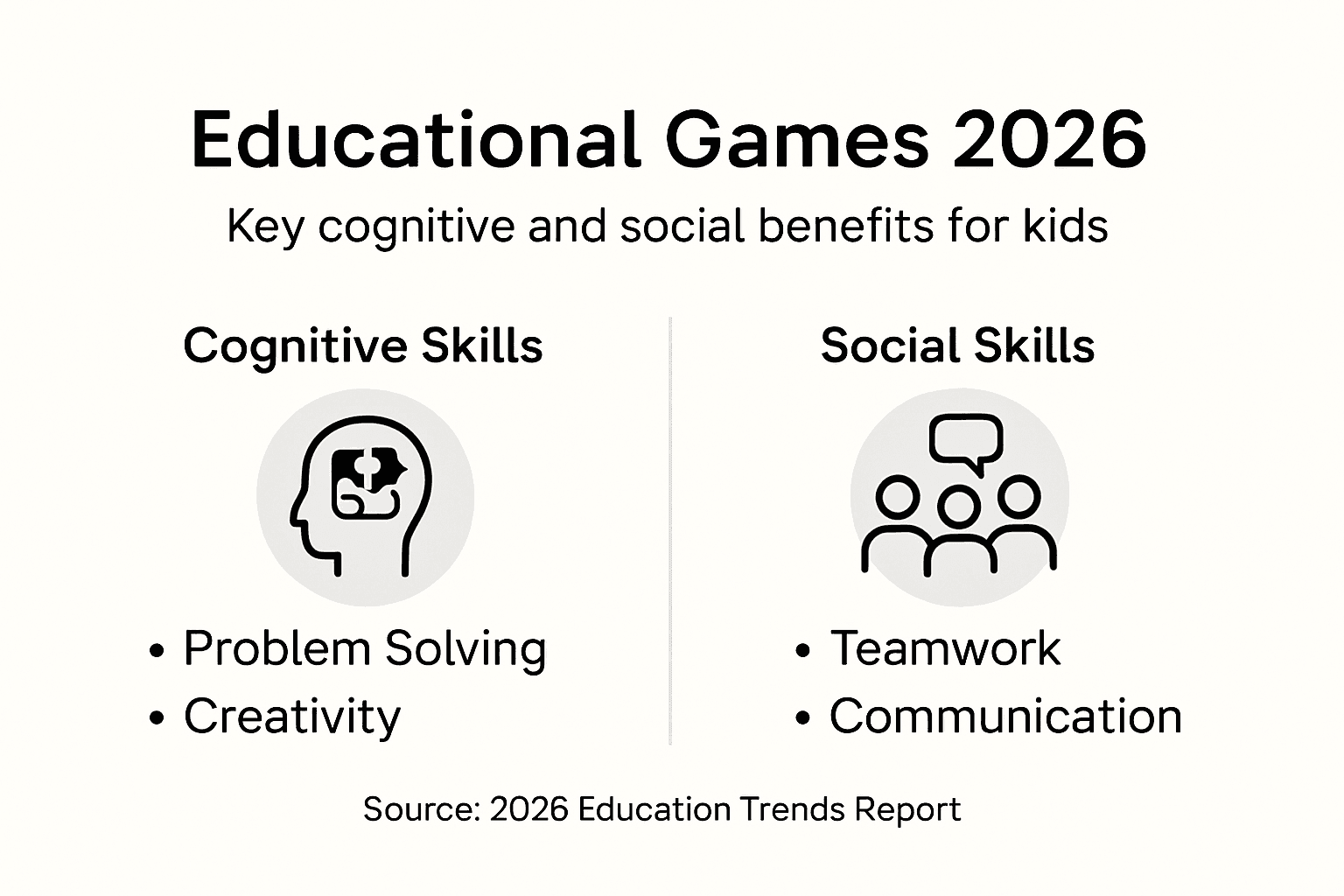
The cognitive benefits of educational games are particularly remarkable. These interactive experiences help children develop essential mental skills, including problem-solving abilities, critical thinking, and strategic reasoning. By presenting challenges within engaging gameplay environments, children learn to analyze situations, make decisions, and adapt their strategies - skills that translate directly into academic and real-world contexts.
Key cognitive and social benefits include:
- Enhanced memory and information retention
- Improved executive functioning skills
- Increased attention and concentration
- Better communication and teamwork abilities
- Development of emotional intelligence
- Reduced learning anxiety
- Strengthened social interaction skills
Quantitative research confirms the dual impact of educational games on children’s development. These games create safe, structured environments where children can practice social skills like cooperation, communication, and empathy. Through collaborative gameplay, children learn to negotiate, share, and understand different perspectives, building critical social-emotional competencies that extend far beyond the gaming experience.
Pro tip: Rotate different types of educational games to ensure comprehensive skill development and maintain your child’s engagement across cognitive and social learning domains.
Choosing Effective Educational Games for Families
Family-centered game selection requires strategic approaches that balance educational value with engaging gameplay. Selecting the right educational games involves understanding your child’s unique developmental needs, learning style, and interests while ensuring the game provides meaningful cognitive and social growth opportunities.
The key to effective game selection lies in identifying age-appropriate interactive experiences that challenge without overwhelming. Parents should look for games that offer graduated difficulty levels, allowing children to progress at their own pace and build confidence through incremental skill development. These games should seamlessly integrate learning objectives with enjoyable gameplay mechanics that maintain children’s motivation and curiosity.
Critical factors for selecting educational games include:
- Alignment with specific learning objectives
- Appropriate difficulty progression
- Interactive and engaging gameplay
- Opportunities for skill transferability
- Balanced challenge and enjoyment
- Potential for family collaboration
- Clear educational outcomes
Research-validated game selection strategies emphasize the importance of user-centered design and clear learning goals. Families should prioritize games that provide immediate feedback, scaffold learning experiences, and support both independent and collaborative play. The most effective educational games create environments where learning feels like a natural, exciting extension of play rather than a structured academic exercise.
Pro tip: Test potential educational games briefly before full commitment, observing your child’s engagement and learning progression to ensure optimal educational impact.
Use this quick reference to evaluate educational games for family use:
| Evaluation Criteria | Why It Matters | What to Look For |
|---|---|---|
| Age Appropriateness | Matches developmental needs | Clear age ratings and guidance |
| Learning Objectives | Supports academic progress | Stated skills and educational goals |
| Difficulty Progression | Allows steady growth | Adjustable levels and feedback |
| Family Collaboration | Fosters shared learning | Multiplayer and cooperative modes |
| Enjoyment Factor | Maintains engagement | Fun, interactive game mechanics |
Unlock Your Child’s Potential with Educational Games Designed to Inspire
The article highlights the growing importance of educational games in 2026 as dynamic tools that boost cognitive skills, social growth, and motivation through engaging gameplay. Parents and educators often face the challenge of finding games that not only entertain but also align with specific learning objectives like geography, critical thinking, and cooperative skills. At Play World Game, we understand these needs and offer a curated selection of card and board games that make learning about countries, cultures, and general knowledge an immersive, fun experience. Our games emphasize age-appropriate challenges, social interaction, and real-world knowledge—all essential components mentioned in recent research on educational benefits.

Discover how playing together can turn educational goals into exciting adventures by browsing our extensive collection at Browse All Games | The World Game. Designed for families and classrooms alike, our games provide immediate feedback and scalable difficulty to keep children motivated as they grow. Start your child’s journey toward both academic success and social development today by visiting https://playworldgame.com. Don’t wait to transform learning into play with trusted educational games that inspire curiosity and confidence.
Frequently Asked Questions
What are educational games and their purpose?
Educational games are interactive digital tools designed to enhance learning by making education engaging and enjoyable. They help develop cognitive skills, knowledge acquisition, and problem-solving abilities in children.
What are the major types of educational games?
The main types of educational games include serious games, gamification, game-based learning, and board games. Each serves unique educational purposes and engages students through different interactive strategies.
How do educational games enhance learning?
Educational games create dynamic learning environments that actively engage students. They provide instant feedback, encourage critical thinking, and make learning intrinsically motivating, leading to improved educational outcomes.
What cognitive and social benefits do educational games provide for kids?
Educational games enhance children’s cognitive skills such as memory retention, problem-solving abilities, and critical thinking. They also promote social skills by fostering collaboration, communication, and emotional intelligence through interactive gameplay.
Recommended
- What Is Educational Gaming and Why It Matters - The World Game
- What Is Educational Gaming and Why It Matters - The World Game
- What Is Educational Gaming and Why It Matters - The World Game
- What Is Educational Gaming and Why It Matters - The World Game
- 7 Strumenti per la didattica innovativa da utilizzare - Recupero Anni Scolastici e Diploma Online