


Learning popular strategy board games like Catan and Ticket to Ride can feel overwhelming when you just want a fun family night. Complex rules, setup confusion, and conflicting house rules often derail the excitement before the first turn. This guide simplifies both games with clear, step-by-step instructions, strategic tips, and warnings about common pitfalls that can ruin your game night experience.
Table of Contents
- Preparing For Your Board Game Night: Essentials And Setup
- Step-By-Step Gameplay Guide For Catan
- Understanding Ticket To Ride: Step-By-Step Gameplay
- Avoiding Common Pitfalls And House Rule Traps
- Explore More Board Games And Tips With Playworldgame
- Frequently Asked Questions
Key takeaways
| Point | Details |
|---|---|
| Initial settlement placement in Catan is crucial for long-term success | Place settlements near red 6 and 8 tokens for maximum resource production |
| Ticket to Ride rewards claiming longer routes early | Prioritize connecting destination tickets and high-point routes before opponents block them |
| House rules often harm game balance and fun | Stick to official rules to preserve strategic depth and reasonable playtime |
| Setup knowledge prevents delays and confusion | Understanding components and board arrangement ensures smooth gameplay from the start |
| Resource management drives Catan while route planning defines Ticket to Ride | Master these core mechanics to improve your strategic decision-making |
Preparing for your board game night: essentials and setup
Before diving into gameplay, gather all components and understand the setup process for each game. Catan requires a modular hexagonal board, resource cards (wood, brick, wheat, sheep, ore), development cards, numbered tokens, settlements, roads, cities, and the robber piece. Ticket to Ride needs a fixed game board showing train routes between cities, colored train cards, destination ticket cards, colored train pieces for each player, and scoring markers.
For Catan beginners, the beginner setup simplifies the initial game state, making rules easier to absorb. The beginner board uses a fixed hex arrangement instead of random placement, eliminating one layer of complexity. Arrange hexes in the recommended pattern, place numbered tokens as specified, and you’re ready to start. This approach helps new players focus on core mechanics rather than optimal board randomization.
Ticket to Ride setup is more straightforward. Unfold the board, shuffle the train cards into a face-down deck, place five cards face-up beside it, shuffle destination tickets separately, and give each player their colored train pieces plus an initial hand of four train cards. Each player also draws three destination tickets and must keep at least two, setting up their secret route goals for the game.
Pro Tip: Complete setup before players arrive to maximize actual game time. Walking through an empty board helps you explain rules more confidently when teaching new players.
Essential components checklist
| Game | Core Components | Setup Time |
|---|---|---|
| Catan | Hex tiles, resource cards, settlements, roads, cities, numbered tokens, robber | 5-8 minutes (beginner setup) |
| Ticket to Ride | Game board, train cards, destination tickets, colored trains, scoring markers | 3-5 minutes |
Knowing what belongs in the box prevents mid-game discoveries of missing pieces. Count components before starting, especially if the game has been played multiple times. For more guidance on how to play board games step by step, you’ll find valuable tips that apply across many titles. Understanding setup also strengthens collaborative board gaming for family bonds, since everyone starts on the same page.
Step-by-step gameplay guide for Catan
Catan begins with initial settlement placement crucial for long-term resource access. Players use a snake draft method: the first player places one settlement and adjacent road, then play proceeds clockwise until the last player places their first settlement. The order then reverses, with the last player placing their second settlement immediately, continuing counterclockwise back to the first player. This double placement for the last player balances the turn order advantage.

Place settlements at intersections where three hexes meet. Each hex produces a specific resource (wood, brick, wheat, sheep, or ore) when its number is rolled. The 6 and 8 tokens are printed in red because they’re statistically rolled most often on two six-sided dice, making adjacent settlements highly valuable. Prioritize these red numbers during initial placement, while ensuring access to multiple resource types.
Each turn follows a consistent sequence:
- Roll two dice to determine which hexes produce resources this turn
- Collect resource cards for every settlement or city adjacent to producing hexes (cities collect double)
- Trade resources with other players or the bank (4:1 ratio, or better with ports)
- Build roads, settlements, cities, or buy development cards using collected resources
Trading is where Catan’s social dynamics shine. You can negotiate any trade with other players during your turn, creating alliances or blocking opponents from critical resources. Bank trades are less favorable but always available. Ports offer better exchange rates (3:1 for generic ports, 2:1 for specialized resource ports) when you control adjacent settlements.
Pro Tip: Don’t hoard resources. If you hold more than seven cards when a 7 is rolled, you must discard half your hand, losing valuable resources.
The robber activates whenever someone rolls a 7. The active player moves the robber to any hex, blocking that hex’s production until the robber moves again. They also steal one random resource card from any player with a settlement or city adjacent to the robber’s new location. The robber serves a balancing function, preventing runaway leaders and adding strategic disruption. Removing or delaying this mechanic through house rules creates unbalanced gameplay.
Victory conditions and scoring
| Achievement | Points |
|---|---|
| Settlement | 1 point each |
| City | 2 points each |
| Longest Road (5+ continuous road segments) | 2 bonus points |
| Largest Army (3+ knight development cards played) | 2 bonus points |
| Victory Point development cards | 1 point each (keep secret until winning) |
The first player to reach 10 points wins immediately, even on another player’s turn if a development card pushes them over. For detailed visual guides on how to play Catan, comprehensive tutorials walk through every phase with examples. Understanding these mechanics also appears in broader board game step guides that help casual players master new titles faster.
Understanding Ticket to Ride: step-by-step gameplay
Ticket to Ride uses simpler turn mechanics than Catan but requires forward planning. After setup, each player holds four train cards and has selected at least two destination tickets showing city pairs they must connect. The game board displays colored routes between cities, with each route requiring matching colored train cards to claim.
On each turn, choose exactly one action:
- Draw two train cards from the face-up display or face-down deck (drawing a face-up rainbow locomotive card counts as both draws)
- Claim one route by playing train cards matching the route’s color and length, then placing your train pieces on that route
- Draw three additional destination tickets, keeping at least one
Route claiming involves matching train cards to route colors and lengths. A blue route of length 3 requires three blue train cards. Grey routes offer flexibility, allowing any single color to claim them. Rainbow locomotive cards act as wild cards but are harder to collect since drawing a face-up locomotive uses your entire turn.
Each route scores points immediately based on length: 1-space routes score 1 point, 2-space routes score 2 points, 3-space routes score 4 points, and the scoring increases exponentially for longer routes (6-space routes score 15 points). Prioritizing longer routes early maximizes points and prevents opponents from blocking critical connections.
Pro Tip: Keep your destination tickets secret. Revealing your plans helps opponents block your routes strategically.
Destination tickets introduce risk-reward elements. Completed tickets add their point value to your final score, but failed connections subtract the same amount. Drawing additional tickets mid-game can boost your score if you’ve already built routes that satisfy multiple destinations, but taking tickets you can’t complete will devastate your final total.
Scoring and game end
The game ends when any player has two or fewer train pieces remaining at the end of their turn. Everyone gets one final turn, then scoring begins:
- Add points from all claimed routes (scored during the game)
- Add points for completed destination tickets
- Subtract points for incomplete destination tickets
- Add 10-point bonus for longest continuous route (most consecutive connected train pieces)
The longest continuous route bonus often determines close games. Plan your route network to create one long connected path rather than several disconnected segments. For comprehensive rules and strategy, the official Ticket to Ride rules guide provides detailed examples. These mechanics translate well to other games covered in general board game guides.
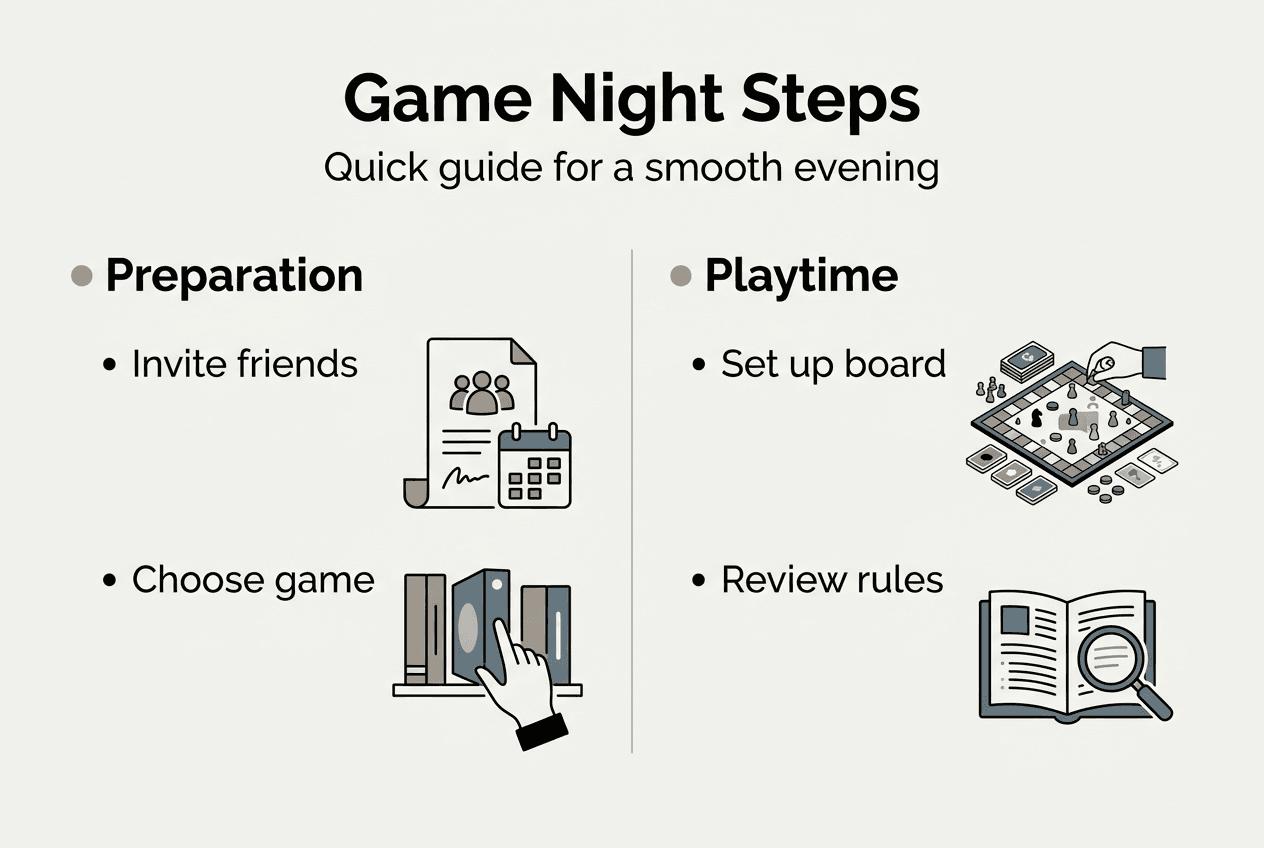
Avoiding common pitfalls and house rule traps
Many casual players modify rules thinking they’ll improve the experience, but house rules often undermine core mechanics, leading to longer playtimes and reduced strategic depth. The most common trap is the Monopoly “Free Parking jackpot” where tax and penalty payments accumulate in the center for lucky players to collect. This extends an already long game by injecting unearned cash, removing the intended resource scarcity that drives player interaction and property trading.
In Catan, some groups delay or remove the robber to avoid “mean” moves. This seems friendly but removes the balancing mechanism that prevents runaway leaders and adds strategic tension. Similarly, allowing unlimited resource trading with the bank undermines the social negotiation that makes Catan engaging. Modifying rules to make games fairer often removes the challenges and strategic decisions that create enjoyment and replayability.
Ticket to Ride house rules frequently involve showing destination tickets openly or allowing players to discard unwanted tickets freely. Both changes eliminate the risk-reward calculation central to the game’s strategy. When everyone knows everyone else’s goals, defensive blocking becomes the only strategy, slowing the game and reducing fun.
Pro Tip: If a game feels broken, the problem is usually misunderstood rules, not bad game design. Reread the rulebook before inventing fixes.
Common problematic house rules
- Monopoly Free Parking jackpots (extends game length by hours)
- Removing trading restrictions in resource games (reduces player interaction)
- Showing hidden information like destination tickets (eliminates strategic uncertainty)
- Preventing “aggressive” moves like the Catan robber (removes game balance)
- Allowing unlimited hand sizes in card games (breaks resource management)
Official rules are playtested extensively to balance strategy, luck, and social interaction. While experienced groups might experiment with variants after mastering the base game, casual players get the best experience following official rules. The challenges built into these games create memorable moments and teach strategic thinking. Removing difficulty often removes the satisfaction of clever play.
For families building connections through gaming, collaborative board gaming strengthens bonds most effectively when everyone plays by shared, understood rules. Understanding why certain house rules damage games helps you avoid common traps and preserve the fun that made these games popular worldwide.
Explore more board games and tips with Playworldgame
Ready to expand your game night repertoire beyond Catan and Ticket to Ride? Playworldgame offers a curated selection of fast, social card and board games perfect for family nights, parties, and casual gatherings. Our collection includes skill-based challenge games, trivia, couples conversation starters, food-themed party games, and music guessing games designed for real entertainment, not classroom learning.

Whether you’re searching for quick games that fit between dinner and bedtime or deeper strategy titles for dedicated game nights, our board games step-by-step guide helps you learn new titles confidently. Explore our blog for tips, strategies, and recommendations that transform ordinary evenings into memorable experiences. Join our community of casual players who value fun, laughter, and connection over complex rules and lengthy playtimes.
Frequently asked questions
What are the key steps to start playing a new board game like Catan or Ticket to Ride?
Read the rulebook once through, then set up the game following the instructions exactly. For your first game, use beginner setups or recommended starting positions to reduce complexity. Walk through one sample turn before starting to clarify the turn sequence and available actions.
How important is following official rules versus house rules for casual players?
Official rules preserve game balance and tested strategic depth. House rules typically extend playtime or remove challenges that make games engaging. Stick to official rules especially when learning, as they provide the experience designers intended and prevent confusion when playing with different groups.
What strategies can help beginners enjoy board games more on family game nights?
Focus on learning one or two games well rather than constantly trying new titles. Accept that losing teaches strategy, and celebrate clever moves by any player. Keep snacks and drinks nearby, take breaks between games, and prioritize fun conversation over cutthroat competition. For more guidance, check out our board games step guide.
How long does a typical game of Catan or Ticket to Ride last for beginners?
Catan typically runs 60 to 90 minutes for new players, with experienced groups finishing in 45 to 60 minutes. Ticket to Ride plays faster, usually 30 to 60 minutes regardless of experience level. Both games include setup time, so budget an extra 10 minutes for your first few sessions.
Can playing these games improve family bonding and social skills?
Absolutely. Board games create shared experiences, teach negotiation and planning skills, and provide structured social interaction. The face-to-face gameplay encourages conversation and builds memories. Strategic games like Catan and Ticket to Ride also develop critical thinking and graceful winning or losing.
How do I place settlements effectively in Catan?
Place settlements adjacent to hexes with red 6 and 8 tokens for maximum resources. Balance access to multiple resource types rather than clustering on one resource. Consider early road building routes to valuable expansion spots and ports that improve trading ratios.
What’s the best strategy for completing destination tickets in Ticket to Ride?
Focus first on routes connecting multiple tickets to maximize efficiency. Claim longer routes early for bigger point bonuses before opponents block them. Adapt your plans based on which routes opponents are building, and don’t draw additional tickets late unless you’re certain you can complete them.
Should I avoid house rules when playing casual board games?
Yes, especially when learning. House rules undermine strategic depth and can extend games unnecessarily. Official rules balance luck and skill carefully through extensive playtesting. Playing by the book also improves your experience when joining other game groups, since everyone knows the standard rules. If you’re interested in how rules affect social dynamics, explore resources on collaborative board gaming.