


Family game nights might seem like simple entertainment, but research shows they’re powerful tools for building essential social skills. While most people view games as fun distractions, they actually create structured environments where communication, empathy, and teamwork develop naturally. This article explores how different game types strengthen family connections and equip players with skills that translate to real-world interactions, offering practical guidance for maximizing these benefits at home.
Table of Contents
- Why Games Matter For Social Skills Development
- Types Of Games And Their Unique Social Skill Benefits
- Role-Playing And Narrative Games: Deepening Empathy And Emotional Skills
- Choosing And Using Games To Build Social Skills At Home
- Discover Games That Bring Families Together
- Frequently Asked Questions
Key takeaways
| Point | Details |
|---|---|
| Games build essential skills | Regular gameplay improves communication by 20% and strengthens conflict resolution abilities. |
| Different games serve different purposes | Cooperative games foster teamwork while competitive games build resilience and strategic thinking. |
| Age matters for game selection | Younger children benefit more from cooperative play, while older kids handle competitive dynamics better. |
| Structure maximizes benefits | Clear rules, positive facilitation, and reflection breaks help players practice social skills effectively. |
| Balanced game mixes work best | Combining 60% competitive and 40% cooperative games develops well-rounded social abilities. |
Why games matter for social skills development
Games create safe spaces where complex social interactions can be practiced without real-world consequences. Players learn to share resources, negotiate strategies, and navigate disagreements within clear boundaries. These structured experiences translate directly to everyday situations at school, work, and in relationships.
Research demonstrates measurable improvements from regular gameplay. Studies show board games increase verbal communication skills by 20% among participants who play consistently. The same research found conflict resolution abilities improve by 15% through repeated game interactions. These aren’t small gains, they represent significant social development that families can achieve through enjoyable activities.
The mechanics of gameplay naturally encourage perspective taking. When you’re trying to anticipate an opponent’s move or coordinate with teammates, you’re actively practicing empathy. Board games facilitate social skill development through turn-taking, negotiation, and problem-solving, leading to more positive social interactions outside game contexts. Players develop the ability to read social cues, adjust their communication styles, and respond appropriately to others’ emotions.
Family game nights offer unique bonding opportunities that strengthen relationships while building skills. Shared goals during cooperative play create moments of genuine connection. Even competitive games provide chances to practice good sportsmanship and celebrate others’ successes. The family collaboration benefits extend beyond individual skill development to strengthen household dynamics overall.
Pro Tip: Schedule game nights at consistent times each week to establish routines that maximize skill development through repeated practice.
Games also provide natural conversation starters and shared experiences that families reference long after gameplay ends. These shared narratives become part of family culture, reinforcing social bonds through common memories. The laughter, friendly competition, and collaborative victories create positive associations with social interaction that encourage continued engagement.
Key social skills developed through gameplay:
- Clear verbal communication and active listening
- Patience and impulse control during turn-taking
- Graceful handling of wins and losses
- Collaborative problem-solving and strategy development
- Recognition and response to others’ emotional states
“Games transform abstract social concepts into concrete, repeatable experiences where families can practice and refine interpersonal skills in low-stakes environments.”
Types of games and their unique social skill benefits
Different game structures foster distinct social abilities, making it valuable to understand what each type offers. Cooperative games foster teamwork and communication more effectively than competitive formats by requiring players to work toward shared objectives. Everyone wins or loses together, eliminating the social tension that can arise from individual competition.
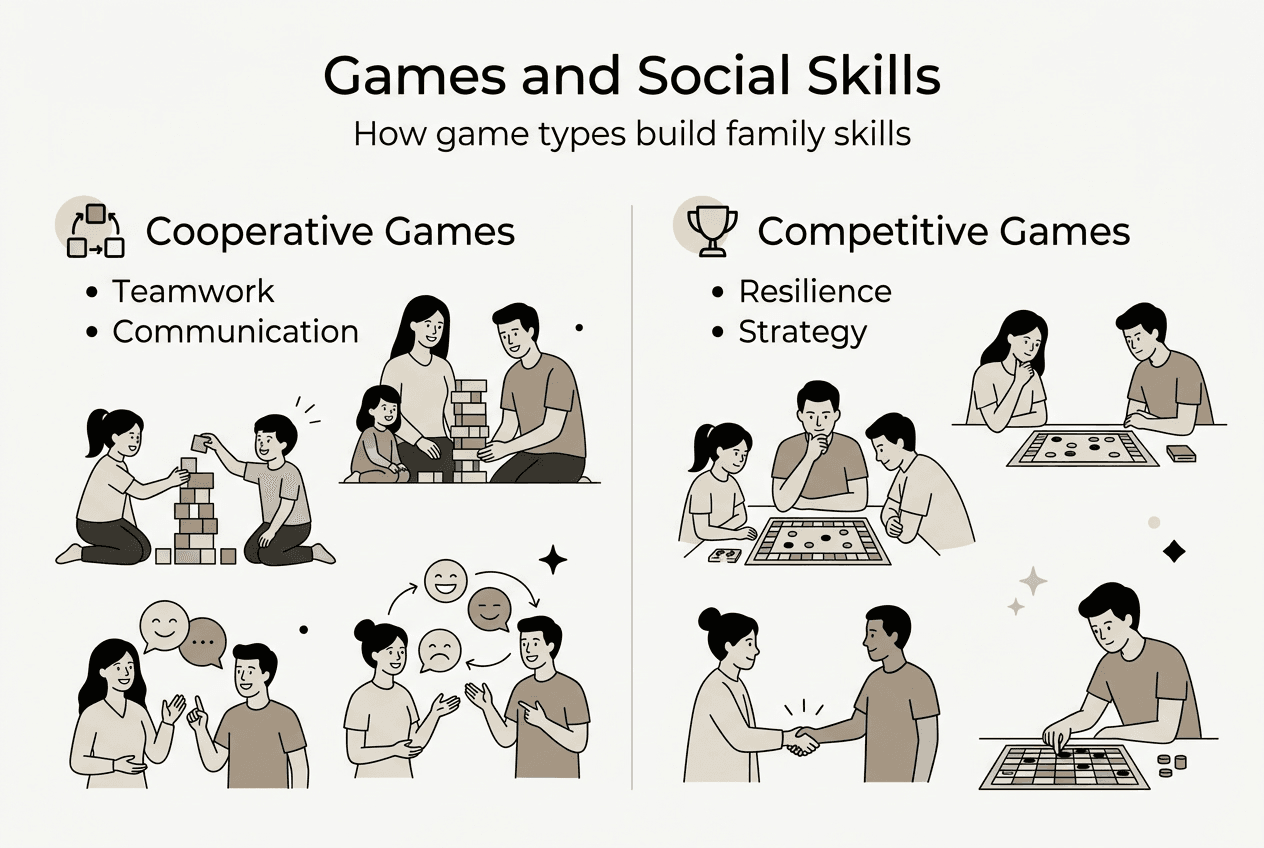
Competitive games serve different developmental purposes. They teach resilience and strategic thinking, helping children handle winning and losing gracefully. Players learn to manage disappointment, celebrate opponents’ successes, and develop mental flexibility as they adapt strategies. These experiences build emotional regulation skills that prove valuable in academic and professional settings.
Hybrid games combine elements from both categories, and research suggests they offer maximum benefits by integrating teamwork with individual strategy. Players collaborate on some aspects while competing on others, mirroring real-world social dynamics where cooperation and competition often coexist. This balanced approach develops versatile social skills applicable across diverse situations.
| Game Type | Primary Skills Developed | Best For | Example Benefits |
|---|---|---|---|
| Cooperative | Teamwork, empathy, shared problem-solving | Younger children, building family bonds | Reduces social anxiety, increases prosocial behavior |
| Competitive | Strategic thinking, resilience, sportsmanship | Older children, developing emotional maturity | Builds confidence, teaches graceful losing |
| Hybrid | Balanced social skills, adaptability | Mixed-age groups, comprehensive development | Combines benefits of both types |
Age appropriateness significantly impacts which game types work best. Younger children often lack the emotional regulation needed for competitive play, making cooperative games more suitable for building foundational social skills. As children mature, they develop the capacity to handle competitive dynamics without excessive frustration or poor sportsmanship.
Research on optimal game mixes suggests families should aim for roughly 60% competitive and 40% cooperative games across multiple sessions. This ratio promotes strategic thinking and resilience while maintaining strong emphasis on teamwork and empathy. The specific balance can adjust based on family dynamics and individual needs.
Pro Tip: Rotate between game types within single game nights to provide varied social skill practice and maintain engagement across different player preferences.
The social benefits extend beyond skill categories to include increased engagement and motivation. Games that align with players’ developmental stages and interests create positive associations with social interaction. Families who explore teamwork development games report stronger connections and more effective communication patterns that persist beyond gameplay.
Selecting games by developmental stage:
- Ages 4 to 7: Simple cooperative games with clear objectives
- Ages 8 to 11: Introductory competitive games with straightforward rules
- Ages 12 and up: Complex strategy games mixing cooperation and competition
- Mixed ages: Hybrid games with adjustable difficulty levels
Role-playing and narrative games: deepening empathy and emotional skills
Role-playing games (RPGs) offer distinctive social and emotional benefits through immersive storytelling. Players inhabit characters with different perspectives, motivations, and challenges, creating powerful opportunities for empathy development. This active perspective-taking goes beyond observing others to actually experiencing decision-making from alternative viewpoints.
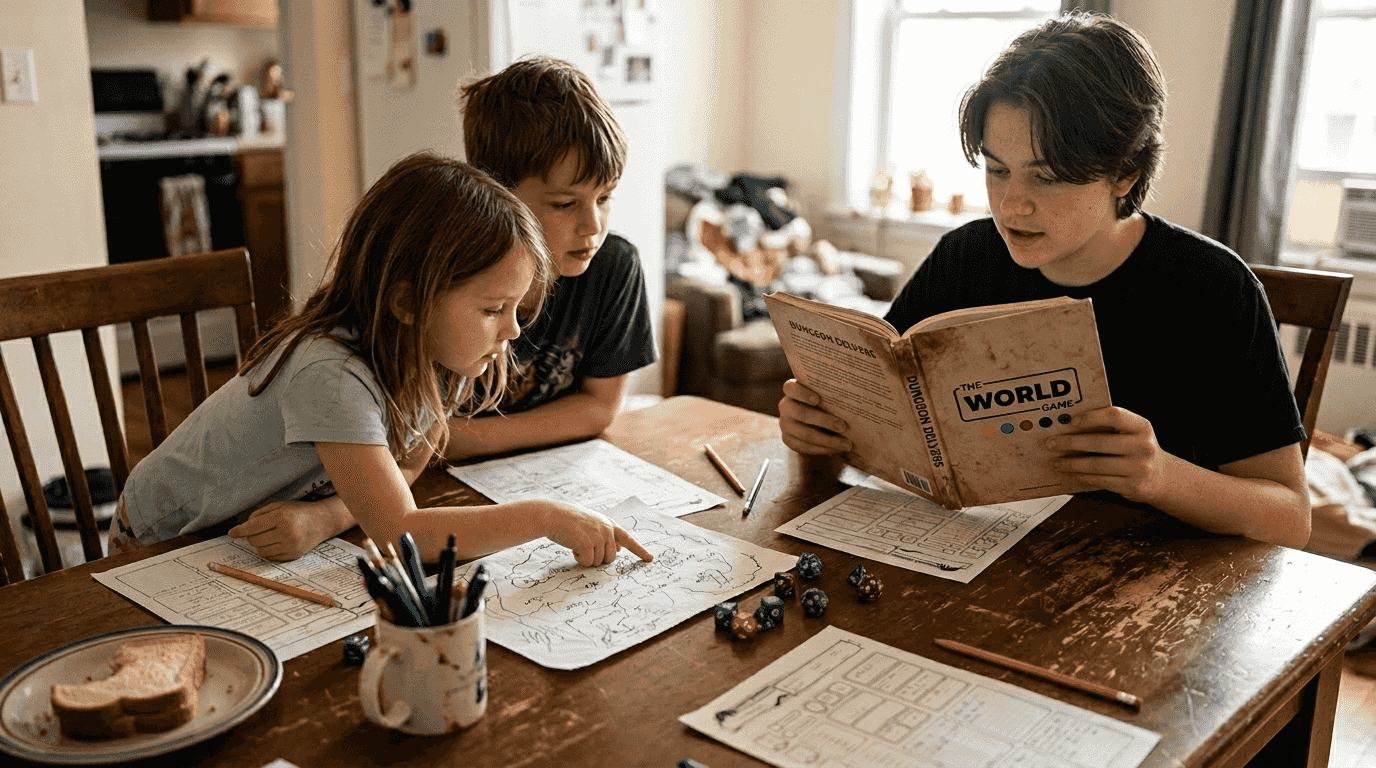
Research confirms these benefits extend beyond gameplay. Studies show role-playing exercises produce lasting cognitive and emotional insights, including enhanced empathy and personal reflection that participants carry into daily interactions. The immersive nature of narrative games creates memorable experiences that shape how players understand and respond to others’ emotions.
Tabletop RPGs like Dungeons & Dragons demonstrate measurable impacts on at-risk youth. Programs using these games report significantly reduced suspensions and improved attendance, with participants showing better emotional regulation and teamwork abilities. The structured social environment of RPGs provides safe spaces for practicing complex interpersonal dynamics.
The collaborative storytelling inherent in role-playing games builds unique social bonds. Players create shared narratives where everyone contributes to outcomes, fostering genuine investment in group success. This collaborative creativity strengthens communication skills as players negotiate plot directions, resolve character conflicts, and build on each other’s ideas.
Narrative games also encourage emotional vocabulary development. Players must articulate their characters’ feelings, motivations, and reactions, expanding their ability to express complex emotional states. This practice translates to improved emotional intelligence in real-world interactions where clear communication about feelings strengthens relationships.
Pro Tip: Start with simplified role-playing games designed for families before progressing to complex systems, ensuring everyone can engage comfortably with the format.
The reflective nature of RPGs promotes social awareness and ethical reasoning. Players face moral dilemmas through their characters, exploring consequences of different choices in low-stakes environments. These experiences build decision-making frameworks that inform real-world ethical choices.
Structured facilitation maximizes role-playing benefits. Game masters or facilitators who establish clear social norms, encourage inclusive participation, and guide reflection help players extract maximum learning from gameplay. Families exploring role-playing game benefits should consider how facilitation styles impact social skill development.
Maximizing RPG social benefits:
- Establish safety tools allowing players to pause uncomfortable scenarios
- Encourage players to explain character motivations and feelings
- Debrief after sessions to discuss social dynamics and decisions
- Rotate storytelling responsibilities to develop diverse perspectives
- Connect in-game situations to real-world social parallels
Choosing and using games to build social skills at home
Selecting appropriate games requires considering multiple factors beyond entertainment value. Age appropriateness stands paramount, as younger children benefit more from cooperative games while older children gain more from competitive formats. Games that match developmental stages keep all players engaged and learning effectively.
Balancing game types across multiple sessions optimizes social skill development. Rather than playing only cooperative or competitive games, families should rotate between formats to practice diverse social abilities. This variety prevents skill gaps while maintaining fresh, engaging experiences that hold everyone’s interest.
Step-by-step game selection process:
- Assess the age range and skill levels of all participants
- Identify specific social skills your family wants to develop
- Research games matching those criteria through reviews and recommendations
- Start with shorter games to gauge engagement before committing to longer sessions
- Gather feedback after gameplay to refine future selections
Facilitation quality significantly impacts learning outcomes. Parents and older siblings who explain rules clearly, model positive communication, and encourage inclusive participation create environments where social skills flourish. Expert-level play involves teaching players how to manage disagreements constructively and focus on shared enjoyment rather than just winning.
Establishing clear expectations before gameplay prevents conflicts and reinforces positive behaviors. Discuss how your family will handle disagreements, celebrate successes, and support each other during challenging moments. These pre-game conversations set social norms that guide interactions throughout play.
Pro Tip: Create a family game agreement outlining expectations for respectful communication, handling frustration, and celebrating both wins and losses together.
Reflection breaks during longer games provide opportunities to process social dynamics. Pause periodically to discuss strategies, acknowledge good teamwork, or address tensions before they escalate. These brief check-ins reinforce learning and help players recognize their social skill development in real time.
Routines strengthen skill development through repetition. Consistent game nights at predictable times create reliable practice opportunities where social skills compound over weeks and months. Families who explore family game night tips report stronger connections and more noticeable skill improvements with regular scheduling.
Creating positive game environments:
- Minimize distractions by turning off screens and creating dedicated play spaces
- Celebrate effort and improvement, not just winning
- Encourage players to verbalize their thinking and decision-making
- Model gracious winning and losing through your own behavior
- Use humor to diffuse tension while maintaining respect
- Allow natural consequences to teach lessons about choices
Conflict management during gameplay requires balancing intervention with allowing natural resolution. Step in when interactions become disrespectful or overly heated, but permit minor disagreements that players can navigate independently. This calibrated approach builds problem-solving abilities while maintaining safe, positive environments.
Discover games that bring families together
Finding games that match your family’s needs and interests makes consistent game nights more achievable. Play World Game offers carefully selected social card and board games designed to foster communication, teamwork, and genuine connection during family gatherings. The collection includes cooperative challenges, competitive strategy games, and engaging party formats suitable for various age groups and skill levels.

Whether you’re seeking games to build specific social skills or simply want engaging activities for your next game night, exploring diverse options helps you discover what resonates with your family. The Play World Game collection features fast-paced, social games perfect for strengthening family bonds while developing essential interpersonal abilities. From skill-based challenges to conversation starters, you’ll find games that turn ordinary evenings into opportunities for growth and laughter.
Frequently asked questions
What social skills can families develop through playing games?
Games build communication, teamwork, empathy, conflict resolution, and emotional regulation through structured social interactions. Players practice turn-taking, negotiation, perspective-taking, and graceful handling of wins and losses. These skills transfer directly to school, work, and personal relationships, making gameplay a practical tool for social development.
How do role-playing games improve empathy and teamwork?
Role-playing games immerse players in different perspectives, requiring them to understand and embody characters with varied motivations and challenges. This active perspective-taking builds empathy more effectively than passive observation. The collaborative storytelling inherent in RPGs strengthens teamwork as players negotiate shared narratives and support each other’s creative contributions.
What is the best mix of cooperative and competitive games for family game nights?
Research suggests approximately 60% competitive and 40% cooperative games provides balanced social skill development. This ratio promotes strategic thinking and resilience while maintaining strong emphasis on teamwork and empathy. Families should adjust based on their specific dynamics, ages, and developmental goals while exploring family game mix guidance for personalized approaches.
How can families handle conflicts that arise during game play?
Encourage players to express feelings calmly using “I” statements and practice active listening to understand others’ perspectives. Focus conversations on the shared goal of enjoyment rather than just winning. Establish clear expectations before gameplay about respectful communication and use brief reflection breaks to address tensions before they escalate, following game conflict management tips for constructive resolution strategies.