


TL;DR:
- Conversation card games focus on sharing, listening, and genuine interactions rather than winning.
- They are versatile, phone-free, replayable, and suitable for all ages and settings.
- Effective prompts are open-ended, unusual, and designed to foster memorable, honest conversations.
Most people assume card games mean competition, score sheets, and someone sulking at the end of the night. But conversation card games flip that whole idea on its head. Instead of racing to win, you’re laughing at an unexpected answer, learning something wild about your best friend, or finally getting your teenager to talk. That’s the kind of game night moment that actually sticks. In this guide, we’ll cover what conversation card games are, how they compare to other game styles, what makes a great one, and how to use them to make any gathering genuinely memorable.
Table of Contents
- What are conversation card games?
- How do conversation card games differ from other games?
- What makes a good conversation card game?
- How to use conversation card games for memorable gatherings
- Why conversation card games work: Our take
- Discover even more ways to connect
- Frequently asked questions
Key Takeaways
| Point | Details |
|---|---|
| Focus on connection | Conversation card games prioritize fun interactions over competition or winning. |
| Adaptable for all ages | Prompts and decks can be tailored for families, friends, or mixed-age gatherings. |
| High replay value | Open-ended questions and random draw keep each game session fresh and engaging. |
| Easy to use anywhere | Conversation card games work well for dinners, trips, virtual meetings, and reunions. |
What are conversation card games?
Now that you know conversation card games offer something beyond competition, let’s define exactly what makes them special.
At their core, conversation card games are exactly what they sound like: card decks packed with questions, prompts, or scenarios designed to get people talking. There are no points to track, no hands to win, and nobody gets eliminated. You just draw a card, answer the question, and let the conversation take over. It sounds simple because it is, and that simplicity is actually the whole point.
These games show up in a lot of different flavors. Some packs focus on lighthearted icebreakers like “What’s the worst movie you secretly love?” Others go deeper, prompting players to share personal stories, reflect on their values, or reveal something they’ve never told the group before. The best decks escalate from light icebreakers to deeper questions, warming everyone up gradually so no one feels put on the spot too early.
Here’s what really sets them apart from a typical deck of cards:
- No winners, no losers. Everyone participates, and nobody gets knocked out.
- Phone-free gameplay. Physical cards naturally pull people’s attention away from screens and into the room.
- Age-flexible. You can tailor the card categories to fit your crowd, whether it’s kids, adults, or a mix of both.
- Replayable. Open-ended prompts mean no two answers are ever the same, even if you draw the same card twice.
- Genuinely surprising. The best prompts are oddly specific or a little unusual, which is exactly why they work.
“Specific and unusual questions bypass polished, rehearsed responses and lead to more genuine, memorable conversations.”
Pro Tip: If your group is new to conversation games, start with the silliest or most lighthearted cards first. Once the laughter kicks in, people open up much faster for the deeper prompts.
It’s also worth noting that these games are a great fit for a wide variety of settings. You can get a clearer sense of how they fit into the larger category by defining party card games and what separates different styles of social play.
How do conversation card games differ from other games?
Defining conversation card games sets the foundation, but how exactly do they compare to other popular game types? Let’s take a closer look.
This is where things get interesting. A lot of social games get grouped together under the “party game” label, but there are real differences in how they play and what they prioritize. Take Say Anything as an example. It’s a social, question-based game, but it also has a judge who picks their favorite answer and players who earn points by guessing the judge’s pick. That competitive layer is fun, but it also changes the energy. Suddenly, you’re trying to impress rather than just share.
Pure conversation card games strip away those mechanics entirely. There’s no judge, no points, no pressure to give the “best” answer. That shift is small on paper but huge at the table.
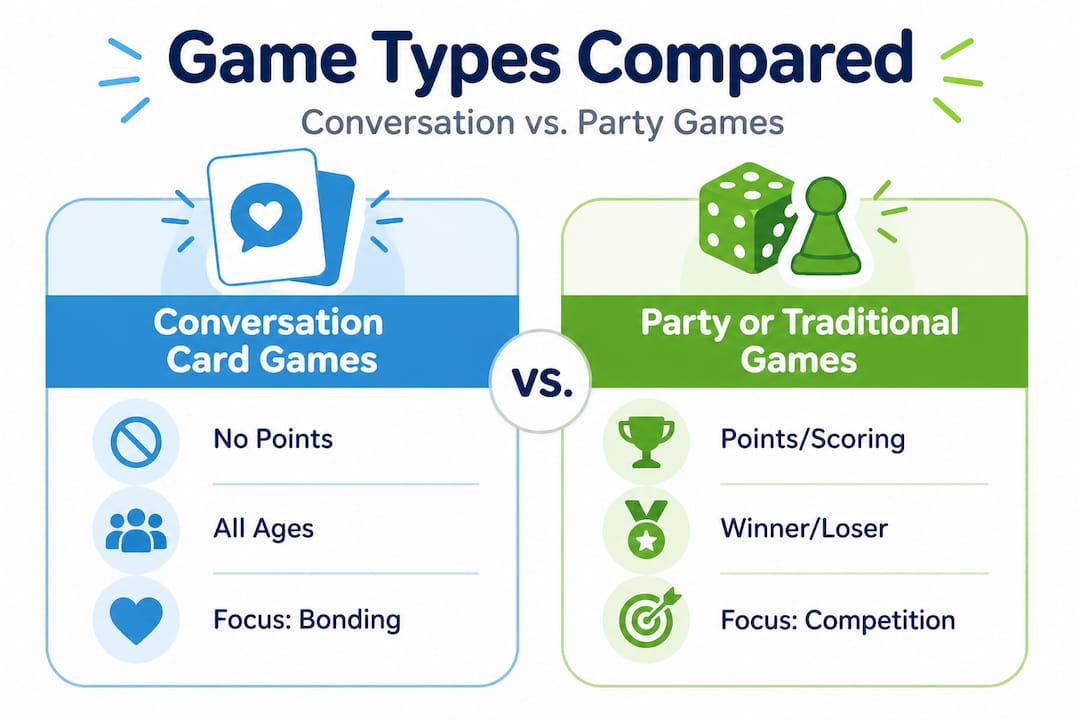
Here’s a quick comparison to make it even clearer:
| Feature | Conversation card games | Party games (e.g., Say Anything) | Traditional card games |
|---|---|---|---|
| Competitive element | None | Moderate | High |
| Focus | Sharing and listening | Impressing/guessing | Winning hands |
| Learning curve | Very low | Low to moderate | Varies |
| Connection factor | Very high | Moderate | Low |
| Best for | All groups | Social crowds | Game enthusiasts |
The party card game goals can shift based on game type, but conversation games consistently put the focus on interaction over outcomes. And honestly? That’s what most people actually want from a game night, even if they don’t realize it yet.
A few other things that make pure conversation games stand out:
- Everyone stays involved. There’s no waiting around while someone else plays their hand.
- No one “checks out.” Because every answer is personal, there’s always something interesting happening.
- Low pressure. Without a judge or score, people feel safe being honest, funny, or even a little vulnerable.
What makes a good conversation card game?
Understanding how conversation card games stand apart is helpful, but what really makes a great one? Here’s what to look for.
Not all conversation decks are created equal. We’ve played through quite a few at this point, and the differences between a forgettable pack and one that becomes a go-to tradition are pretty clear. Here’s what the best ones have in common:
- Open-ended prompts with real replay value. Questions that can’t be answered with a single word force people to actually think. Open-ended prompts mean no two game nights are ever quite the same, even with the same cards.
- A smart progression from easy to meaningful. Starting with low-stakes, funny questions before moving into deeper territory is a game design feature that great decks nail. Nobody wants to answer “What’s your biggest regret?” as the first card of the evening.
- Age-appropriate options within the same deck. The best games let you choose categories or difficulty levels, so grandparents and grandkids can play together without awkwardness.
- Specific, unusual prompts that cut through small talk. A prompt like “What’s something you own that you’d be embarrassed to explain to a stranger?” hits differently than “Tell us about yourself.” Specific and strange questions get past the surface-level stuff fast.
- Physical card format. There’s something about holding an actual card that keeps people present. It’s tactile, it’s screen-free, and it gives each question a little weight.
Pro Tip: If you’re buying for a mixed-age group, look for decks that separate prompts by category or intensity level. It saves a lot of awkward shuffling in the moment.
If you’re specifically shopping for younger players, there are some genuinely fantastic options. We’ve covered the best kids conversation games in detail if you want to go deeper on that front. Kids’ decks tend to keep things silly and imaginative, which is exactly the right call for little ones who are still figuring out how conversations work.
One more thing worth mentioning: replayability is everything. A game that only has 50 questions is going to run dry quickly if you’re using it regularly. Look for decks with a large card count or ones designed to be mixed and matched across multiple sessions.
How to use conversation card games for memorable gatherings
Knowing what makes a game engaging, let’s see how you can make conversation card games the centerpiece of your next gathering.
The beauty of conversation card games is that they adapt to almost any social situation. They’re not just for game night. They work at family reunions, road trips, holiday dinners, virtual hangouts, and even those awkward gaps at the start of a dinner party when nobody quite knows what to say yet.

Here’s a breakdown of where they shine:
| Setting | How to use them | Best card style |
|---|---|---|
| Family dinner | Pass the deck around; everyone draws one card per turn | Light to moderate prompts |
| Road trip | One person reads, others answer in order | Funny or thought-provoking |
| Holiday gathering | Set the deck on the table as a centerpiece; people grab cards freely | Mixed or seasonal prompts |
| Virtual hangout | Share the question on screen; everyone unmutes to answer | Icebreaker style |
| Girls’ night or couples game night | Use category-specific decks; pair with snacks or drinks | Themed decks |
The key to making any session work is setting the tone upfront. Here’s our go-to setup:
- No phones at the table. Sounds obvious, but it makes a huge difference. When phones are down, people are actually listening.
- Rotate who picks the card. It keeps everyone invested and prevents one person from hogging the spotlight or steering toward their comfort zone.
- Select age-appropriate categories if the group is mixed. Don’t leave it to chance.
- Keep it low-pressure. Remind the group there are no wrong answers and anyone can pass if a question feels too personal.
The tradition angle is one we love especially. Families who make conversation games part of a weekly dinner or monthly game night report that it becomes something everyone genuinely looks forward to. It stops feeling like “a game” and starts feeling like a ritual. That kind of consistent, shared experience is exactly what strengthens family bonds through play over time.
For groups who play remotely or who want low-structure options, conversation cards work beautifully as part of collaborative gaming ideas where there’s no head-to-head competition, just shared experience. Long-distance families use them over video calls. Friend groups use them on group chats. They’re that flexible.
Why conversation card games work: Our take
Here’s where we want to push back a little on conventional wisdom about what makes a game night “successful.”
Most people default to competitive games because winning feels like a clear goal. You sit down, you play, someone wins, and it feels like the evening had a point. We get it. But here’s the thing: when we think back on our best game nights, the memories that stick aren’t about who won. They’re about the answers nobody expected, the stories that came out sideways, and the moments where someone said something that made the whole table go quiet for a second before erupting into laughter.
That’s what conversation card games actually deliver. And the reason they work so well comes down to prompt design. Specific, unusual questions bypass polished responses and get people saying things they’ve genuinely never thought to share before. Generic prompts like “What’s your favorite memory?” invite a safe, practiced answer. But “What’s the strangest thing you believe that most people don’t?” forces someone to actually think and reveal something real.
There’s also a broader cultural shift worth naming here. We live in an era where screens and notifications compete for everyone’s attention constantly. Sitting down with a deck of cards and nowhere to be is a genuinely rare gift. Conversation card games make that easy to do together without any planning or structure required. They’re the key to real bonding with games precisely because they demand nothing except showing up and being honest.
Our honest take? If you’ve never tried a conversation card game because it seemed too simple or not “game-y” enough, you’re missing out on what game nights are actually for.
Discover even more ways to connect
If you’re ready to build more connection into your game nights, family dinners, or friend gatherings, we’ve got you covered.

At Playworldgame.com, we’ve curated a lineup of fast, social card and board games built exactly for moments like these. Whether you’re looking for a couples conversation game that sparks real talk, a girls-night deck that keeps things fun and a little spicy, or a family-friendly set that works for all ages around the table, there’s something in our collection for every crowd. We believe the best game nights aren’t about winning. They’re about the stories you’re still retelling the next morning. Browse our full collection and find your next favorite game night tradition.
Frequently asked questions
Are conversation card games suitable for kids and adults?
Yes, conversation card games are designed for all ages, and the best decks include tailored categories that make it easy to keep prompts appropriate for whoever is at the table.
What types of prompts work best for sparking interaction?
Specific, unusual, or escalating questions work best because they encourage honest and memorable conversations. Strange, specific prompts push past rehearsed answers and get people sharing things that actually surprise the group.
Can you play conversation card games virtually or on trips?
Yes, they’re flexible enough for in-person, online, or travel settings. You can integrate them into dinners, trips, or nights at home without any additional setup.
How do you keep everyone engaged with conversation games?
Rotate who draws the card, keep prompts age-appropriate, and commit to phone-free play so everyone stays present and actually listens to each other’s answers.