


TL;DR:
- Party card games prioritize social interaction, humor, and inclusivity over strategy and skill.
- Core mechanics include simultaneous play, short rounds, and subjective judging to keep energy high.
- They are designed for larger groups, emphasizing fun and bonding rather than mastery or competition.
There’s a moment at every gathering when someone pulls out a deck of cards and suddenly the whole room leans in. Not because people are dying to show off their poker strategy, but because something about the right party card game just clicks. It turns strangers into teammates, quiet cousins into comedians, and a Tuesday night into a story everyone tells later. Party card games are built around casual social play that puts laughter and bonding front and center, not competition. So what exactly separates a party card game from every other deck on the table? Let’s find out.
Table of Contents
- What truly defines a party card game?
- Signature mechanics and structure: How party card games keep energy high
- Party card games vs. classic card games: Key differences
- Iconic examples and benchmarks: What makes a game legendary?
- Why classic strategy doesn’t always win: An insider’s take on party card games
- Host your next unforgettable game night
- Frequently asked questions
Key Takeaways
| Point | Details |
|---|---|
| Fun over competition | Party card games focus on laughter and bonding, not who wins. |
| Inclusive mechanics | Accessible rules and flexible formats make them perfect for any group. |
| Engagement is everything | Games keep all players involved and energy high through unique mechanics. |
| Iconic examples set standards | Legendary games like Apples to Apples show what makes a true party classic. |
What truly defines a party card game?
With the confusion around what qualifies as a party card game in mind, let’s break down their defining qualities. Because honestly, calling every card game a “party game” is like calling every board game chess. The differences are real, meaningful, and worth knowing before you pick something for your next girls’ night or family gathering.
At its core, a party card game is designed to get people talking, laughing, and reacting to each other. It’s less about mastering complex rules and more about the moments those rules create. Think less “who played the highest card” and more “who just said THAT out loud.” Casual social play focused on interaction and group bonding is what defines the genre, and it shapes every design decision a game creator makes.
Here’s what makes a game truly qualify as a party card game:
- High social interaction: Players are constantly reacting to each other, making choices based on personalities in the room, not just strategy.
- Laughter as a mechanic: The game is literally structured to produce funny moments. Whether it’s a ridiculous card combination or an unexpected answer, humor isn’t a side effect. It’s the point.
- Inclusive, casual play: You don’t need to be a card shark or a board game enthusiast. Rules are simple enough that Grandma and your college roommate can both jump in on round one.
- Winning is secondary: Yes, most party card games have a winner. But ask anyone who’s played them and they’ll tell you the score was basically irrelevant by round three.
- Scalability: These games work whether you’ve got six people or sixteen. That flexibility is built in by design.
Understanding how party games build connections also helps explain why they’re engineered this way. When a game removes the pressure of skill-based competition, people relax and open up. Conversations flow naturally. Inside jokes get created in real time. That’s not an accident. It’s the entire architecture of the experience.
The best party card games aren’t designed to find the smartest person in the room. They’re designed to make sure everyone has a reason to stay in the room.
This philosophy shapes everything from card count to round length to how rules are taught. A great party card game doesn’t need a rulebook that takes twenty minutes to read. It needs to get people playing and laughing as fast as possible.
Signature mechanics and structure: How party card games keep energy high
Now that we’ve laid the groundwork, let’s explore the engines that drive the fun in party card games. Because the best ones don’t just happen to be entertaining. They’re engineered, sometimes brilliantly, to keep energy high and downtime low from the first card to the last.
The core mechanics of party card games are worth knowing because they explain why these games feel so different from everything else:
- Simultaneous play: Everyone acts at the same time rather than waiting for turns. No one zones out. No one checks their phone. Everyone is always in the game.
- Team formats: Splitting into teams adds a collaborative layer that gets people cheering each other on (or dramatically blaming their teammates, which is equally fun).
- Short rounds: Most party card games wrap up in 15 to 30 minutes, and individual rounds take seconds to minutes. That pacing keeps energy high and gives the game a natural rhythm.
- Low rules overhead: The best party games can be learned in under two minutes. Short hands of three to seven cards mean fewer decisions per turn and more time for reactions.
- Bluffing and collaboration: These mechanics add personality. Bluffing creates tension. Collaboration creates camaraderie. Both create memories.
- High replayability: A good party card game plays differently every single time because the combinations, the people, and the moments are always changing.
One of the most underrated mechanics in party card games is subjective judging. Games like Apples to Apples use a rotating judge model where one person picks their favorite answer from the group. Subjective judging fosters debate rather than strict scoring, and those debates are often the funniest moments of the whole night. When someone makes an unexpected choice and has to defend it, that’s pure party gold.
| Mechanic | Purpose | Effect on energy |
|---|---|---|
| Simultaneous play | Eliminates waiting | Keeps everyone engaged |
| Short rounds | Fast pacing | Sustains momentum |
| Subjective judging | Promotes discussion | Generates laughter and debate |
| Team formats | Creates collaboration | Builds group energy |
| Bluffing | Adds tension | Creates memorable moments |
Pro Tip: If you’re hosting a mixed group where some people love games and others are reluctant, pick a game that uses simultaneous play and subjective judging. These mechanics pull everyone in without making anyone feel left behind or put on the spot.
Party card games also do a smart thing: they boost kids’ social skills and adult social bonds in the same session. When a game is structured to include everyone, it teaches communication, listening, and creative thinking almost by accident. That’s a design feature, not a coincidence.
Party card games vs. classic card games: Key differences
To further clarify, let’s see how party card games stand apart from the classics you’re probably familiar with. Poker night has its place. So does a rousing game of Spades. But when you’ve got ten people over and you want everyone genuinely engaged and laughing, classic card games often fall flat.
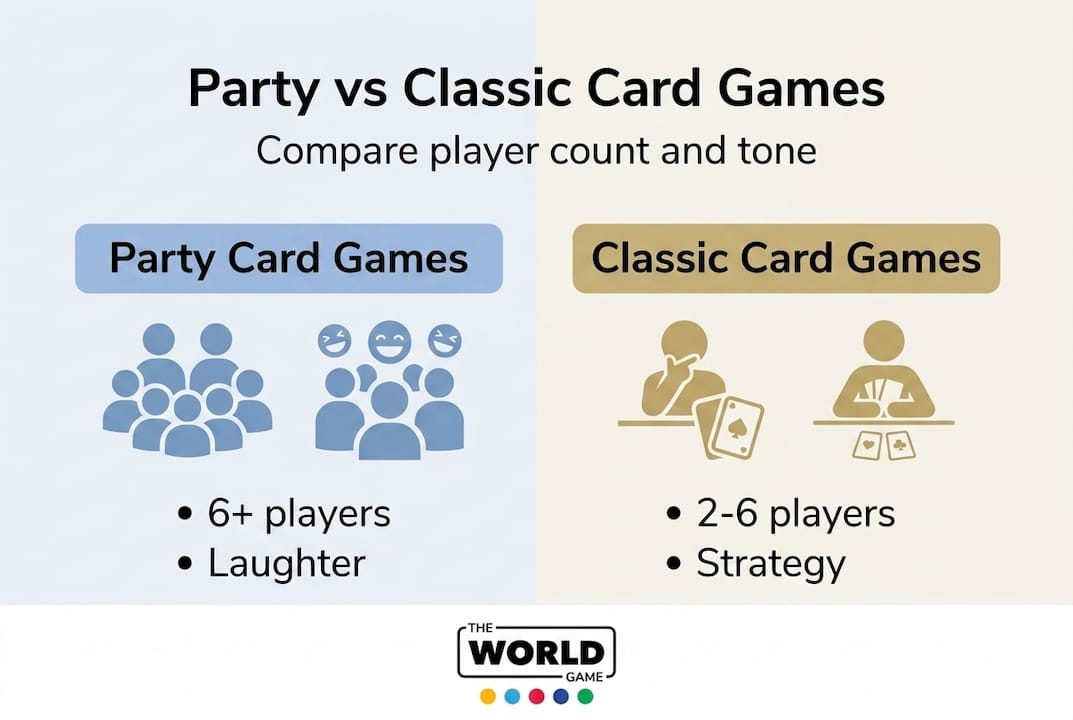
The biggest structural difference is player count. Classic card games like poker strain beyond four to six players because turn wait times get long and momentum dies. Party card games are designed for six or more and often get better with a bigger crowd. More people means more personality combinations, more unexpected answers, and more chances for something gloriously chaotic to happen.
Here’s a quick comparison to make this crystal clear:
| Feature | Party card games | Classic card games |
|---|---|---|
| Ideal player count | 6 to 10+ | 2 to 6 |
| Learning curve | Under 2 minutes | Can take hours to master |
| Focus | Fun, laughter, bonding | Skill, strategy, winning |
| Downtime between turns | Minimal (often simultaneous) | Can be significant |
| Accessibility for non-gamers | Very high | Often low |
| Replayability | High due to social variation | High due to strategic depth |
Classic card games are built around mastery. Poker rewards reading opponents, managing odds, and keeping a straight face. Spades demands communication and strategy between partners over many hands. There’s real depth there, and for the right group at the right time, that depth is exactly what you want.
But here’s the thing: party card games prioritize accessibility over skill, which is genuinely ideal for non-gamers and mixed-experience groups. They level the playing field by leaning on humor, luck, and creative thinking instead of years of experience. A ten-year-old and a fifty-year-old can genuinely compete on equal footing.
That said, we’ll be honest. Some competitive players find this frustrating. If someone in your crew is a seasoned gamer who only finds joy in winning through skill, a pure party card game might not scratch that itch. Knowing your group matters. But for the vast majority of gatherings where the goal is fun and connection, understanding how to choose party games for gatherings makes all the difference.
The other key distinction is emotional tone. Classic card games create tension through strategy and stakes. Party card games create tension through humor, surprise, and social dynamics. Both are valid. They’re just serving very different needs on very different nights.
Iconic examples and benchmarks: What makes a game legendary?
Understanding the core traits is even clearer when we see them at work in the most iconic party card games of our time. These games didn’t just become popular. They became cultural moments, and the reasons why tell us everything about what this genre does best.
Let’s look at a few hall-of-famers:
- Cards Against Humanity: The fill-in-the-blank format creates absurd combinations that range from silly to shocking. The humor is the mechanic. Every round produces a moment that people screenshot, quote later, or immediately regret saying out loud. That’s by design.
- Exploding Kittens: This cat-filled card game of social deduction and strategic avoidance became a phenomenon. Exploding Kittens raised $8.7M from 219,000 backers on Kickstarter, which remains one of the most successful tabletop campaigns ever. It’s fast, chaotic, and endlessly replayable.
- Apples to Apples: The granddaddy of the subjective judgment format. Players match noun cards to an adjective chosen by the judge, and the funniest or most creative match wins. Simple, brilliant, and genuinely fun across generations. It was named Party Game of the Year in 1999 and earned Mensa Select recognition, which is a rare combination of “smart design” and “anyone can play this.”
- Wits & Wagers: A trivia-style game where you bet on which answer is closest to correct rather than having to know the actual answer. This mechanic is genius because it means knowing nothing about a topic doesn’t knock you out of the game. Bluffing and reading people matter just as much as knowledge.
Pro Tip: When you’re choosing between these iconic games for your gathering, think about your group’s humor threshold and age range. Exploding Kittens and Apples to Apples work beautifully across all ages. Cards Against Humanity is strictly an adults-only affair. Wits & Wagers is perfect for trivia lovers who hate feeling dumb when they don’t know the answer.
What all four of these games share is a commitment to keeping everyone in the experience, not just the people who are “good” at games. The mechanics are built to create talking points, laughs, and moments of connection. That’s what earns a party card game legendary status. Not the complexity of the rules, but the simplicity of the joy it creates.
The success stories of these games also reveal something important: when a party card game genuinely delivers on fun and connection, word of mouth does the marketing. People don’t just buy these games. They recruit their friends to play them, host dedicated nights around them, and bring them out at every gathering until the cards start to show wear. That kind of loyalty doesn’t come from a clever rulebook. It comes from real moments shared around a real table.
Exploring party game classics can give you even more inspiration when you’re building out your game night lineup.
Why classic strategy doesn’t always win: An insider’s take on party card games
After seeing the defining examples, let’s reflect a little deeper on why the very best party card games break the mold, and what that means for your next gathering.
Here’s our honest take: we’ve seen people walk into game nights fully convinced they’re going to dominate, only to discover that dominating isn’t really the point. Party card games are intentionally designed to celebrate joy and unpredictability over expert-level skill. And that design choice is not a flaw. It’s the whole idea.
Subjective judging fosters debate over winning, and those debates are where the real magic lives. When someone makes a wildly unexpected card choice and has to defend it with a straight face, the room explodes. That moment of shared laughter creates a memory that outlasts any scoreboard.
The players who get the most out of party card games are the ones who let go of winning. Embrace the chaos. Root for the ridiculous answer. Let someone else’s bluff land perfectly and applaud it. Games that prioritize boosting social bonds are doing something that chess or poker rarely manages: they remind everyone that being together is the whole point.
If your competitive instincts are strong, try channeling them into making the group laugh instead of keeping the score. You might just find that’s the most satisfying win of all.
Host your next unforgettable game night
Now that you know what makes party card games the life of the party, here’s your next step.
Whether you’re planning a girls’ night, a family get-together, or a casual hangout with friends who haven’t laughed together in way too long, the right game makes all the difference. We at Play World Game have put together a lineup of fast, social card and board games built exactly for these moments. From food-themed party games to music guessing games and couples’ conversation starters, there’s something for every group and every vibe.

Browse our full collection and find the game your next gathering has been missing. Join a growing community of game lovers who know that the best nights aren’t planned around a menu or a playlist. They’re built around a great game and great company. Your next unforgettable memory is one card flip away.
Frequently asked questions
What is the main purpose of a party card game?
The main purpose is to promote laughter, connection, and group engagement. As casual social play centered on bonding shows, determining a single winner is genuinely beside the point.
How many players do party card games usually support?
Most support six or more players and scale well beyond that. Party card games designed for large groups of 10 or more are often more fun with a bigger crowd, unlike classics like poker that struggle past four to six players.
Do you need to be a card game expert to play party card games?
Absolutely not. Core mechanics like simultaneous play and short hands mean rules can be learned in under two minutes, making them genuinely accessible for all ages and experience levels.
What makes party card games different from classics like Poker?
Party card games focus on fun, accessibility, and group interaction rather than skill-based competition. Party games emphasize accessibility over skill, making them ideal for non-gamers and mixed groups where everyone deserves to have a great time.