


Most parents know kids need playtime, but what they might not realize is that group activities shape the most critical social skills children will use for life. Research shows that structured cooperative play enhances peer relationships and builds empathy, teamwork, and emotional intelligence from as early as age three. While solo play has its place, group activities create unique opportunities for children to practice sharing, turn-taking, and collaboration in ways that translate directly to school success and lifelong friendships. This guide breaks down exactly how group games benefit young children and gives you practical strategies to make the most of playtime.
Table of Contents
- Key takeaways
- The social and emotional benefits of group activities for young children
- How group games support cognitive and academic skills
- Facilitating successful group activities: tips for parents
- Explore fun and educational group games at The World Game
- Frequently asked questions
Key Takeaways
| Point | Details |
|---|---|
| Social skills boost | Structured cooperative play strengthens empathy, teamwork, and emotional intelligence starting around age three. |
| Age tailored complexity | Matching game difficulty to developmental stage increases engagement and reduces frustration. |
| Conflict reduction | Cooperative formats where everyone learns together reduce fights and emphasize strategy and teamwork. |
| Adult facilitation matters | Guided group play by adults models language redirects conflicts and ensures quieter children participate. |
| Numeracy gains | Board games focusing on counting and numbers significantly improve early numeracy skills, with about 76 percent improvement reported. |
The social and emotional benefits of group activities for young children
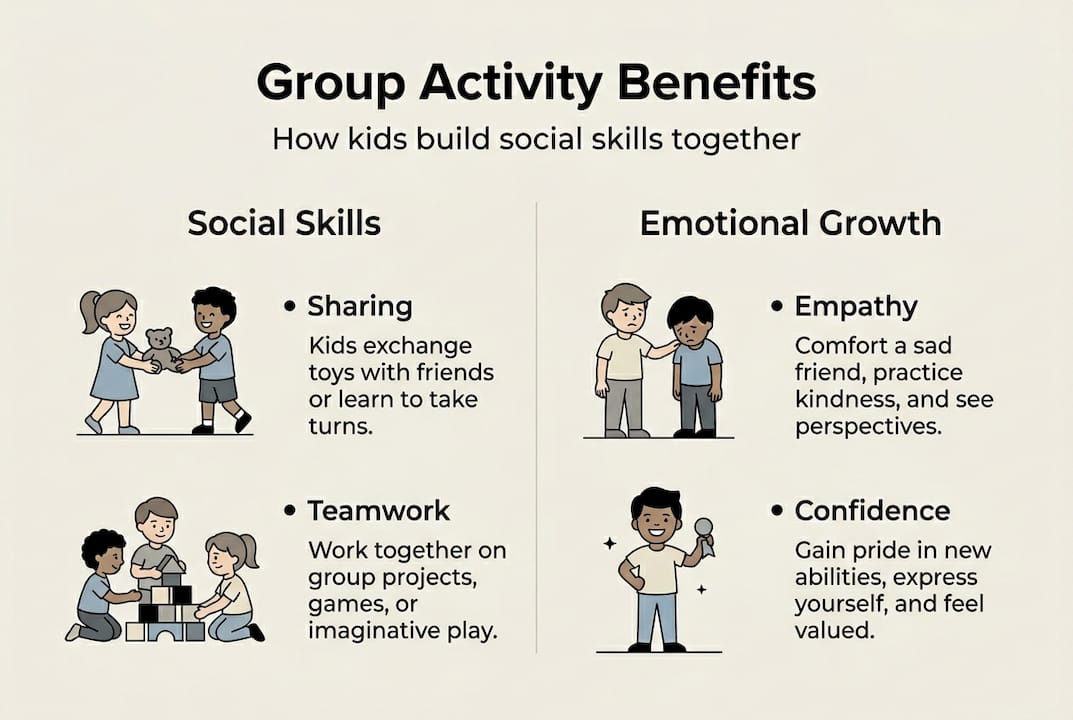
Group activities serve as training grounds for essential social and emotional skills that children carry into adulthood. When kids play together, they naturally practice empathy by reading facial expressions and responding to peers’ emotions. They learn teamwork by coordinating actions toward shared goals. Sharing and turn-taking become second nature through repeated practice in low-stakes game environments.
The effectiveness of these activities depends heavily on age-appropriate design. Research confirms that structured cooperative play enhances social-emotional competencies including teamwork and empathy, but the magic happens when you match complexity to developmental stage. Children aged 3-4 benefit most from simple turn-taking games where rules are clear and wait times are short. Think quick card flips or rolling dice and moving pieces one space at a time.
Once kids reach 5-6 years old, their brains can handle more complex cooperative tasks. They can follow multi-step rules, remember whose turn comes next, and work together on strategies that require planning. Games at this level might involve collecting sets, building structures together, or solving simple puzzles as a team. The cognitive leap between these age groups is substantial, so choosing the right complexity level makes the difference between engaged learning and frustrated tears.
Cooperative games specifically reduce conflict compared to competitive formats. When everyone wins or loses together, children focus on helping each other rather than celebrating individual victory. This dynamic promotes positive peer relationships and teaches kids that success can be collective. You’ll notice fewer arguments about winners and losers, and more conversations about strategy and teamwork.
Key social skills developed through group activities include:
- Empathy and emotional recognition through observing peers’ reactions
- Turn-taking and patience while waiting for their moment to play
- Sharing resources and celebrating collective achievements
- Communication skills by explaining ideas and listening to others
- Conflict resolution when disagreements arise during gameplay
Adult facilitation amplifies these benefits dramatically. When parents or caregivers guide group play, they can model positive language, redirect conflicts constructively, and ensure quieter children get opportunities to participate. Your role isn’t to control the game but to create a supportive environment where kids develop social skills naturally through play.
Pro Tip: Watch for moments when a child struggles with sharing or waiting their turn. Instead of immediately intervening, give them 10-15 seconds to work it out themselves. Kids often surprise you by finding their own solutions when given space, and these self-directed resolutions build confidence faster than adult-imposed fixes.
How group games support cognitive and academic skills
Beyond social benefits, group games deliver measurable cognitive advantages that translate directly to academic performance. Board games in particular have emerged as powerful tools for building early math skills. A comprehensive meta-analysis found that linear number board games improve numeracy skills with a 76% probability of gains in counting and number recognition after sessions as brief as 10 minutes.
These aren’t abstract benefits that might appear years later. Parents report noticing improvements in counting accuracy within weeks of regular game sessions. Kids who struggle with one-to-one correspondence, where each object gets counted exactly once, often master this concept through moving game pieces along numbered paths. The physical act of touching each space while saying numbers aloud creates multiple learning pathways that worksheets can’t replicate.
The format of gameplay matters significantly for behavioral outcomes. Studies show that cooperative games increase sharing behavior more than competitive ones in young children. When kids play cooperatively, they practice generosity in low-pressure situations where sharing leads to collective success. Competitive games can be fun and have their place, but for building prosocial behaviors, cooperative formats deliver superior results.
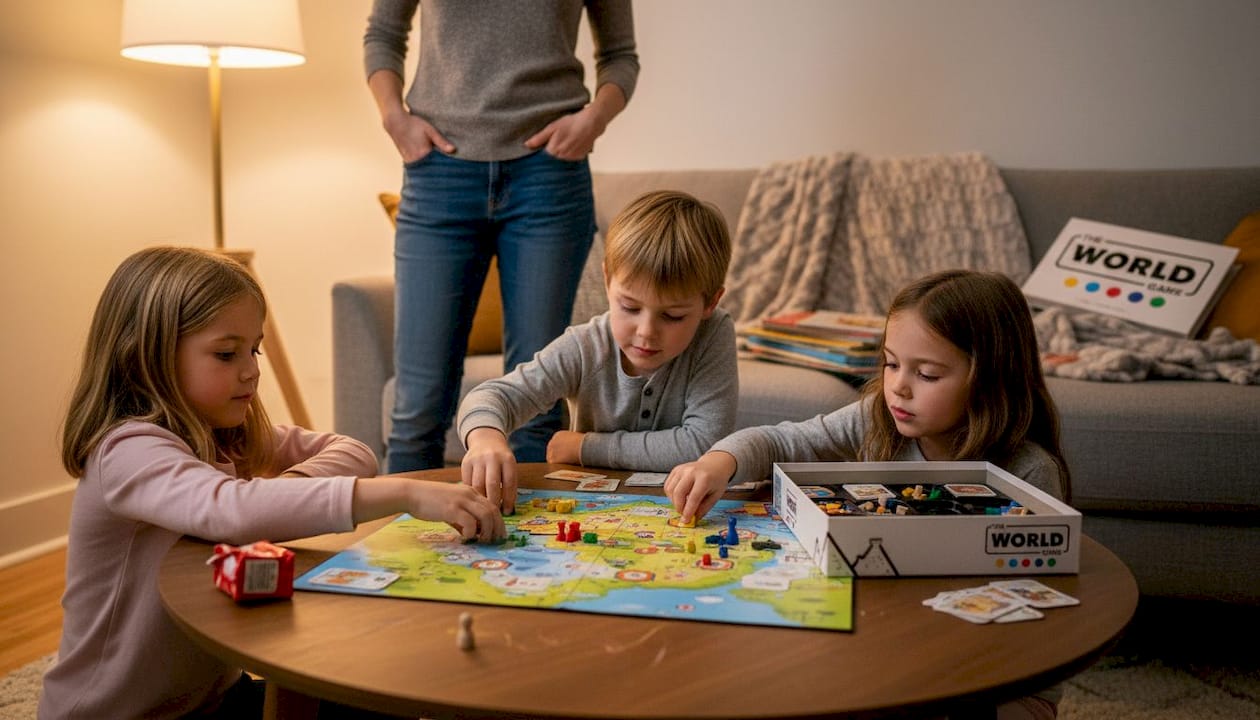
| Game Type | Social Behavior Impact | Cognitive Benefits | Best Age Range |
|---|---|---|---|
| Cooperative board games | High sharing, teamwork, reduced conflict | Strong numeracy gains, problem-solving | 4-7 years |
| Competitive card games | Moderate sharing, resilience building | Pattern recognition, memory | 5-8 years |
| Turn-taking dice games | High patience, basic sharing | Counting, probability concepts | 3-5 years |
| Team challenge games | Very high collaboration, communication | Strategic thinking, planning | 6-9 years |
The cognitive skills enhanced through group games extend beyond mathematics:
- Counting and number recognition through moving pieces and tracking scores
- Pattern recognition by identifying sequences and matching elements
- Strategic thinking when planning moves and anticipating outcomes
- Memory development by remembering rules and previous plays
- Executive function skills like impulse control and flexible thinking
Games engage kids in learning without the pressure of formal instruction. A child who resists math worksheets will often count enthusiastically when moving their game piece toward a goal. The fun context transforms practice into play, making skill development feel effortless. This emotional engagement actually enhances retention, as positive feelings during learning create stronger neural connections.
Modern board and card games designed for families often incorporate multiple skill areas simultaneously. A single game might require counting spaces, recognizing colors or shapes, taking turns politely, and working together toward a shared objective. This multi-layered learning maximizes the educational value of each play session while keeping kids entertained.
Parents sometimes worry that games are just entertainment without real learning value, but research consistently proves otherwise. The key is choosing games with clear learning objectives embedded in engaging mechanics. Look for games where the core actions, like counting spaces or matching patterns, align with skills you want to develop. When learning is inseparable from gameplay, kids practice without even realizing they’re building social and academic skills simultaneously.
Facilitating successful group activities: tips for parents
Knowing the benefits of group activities is one thing, but creating successful play experiences requires intentional facilitation. Follow these steps to maximize your children’s growth during group play:
-
Choose age-appropriate games by checking recommended age ranges and observing your child’s attention span and rule-following ability during initial plays.
-
Start with 2-3 children for first group experiences, as smaller groups reduce overwhelm and make turn-taking easier to manage.
-
Explain rules clearly before starting by demonstrating one complete round yourself while narrating each step in simple language.
-
Position yourself nearby but not hovering, ready to guide conflicts or confusion without controlling every interaction.
-
Encourage shy or hesitant children by allowing them to watch one full game before joining, or letting them be your “partner” initially.
-
Celebrate cooperative moments explicitly by pointing out when kids help each other or share generously, reinforcing positive behaviors.
-
Keep sessions short, ending games while energy is still high rather than pushing through to frustration or boredom.
Adjusting game complexity to match your child’s developmental stage prevents frustration and maintains engagement. For 3-4 year olds, choose games with simple one-step actions, bright visual cues, and quick rounds. These children need immediate gratification and can’t sustain focus through lengthy explanations. Games where each turn takes 10-20 seconds work best.
Children aged 5-6 can handle more sophisticated rules and longer wait times between turns. They can remember sequences, follow conditional rules like “if you roll a six, take another turn,” and engage in basic strategy. The research is clear: tailoring activities to age, with simple tasks for 3-4 year olds and complex challenges for 5-6 year olds, maximizes developmental benefits.
Shy or reluctant children need special consideration during group activities. Forcing participation often backfires, creating negative associations with group play. Instead, experts recommend gradual entry through observation and parallel play. Let your shy child sit beside the game and watch without pressure to join. Many children warm up after seeing others have fun and will ask to participate once they understand the flow.
Parallel play, where a child plays alongside but not directly with others, serves as a comfortable middle step. Your shy child might sort their own cards or roll dice without taking official turns, gradually becoming part of the group’s energy without the spotlight of active participation. This approach respects their temperament while still exposing them to social learning opportunities.
Creating a supportive environment means praising effort over outcomes and normalizing mistakes. When a child forgets a rule or makes a wrong move, respond with gentle correction rather than criticism. Model the language you want kids to use with each other by saying things like “Let’s try that again” or “Good thinking, and here’s another way to do it.” Your tone sets the emotional temperature for the entire group.
Incorporating modern board and card games keeps activities fresh and aligned with current interests. Today’s family games often feature themes from popular culture, vibrant artwork, and mechanics that feel more dynamic than classic games from previous generations. Kids respond enthusiastically to games that feel relevant to their world, increasing their willingness to engage repeatedly.
Pro Tip: Rotate games every 2-3 weeks even if your kids still enjoy the current favorite. Variety prevents skill plateaus and maintains novelty, which drives engagement. Keep 4-5 games in rotation so returning to an old favorite after a break feels exciting rather than repetitive. This strategy also exposes children to different types of thinking and social interactions, broadening their developmental gains.
The facilitation strategies that work best acknowledge that you’re creating a learning environment disguised as fun. Your goal isn’t to teach explicitly but to structure experiences where social and cognitive growth happen organically. When you master this balance, games build teamwork and skills without feeling like lessons, making kids eager to play again and again.
Explore fun and educational group games at The World Game
Now that you understand how group activities shape your child’s social and cognitive development, finding the right games becomes the next step. The World Game offers a curated collection of board and card games specifically designed for family play, with many options perfect for building the teamwork and social skills we’ve discussed throughout this article.

Our selection focuses on fast, engaging games that keep young children interested while delivering genuine learning value. Whether you’re looking for cooperative challenges that require teamwork, quick card games for short attention spans, or skill-building activities that make counting and pattern recognition fun, you’ll find options that match your family’s needs. Each game in our collection balances educational benefits with entertainment, so kids ask to play again without realizing they’re practicing essential skills.
Browse games organized by type, age range, and group size to find perfect fits for your children’s developmental stage. Many families start with our party game selections, which excel at building social skills through laughter and interaction. As your kids grow, explore our challenge and strategy games that introduce more complex thinking while maintaining the cooperative spirit that makes group play so valuable.
Visit The World Game to discover how the right games transform ordinary playtime into powerful learning experiences. Our modern approach to family gaming means you get products designed for real game nights at home, not classroom settings, with the fun factor that keeps everyone coming back for more. Start building your collection today and watch your children’s teamwork and social abilities flourish through play.
Frequently asked questions
What age is best to start group activities for kids?
You can introduce simple group activities as early as age 3, when children begin understanding basic turn-taking and can follow one-step rules. At this age, keep groups small with 2-3 children and choose games with quick turns and clear visual cues. By age 4-5, kids can handle slightly more complex cooperative games with multiple steps, and by age 6, they’re ready for strategic thinking and longer play sessions. The key is matching activity complexity to developmental stage rather than waiting for a perfect age.
How do group games help shy children participate?
Group games provide structured social interaction with clear rules and predictable patterns, which reduces anxiety for shy children compared to unstructured play. Allowing shy kids to observe one or two complete games before joining helps them understand expectations without pressure. Many shy children feel more comfortable participating when they can predict what will happen next, and games provide this predictability. Adult facilitation that gently includes quieter children without forcing them into the spotlight creates safe opportunities for gradual social engagement and confidence building.
What types of games are best for building teamwork?
Cooperative board and card games where all players work toward a shared goal build teamwork most effectively. Look for games where players must communicate, share resources, and coordinate actions to succeed together rather than competing against each other. Games with roles or special abilities for each player teach children that different strengths contribute to group success. Avoid games with player elimination, as they remove learning opportunities for kids who get out early. The best teamwork games create situations where helping others directly benefits yourself, reinforcing collaborative thinking.
How long should a typical group activity session last for young kids?
For children aged 3-4, keep group activity sessions to 10-15 minutes maximum, as their attention spans are naturally short and they fatigue quickly in social situations. Kids aged 5-6 can typically sustain focus for 20-30 minutes if the activity maintains their interest. Watch for signs of restlessness or frustration rather than adhering strictly to time limits, and end sessions while energy is still positive. Playing multiple short sessions throughout a week builds skills more effectively than one long session, as frequent practice with breaks for processing enhances learning and prevents burnout.
Can group games improve academic skills?
Yes, research demonstrates that group games, particularly board games, significantly improve academic skills like numeracy, with a 76% probability of gains in counting and number recognition. Games create engaging contexts where children practice math, literacy, and problem-solving without the pressure of formal instruction. The social element adds motivation, as kids want to keep playing with friends, which translates to more practice time than solitary worksheets would generate. Pattern recognition, strategic thinking, memory, and executive function skills all improve through regular game play, giving children cognitive advantages that transfer directly to classroom performance and standardized assessments.