


TL;DR:
- Simple, monomechanical games with quick setup and low learning curves foster genuine fun and connection. They are inclusive, scalable, and ideal for family, casual, or mixed groups, enhancing social bonding through accessible gameplay. Choosing these games ensures memorable, low-stress game nights that everyone can enjoy and repeat effortlessly.
Some of the most memorable game nights we’ve ever had didn’t involve a towering stack of rulebooks or a three-hour setup. They involved a simple deck of cards, a kitchen table full of laughing adults, and a game someone learned in under five minutes. Easy board games get a bad reputation for being “just for kids,” but that couldn’t be further from the truth. The right simple game can generate more genuine fun, more laughter, and more real connection than a complex strategy marathon ever could.
Table of Contents
- Core mechanics that make games easy
- Why simplicity matters for families and social groups
- Simple vs. complex: Board game comparison
- Strategic depth without complexity
- How to choose your next easy board game
- The overlooked advantage of easy board games
- Find your perfect easy-to-learn board game
- Frequently asked questions
Key Takeaways
| Point | Details |
|---|---|
| Simple rules are key | Games with one main mechanic are easier for everyone to jump into and enjoy quickly. |
| Family appeal matters | Non-confrontational, accessible games best suit groups and foster positive social play. |
| Easy can still be deep | Straightforward games often include surprising strategic opportunities and fun. |
| Compare before you buy | Use checklists and side-by-side comparisons to pick the best fit for your group. |
| Start simple for fun | Choosing lighter games ensures everyone has a good time—no experience required. |
Core mechanics that make games easy
Now that we’ve questioned the whole idea that easy equals boring, let’s get into what actually makes a game easy to pick up in the first place.
The single biggest factor? The core mechanic. A game’s mechanic is the fundamental action players repeat throughout play. When a game relies on just one primary mechanic, the learning curve practically disappears. Game design experts call this a “monomechanical” design, and it’s the backbone of most beloved classics. Simple mechanics make board games easy, with monomechanical designs relying on one core rule set that anyone can grasp in seconds.
Think about it this way:
- Uno: Match a color or a number. That’s it. The whole game.
- Connect Four: Drop a disc, connect four in a row before your opponent does.
- Checkers: Move diagonally, jump over pieces to capture them. Done.
Each of these games has layers of subtle strategy, but the entry point is almost zero. You explain the game in two sentences and you’re playing. That’s the magic of how straightforward rules help new players get into the fun without the dreaded rulebook panic.
“The best party games teach themselves. If you need to explain it twice, you’ve already lost the room.”
Beyond just the mechanic itself, component count matters too. Games with fewer physical pieces, cards, or tokens are quicker to set up and put away. That sounds minor until you’re at 10 PM with a bunch of tired adults who want one more round but don’t want to manage a hundred little cardboard tokens.
Pro Tip: When shopping for game night, check the box for a “setup time” indicator or read reviews specifically mentioning how fast you can get started. Games that hit the table in under five minutes consistently see more repeat plays.
Why simplicity matters for families and social groups
Once you recognize the importance of basic mechanics, it’s essential to consider the social context in which easy games shine most.
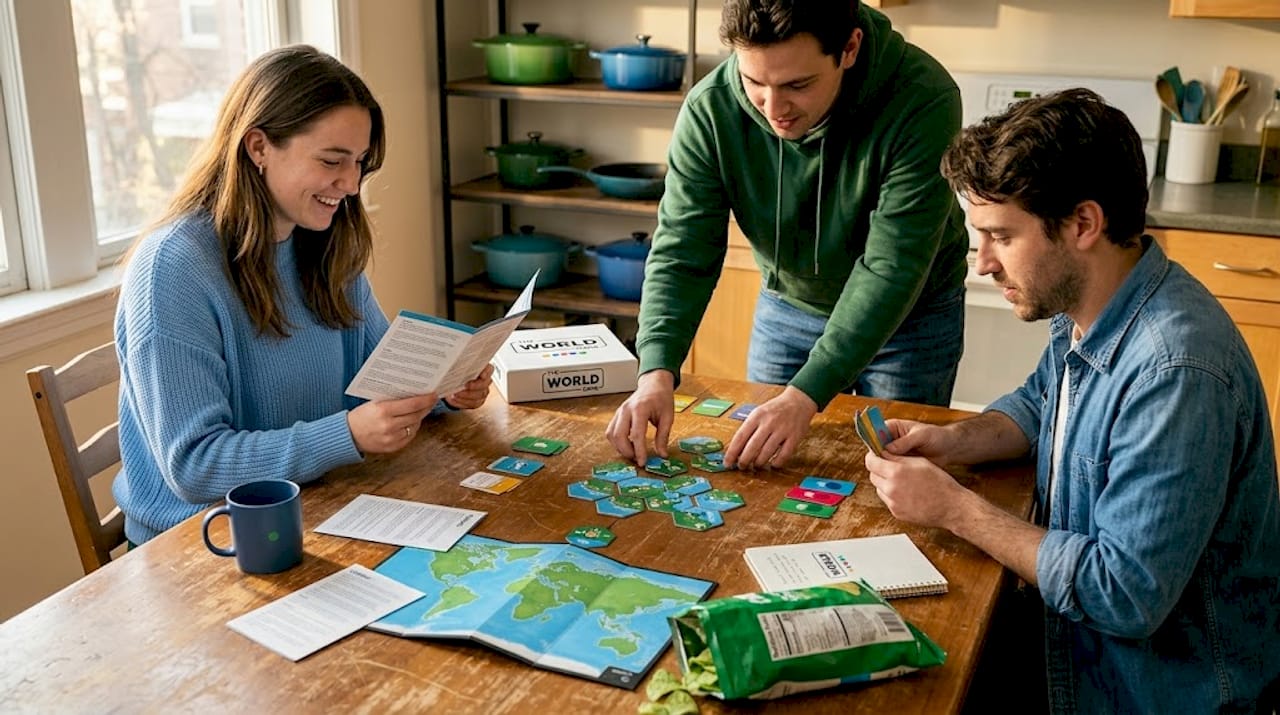
Here’s a truth that doesn’t get said enough: the best family game isn’t the most educational one or the one with the most beautiful artwork. It’s the one where everyone at the table is actually having fun and no one is sitting out because they don’t understand what they’re supposed to do. Easy games solve this problem naturally because the rules don’t exclude anyone.
As game designer Elizabeth Hargrave has noted about family game design, non-confrontational mechanics and scalable complexity are what truly suit families and casual groups. When a game doesn’t pit one player aggressively against another, everyone feels safer jumping in. Nobody feels ganged up on, and nobody quits early in frustration.
Research backs this feeling up. About 90% of families report preferring accessible, easy-to-learn games for their regular gatherings, making simplicity the number one feature families actually look for. That’s a stat worth paying attention to when you’re choosing your next game.
Here’s a simple process we use when picking a game for a mixed group:
- Consider your youngest or newest player first. If they can engage fully, everyone else definitely can.
- Check the recommended age range on the box. Age 8 and up usually means it’s genuinely accessible for adults too, not dumbed down.
- Read the setup instructions. If setup takes longer than five minutes, factor that into your evening.
- Look for games that scale to your group size. A game that works for three players AND eight players is worth its weight in gold.
- Ask yourself if someone can jump in mid-game if they arrive late. This is especially useful for parties.
When a game passes all five of these filters, you’ve probably found a winner. Family-friendly board games consistently share these traits: they’re inclusive, flexible, and forgiving of the learning curve.
The social glue factor is real. Easy games create an environment where conversation happens naturally because no one is studying a complex tableau. People make jokes, tell stories, and actually connect. That’s the whole point of game night, isn’t it?
Simple vs. complex: Board game comparison
After understanding why simplicity works for groups, let’s compare how easy and complex games actually measure up across different situations.
| Feature | Easy board games | Complex board games |
|---|---|---|
| Setup time | Under 5 minutes | 15 to 45+ minutes |
| Rules length | One page or less | Full rulebook, multiple pages |
| Learning curve | Minutes | Hours to sessions |
| Playtime | 15 to 45 minutes | 1 to 4+ hours |
| Best group size | Any (flexible) | Usually set number |
| Social energy | High, everyone talks | Focused, quieter |
| Replay appeal | Immediate | Builds over time |
| Best for | Parties, family nights, casual gatherings | Dedicated hobbyists, game clubs |
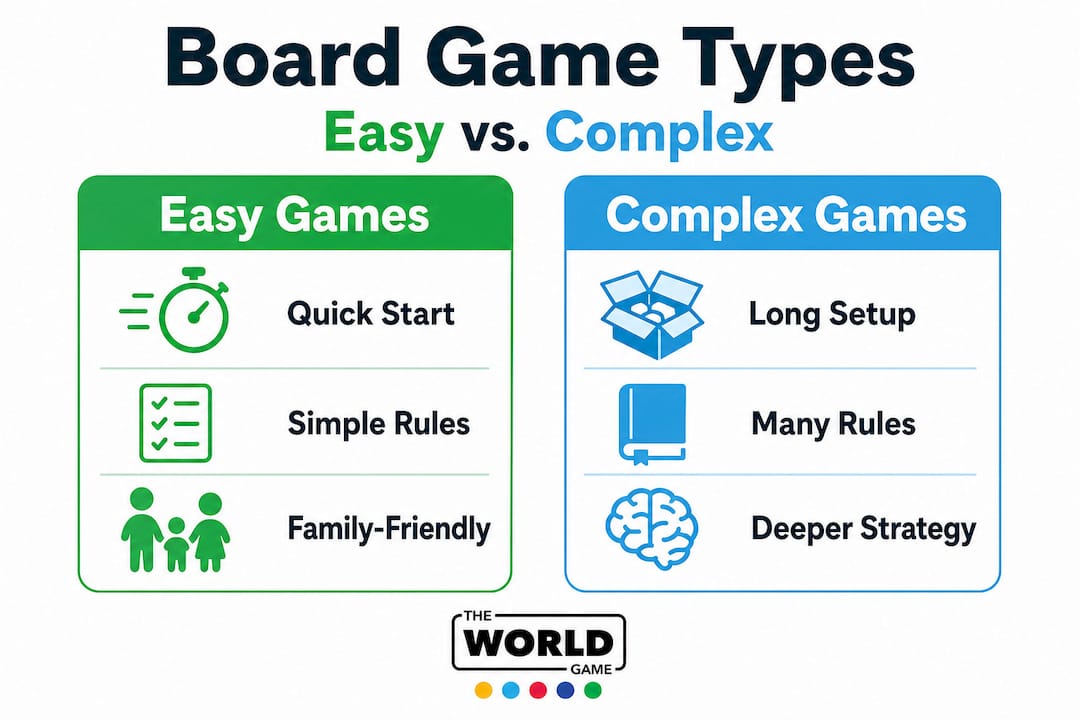
As monomechanical vs. multi-mechanic game structures show, simple games perform better for casual play while multi-mechanic games offer greater long-term replayability but carry a much steeper entry point.
Easy games shine in these moments:
- It’s a weeknight and you have 30 minutes before bed
- You’re hosting a party with guests who don’t normally play games
- Kids and grandparents are both at the table
- Someone is trying board games for the very first time
- You want something quick between rounds of a bigger game
Complex games are a better fit when:
- Your group commits to a regular game night every week
- Everyone at the table is already familiar with the game
- You have a full evening dedicated entirely to playing
- Your group actively enjoys learning rules as part of the hobby
Neither type is better across the board (pun intended). But for the step-by-step guide to easy board games and the majority of real home game nights, simple wins almost every time.
Strategic depth without complexity
Understanding the differences between game types, you might wonder if easy games can still be genuinely interesting. The answer is a confident yes, and here’s why.
There’s a concept in game design called the depth-to-complexity ratio. A game with a high depth-to-complexity ratio gives you simple rules but strategic depth without overwhelming players. Think of it like chess in reverse: instead of a complex game with deep strategy, you get a simple game that still rewards smart thinking.
Ticket to Ride is a perfect example. The rules fit on a single sheet of paper. You draw cards, collect colored trains, and try to connect cities on a map. Simple. But the decisions you make about when to block a route, when to extend your network, and when to grab that last critical connection? Those create genuinely tense, exciting moments that keep groups coming back for years.
Carcassonne works the same way. You flip a tile, you place it on the table, and you decide whether to put your little wooden meeple on it. That’s the whole game at its core. Yet experienced players think several moves ahead, managing multiple scoring opportunities at once.
“Easy to learn doesn’t mean easy to master. The best games in the world give beginners a fair shot and still give experts something to think about.”
This is what separates a great easy game from a throwaway one. A truly excellent game scales its challenge naturally. New players have a good time because they’re not overwhelmed. Experienced players have a good time because the decisions keep them engaged. Everyone wins.
Pro Tip: Look for games that list “easy to learn, hard to master” in their descriptions. This phrase signals a high depth-to-complexity ratio, which almost always means more replay value and broader appeal across your whole group.
How to choose your next easy board game
To put all this knowledge into practice, here’s how to pick a game everyone will enjoy at your next get-together.
Use this quick checklist when evaluating a new game:
| Trait | What to look for |
|---|---|
| Rules length | Fits on one to two pages |
| Setup time | Under five minutes |
| Group size | Supports your expected number |
| Age range | Matches your youngest player |
| Play time | 20 to 45 minutes |
| Replay value | Fresh enough to play twice in one night |
Here’s our go-to process for choosing the right game:
- Name your group. Adults only? Mixed ages? First-timers? Your group defines everything else.
- Set a time limit. Knowing you have 45 minutes versus two hours changes which games work.
- Browse reviews with your group in mind. Look specifically for comments from people playing with the same type of group you have.
- Watch a five-minute playthrough video. Seeing a game in action tells you more than any written description ever could.
- Check if a free print-and-play or demo version exists. Some publishers offer these so you can try before you buy.
- Trust the classics. Games like Just One, Sushi Go!, and Codenames are perennially popular for very good reasons. They check every box on the list above.
Just One is a cooperative word-guessing game where everyone writes a one-word clue, and duplicate clues get eliminated before the guesser sees them. It sounds almost too simple. But the hilarious chaos of everyone trying to give unique clues is genuinely unforgettable.
Sushi Go! is fast, colorful, and uses a clever card-drafting mechanic (you pick a card, pass your hand, pick again) that anyone grasps after one round. It’s over in 15 minutes and you always want another round immediately.
Codenames has two teams competing to give one-word clues connecting multiple cards on a grid. The tension when your clue accidentally points to the assassin card is the stuff of game night legend.
As simple monomechanical designs show, games built around one clear rule consistently deliver the best experience for players of all experience levels. Always let why families choose simple board games guide your thinking when your group includes a mix of ages and backgrounds.
The overlooked advantage of easy board games
Here’s the thing nobody talks about in the board game hobby: complexity has become a status symbol in some circles. Heavier games with enormous rule books and intricate strategies get praised as more “serious” or more “worthy.” We think this overlooks something really important.
Easy games level the playing field in a way nothing else can. When your teenager, your 70-year-old parent, and your non-gamer friend are all laughing together over the same game, that’s not a small thing. That’s genuinely rare. Complex games, for all their virtues, often create a two-tier experience: the person who knows the game well and everyone else who’s just trying to keep up.
We’ve had game nights where we pulled out something quick and simple because we were running short on time, and those turned into two-hour sessions because everyone just wanted to keep playing. Nobody was checking their phone. Nobody was waiting for their turn to be over. The simplicity created space for the people at the table to actually show up.
There’s also something to be said about the lasting bonds formed through games that don’t require a learning investment. When anyone can jump in, you end up playing more often, and more often means more memories. The best game isn’t always the most impressive one on the shelf. Sometimes it’s the one that actually hits the table.
Find your perfect easy-to-learn board game
Ready to bring people together with the right game? Take the next step in planning your most memorable, stress-free gathering yet.
We handpick every game in our collection specifically for groups who want fun without the friction. If you’ve ever pushed a game to the back of the shelf because setup took too long or someone got confused mid-round, we get it. That’s exactly why our lineup focuses on games that earn their place at the table by being genuinely enjoyable for everyone, from the casual player to the competitive one.

Whether you’re hosting a girls’ night, a family birthday, or a couples game night with no set agenda, we’ve got something that fits. Browse easy-to-learn board games and find the one that becomes your new go-to. Your next great game night is a lot closer than you think.
Frequently asked questions
What are some signs that a board game will be easy to learn?
Look for games with a single main rule, quick setup, and player guides that fit on one page. Simple monomechanical designs are the clearest sign you’ve found something genuinely accessible.
Why do families prefer easy board games?
Easy games are welcoming for all ages and help everyone enjoy the experience together. Non-confrontational mechanics and scalable complexity are exactly what make these games such reliable family favorites.
Can a simple board game still offer engaging strategy?
Yes, many easy games give plenty of room for clever moves despite having straightforward rules. A high depth-to-complexity ratio means simple rules can still reward smart thinking over many plays.
What’s a recommended easy game for a group of adults?
Codenames is a popular choice for adults, blending simple one-word clue mechanics with team play for genuinely exciting moments. It scales easily from four to ten players and works great at parties or casual game nights.