


TL;DR:
- Game-based learning uses real games to teach skills through mechanics, rules, and narratives.
- Well-designed GBL promotes retention, problem-solving, collaboration, and emotional development.
- Family game nights with purposeful, balanced games foster connection, learning, and lifelong skills.
Most people hear “game-based learning” and picture a kid tapping through a math app on a tablet. But here’s the thing: some of the most powerful learning moments we’ve ever seen happen around a real table, with real cards in hand, and the whole family laughing (or groaning) together. Game-based learning, or GBL, is not a digital-only concept, and it is definitely not boring. It is a research-backed approach that turns gameplay into genuine skill-building. In this article, we’ll walk you through what GBL actually is, how its mechanics work, what the research says, and how your next game night can be both ridiculously fun and surprisingly educational.
Table of Contents
- What is game-based learning?
- Key mechanics that make learning fun
- The real-world impact: How game-based learning boosts results
- How to use game-based learning at family game night
- What to watch out for: Pitfalls and expert guidance
- Our perspective: The family table is the true classroom
- Bring engaging game-based learning home
- Frequently asked questions
Key Takeaways
| Point | Details |
|---|---|
| Game-based learning defined | Game-based learning uses gameplay mechanics, rules, and stories to support real learning and engagement. |
| Analog games excel | Board and card games offer fun, social learning opportunities that strengthen family and group bonds. |
| Proven results | Research shows GBL boosts motivation, retention, and problem-solving more than traditional study. |
| Practical application | Families can maximize GBL by picking the right games, aligning them with learning goals, and reflecting together after play. |
| Mind common pitfalls | Avoid mismatched objectives and over-competition by choosing inclusive games and balancing challenge. |
What is game-based learning?
Game-based learning (GBL) is exactly what it sounds like: using actual games as the primary vehicle for learning. But there’s an important distinction worth making right away. GBL is not the same as gamification. Gamification means layering game-like elements, think points, badges, or leaderboards, onto existing activities to boost motivation. GBL goes deeper. As Flip Education explains, “game-based learning uses games as the main vehicle for learning objectives, tied to mechanics, rules, and narratives.” In other words, the game itself is the lesson.
In a true GBL experience, you cannot win without actually engaging with the content. A trivia game about world geography means you need to know world geography to score points. A cooperative strategy game teaches resource management because the game mechanics demand it. The learning is baked into the structure of play, not bolted on afterward.
“The difference between GBL and gamification is engagement depth. Gamification motivates. GBL teaches.”
Here’s a quick breakdown of what makes GBL tick:
- Rules and structure: Clear rules create a safe space to experiment and fail without real-world consequences.
- Feedback loops: Immediate results (you won that round, or you didn’t) tell players what’s working.
- Narrative and context: A story or theme gives meaning to decisions and makes content memorable.
- Interactive challenges: Players must apply knowledge or skills, not just recall them.
GBL can absolutely be digital, but analog games (board games, card games, dice games) are having a genuine moment right now. Families are rediscovering that a well-designed card game teaches just as much as any app, and it comes with eye contact, laughter, and zero screen time. Understanding educational game design helps you see why some games just click while others fall flat. The difference between gamification and GBL is worth understanding before you pick your next game night title.
Key mechanics that make learning fun
Now that you know what GBL is, let’s see how its pieces create excitement and educational value during gameplay.
The magic of GBL lives in its mechanics. These are the rules, systems, and structures that shape how a game is played. When mechanics are well-designed, they pull players into a state of focused engagement that researchers call “flow,” where the challenge is just hard enough to be exciting but not so hard that you give up.
Key mechanics include challenges, points, levels, badges, rewards, progression systems, feedback loops, resource management, and narratives that foster engagement, critical thinking, problem-solving, collaboration, and flow states. Here’s how those show up in real family game nights:
| Mechanic | What it teaches | Family game example |
|---|---|---|
| Points and scoring | Math, strategy, prioritization | Trivia and word games |
| Challenges and tasks | Problem-solving, quick thinking | Party challenge games |
| Resource management | Planning, budgeting decisions | Strategy card games |
| Narrative and theme | Empathy, context, storytelling | Cooperative adventure games |
| Feedback loops | Self-correction, resilience | Any game with instant results |
Progression is a big one. When players can see themselves improving, round by round, they stay motivated. That’s why games with escalating difficulty or unlockable rounds keep everyone at the table longer. Narrative matters too, especially for mixed-age groups. A game with a fun theme (say, you’re all running a chaotic food truck) gives younger players a reason to care about the outcome even if they don’t fully grasp the strategy yet.
Teamwork mechanics are particularly powerful for families. Cooperative games, where everyone wins or loses together, eliminate the “sore loser” problem and encourage communication across age gaps. When aligning mechanics and narrative in a game’s design, the result is something that feels effortless to play but is quietly building real skills the whole time.
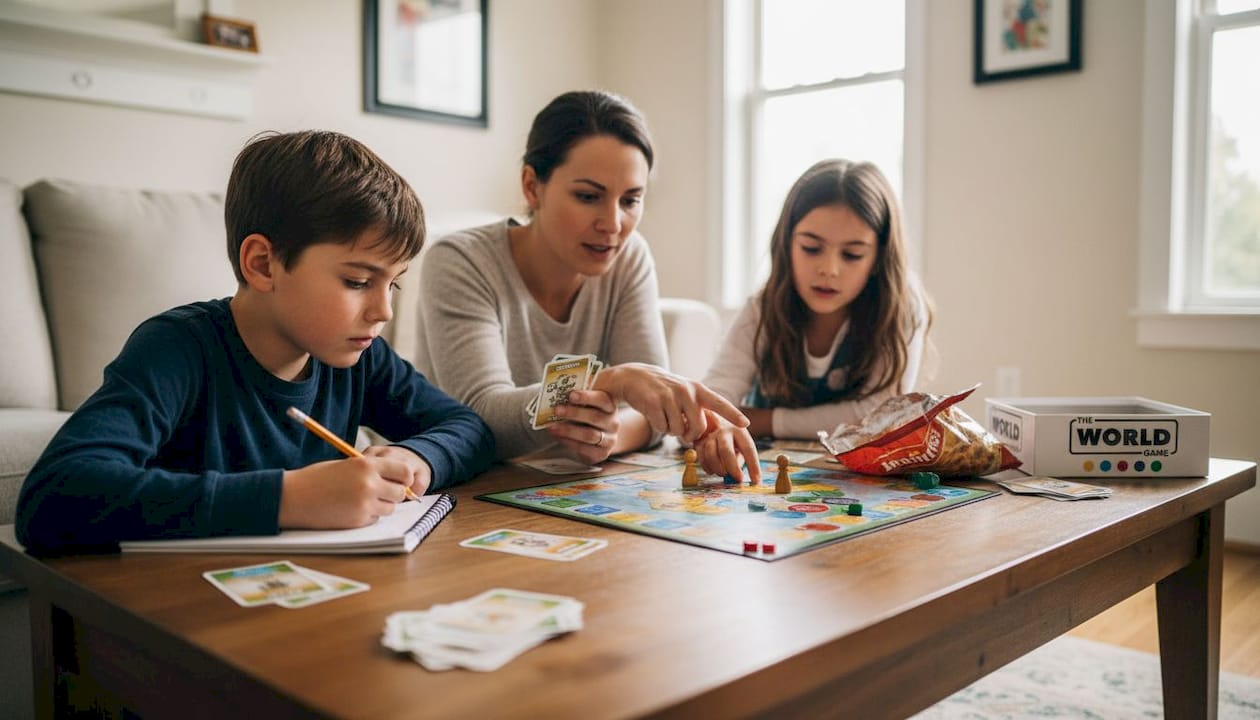
Pro Tip: Look for games that balance challenge and skill level for your group. If a game is too easy, people check out. Too hard, and frustration sets in. The sweet spot is where everyone feels capable but still has to think.
The real-world impact: How game-based learning boosts results
Understanding the mechanics is just the start. Let’s look at what research and experience say about GBL’s actual results.
The numbers here are genuinely impressive. Meta-analyses show that GBL improves learning outcomes, problem-solving, and retention, with notable gains especially in STEM subjects where standardized mean differences (SMDs) can reach up to 1.26. That’s a significant jump. Retention rates in GBL environments improve by up to 40% compared to traditional instruction methods. That means kids (and adults) remember more of what they learned when they learned it through play.
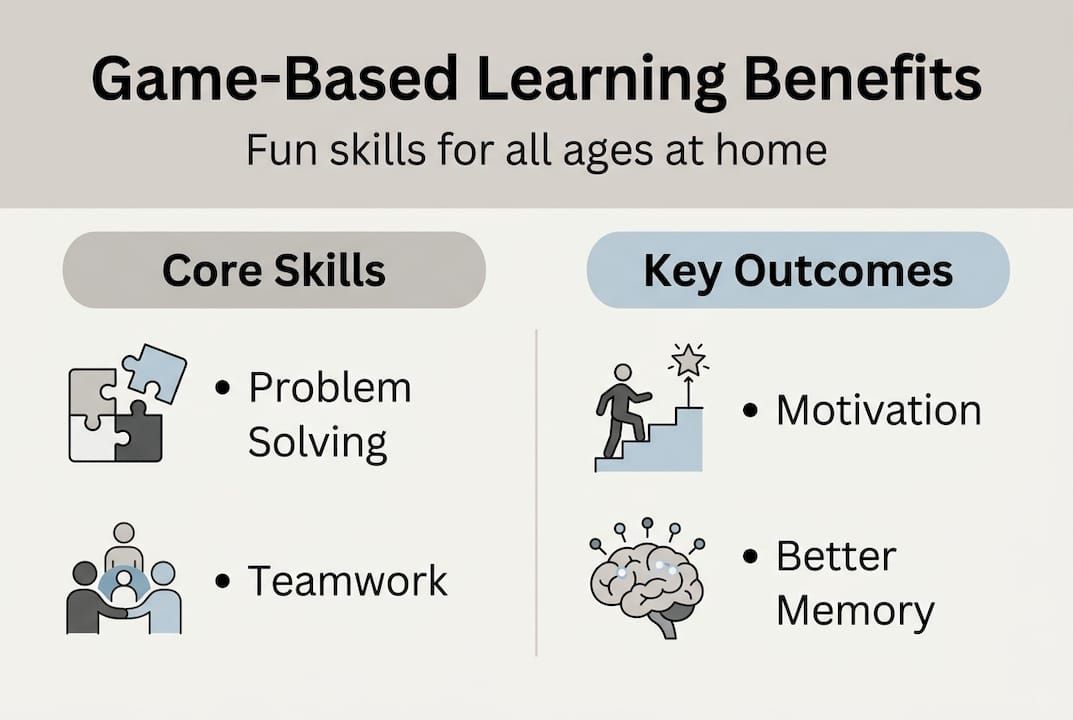
For families specifically, the benefits go well beyond test scores. Board games for family bonding create an atmosphere where learning feels like a side effect of having fun, which is exactly when it sticks best.
GBL vs. traditional learning: a quick comparison
| Outcome | Traditional methods | Game-based learning |
|---|---|---|
| Motivation | Moderate (external) | High (intrinsic) |
| Retention | Baseline | Up to 40% higher |
| Engagement | Passive | Active and social |
| Collaboration | Limited | Built into gameplay |
| Emotional connection | Low | High (shared experience) |
The social benefits of analog games are especially worth noting. Physical games create face-to-face interaction that digital tools simply cannot replicate. Here are three ways family games go beyond knowledge-building:
- Empathy: Taking turns, reading the room, and managing wins and losses gracefully all build emotional intelligence.
- Communication: Explaining your strategy, negotiating, and debating answers sharpens verbal skills naturally.
- Teamwork: Cooperative and team-based games teach players to combine strengths and cover for each other’s weaknesses.
These are not soft skills. They are the foundation of how people work, lead, and connect throughout their lives.
How to use game-based learning at family game night
Want to bring this home? Here’s how your next game night can double as a fun, powerful learning experience.
The good news is you don’t need a lesson plan or a teaching degree. You just need the right game and a little intention. Best practices for GBL include aligning mechanics to goals, balancing challenge and skill, debriefing for reflection, and combining play with real teaching moments. Here’s how that looks in practice:
- Pick a game with purpose. Look for games where the content or skill you want to practice is embedded in the mechanics, not just slapped on as a theme. A game about communication should actually require players to communicate to win.
- Set a loose intention. You don’t need to announce “tonight we’re learning empathy.” Just notice what the game naturally encourages and lean into it during play.
- Play it through. Let the game do its work. Resist the urge to pause and lecture. The mechanics will teach if you let them.
- Debrief afterward (briefly). Ask one or two questions after the game: “What was the hardest decision you made?” or “What would you do differently?” This reflection is where learning cements itself.
- Adapt for your group. Modify rules for younger players, allow team-ups for mixed ages, or play a practice round before the real game starts.
Spotting a game with meaningful mechanics is easier than it sounds. Ask yourself: does winning this game require actual thinking, or is it mostly luck? Games that reward strategy, communication, or knowledge retention are your GBL gold. Strengthening family bonds with games is a natural outcome when the game itself creates shared challenges and shared wins.
Pro Tip: Choose cooperative or team-based games when your group includes big age gaps. When everyone is working toward the same goal, younger players feel included and older players naturally step into mentorship roles.
What to watch out for: Pitfalls and expert guidance
But like any tool, GBL is most effective when used wisely. Here’s how to steer clear of common pitfalls.
Not every game night becomes a learning win. Sometimes the game is wrong for the group, the competition gets too heated, or the whole thing just feels like homework with dice. Outcomes depend on the alignment of mechanics to objectives and game design quality, and edge cases include over-competition causing anxiety or reduced collaboration. Here’s what to watch for:
“Poor alignment between game mechanics and learning goals yields variable results. Design matters as much as intention.”
The most common pitfalls families run into:
- Mismatched difficulty: A game that’s too complex for younger players or too simple for older ones kills engagement fast.
- Over-competition: When winning becomes the only goal, the learning evaporates and someone usually ends up upset.
- Luck-heavy games: Games that rely almost entirely on chance don’t build skills. They’re fun, but they’re not GBL.
- No reflection: Skipping the post-game conversation means missing the moment when learning actually locks in.
- Forcing it: If the game feels like a chore, it’s not working. Fun is not optional in GBL. It’s the whole mechanism.
Here’s a simple do’s and don’ts list to keep your game nights on track:
Do: Choose games where all players can contribute meaningfully. Encourage collaboration over cutthroat competition. Rotate game choices so everyone gets a favorite. Celebrate creative thinking, not just winning.
Don’t: Use games as a reward or punishment. Pick games that only suit one age group. Ignore frustration signals. Let one player dominate every session.
Avoiding competition pitfalls is especially important in family settings where the goal is connection, not a leaderboard. Adjust rules freely. House rules are not cheating. They’re smart design.
Our perspective: The family table is the true classroom
With practical steps covered, here’s our candid take on what matters most.
We’ll be honest: in a world full of apps, platforms, and “educational” screen time, the humble board game is quietly doing something that technology struggles to replicate. When you sit around a table with people you love (or at least like), something different happens. You read faces. You negotiate. You celebrate together and groan together. That’s not just fun. That’s learning at its most human.
We think analog GBL is underrated precisely because it looks too simple. There’s no algorithm, no progress bar, no notification. Just people, a game, and a shared experience. And that simplicity is the point. Real family gaming stories consistently show that the games people remember years later are the ones played around a real table.
The families who use game night intentionally, even loosely, tend to build something rare: a habit of curiosity, laughter, and connection that no app can fully replace. The simplest card game can spark a conversation that lasts long after the cards are put away.
Bring engaging game-based learning home
Ready to try game-based learning for yourself? Here’s your next step.
We’ve seen firsthand how the right game transforms a regular Tuesday night into something everyone talks about the next day. The research backs it up, the mechanics explain it, and honestly, the laughter seals the deal. Game-based learning is not a school concept. It’s a family superpower.

At Playworldgame.com, we’ve curated a collection of fast, social card and card games built exactly for this kind of play. Whether you want trivia, cooperative challenges, conversation starters, or pure party chaos, we’ve got something that fits your crew. Discover family game night ideas and find your next favorite game. Your table is waiting.
Frequently asked questions
How is game-based learning different from gamification?
Game-based learning requires players to genuinely engage with content to succeed, while gamification simply adds points or badges to existing activities without demanding true learning. GBL is the game. Gamification decorates the lesson.
Can board and card games really help kids and adults learn?
Absolutely. Analog games boost retention, motivation, and critical skills while making the whole experience social and genuinely fun for everyone at the table.
What are the best practices for successful game-based learning at home?
Align mechanics to goals, balance challenge with skill level, and take a few minutes after play to talk about what everyone noticed or learned. That debrief is where it all clicks.
Are there risks to using game-based learning in family settings?
The main risks are mismatched learning goals and over-competition, both of which are easy to avoid by choosing well-designed games and keeping the focus on teamwork and shared fun over winning.