


TL;DR:
- Geography knowledge is crucial for understanding news, making decisions, and global awareness.
- Family-based geography games enhance retention, critical thinking, and family bonding through active play.
- Modern teaching shifts from memorization to reasoning, using active, game-based, and project-oriented methods.
Most American families would be surprised to learn just how significant the geography knowledge gap has become among young people. National assessments and surveys consistently show that college-aged Americans struggle to locate basic countries, capitals, and regions on a map. That gap matters way more than a trivia score. Geography shapes how we understand the news, make decisions, and connect with the wider world. The good news? You don’t need a classroom or a textbook to fix it. A great game night can do the heavy lifting, and honestly, it’s a lot more fun for everyone at the table.
Table of Contents
- Why geography knowledge matters in modern life
- How geography games transform learning for families
- How geography education methodologies have evolved
- From knowledge gaps to game night wins: Tips for making geography stick
- Our take: Beyond the map—what most families miss about geography education
- Turn family night into an adventure: Explore geography games together
- Frequently asked questions
Key Takeaways
| Point | Details |
|---|---|
| Geography shapes real-world choices | Understanding geography helps families make sense of current events, travel, and global connections. |
| Games boost learning and bonding | Geography games turn learning into fun, improve retention, and spark family competition and teamwork. |
| Modern methods engage all ages | Active, project-based, and game-driven learning suit kids and adults, making geography memorable for everyone. |
| Everyday opportunities abound | Reading, news, and even trips can become quick geography lessons with the right mindset and tools. |
Why geography knowledge matters in modern life
After highlighting the knowledge gap, let’s explore what makes geography relevant for everyone today. Geography is not just about knowing where France is. It’s the backbone of how we interpret almost everything happening around us.
When a news story breaks about a conflict, a trade dispute, or a natural disaster, your ability to place that event in a real-world context depends on geography. Geography education builds foundational knowledge essential for understanding history, politics, civics, and current events, enabling informed decision-making on issues like immigration, foreign policy, and environmental protection. Without that foundation, it’s easy to feel lost or, worse, to fall for misinformation.
Beyond the news, geographic literacy empowers individuals to interpret global systems, spatial relationships, human-environment interactions, supply chains, climate change, natural disasters, and disease spread. These aren’t abstract concepts. They’re the forces shaping your grocery prices, your weather, and your job market.
Here’s a quick look at what geographic knowledge actually supports in everyday life:
- Critical news literacy: Knowing where events happen helps you assess their significance and context.
- Environmental awareness: Understanding ecosystems and climate zones connects people to conservation decisions.
- Spatial reasoning: Reading maps, planning routes, and visualizing scale are practical daily skills.
- Global citizenship: Recognizing how countries relate to each other builds empathy and reduces bias.
- Tech independence: Heavy GPS reliance can erode natural spatial instincts, making map literacy more valuable than ever.
“Geography is the canvas on which history is painted.” Knowing the canvas makes the whole picture clearer.
We also love how why teach geography through games breaks down the connection between play and real geographic understanding. Geography isn’t a subject you finish in school. It’s a lens you carry everywhere.
How geography games transform learning for families
Understanding the value of geographic literacy, let’s see how families can bring learning to life right at the kitchen table. The secret is that games replace passive memorization with active play, and that changes everything about how knowledge sticks.
Family geography games like Continent Race, The World Game, and GeoBingo use mechanics such as card matching by continent and color, locating countries on maps, trivia on capitals, flags, and populations, and bingo-style play to engage multiple ages in learning countries, capitals, flags, and locations during game nights. Each mechanic targets a different learning style, so visual learners, competitive players, and cooperative thinkers all get something.
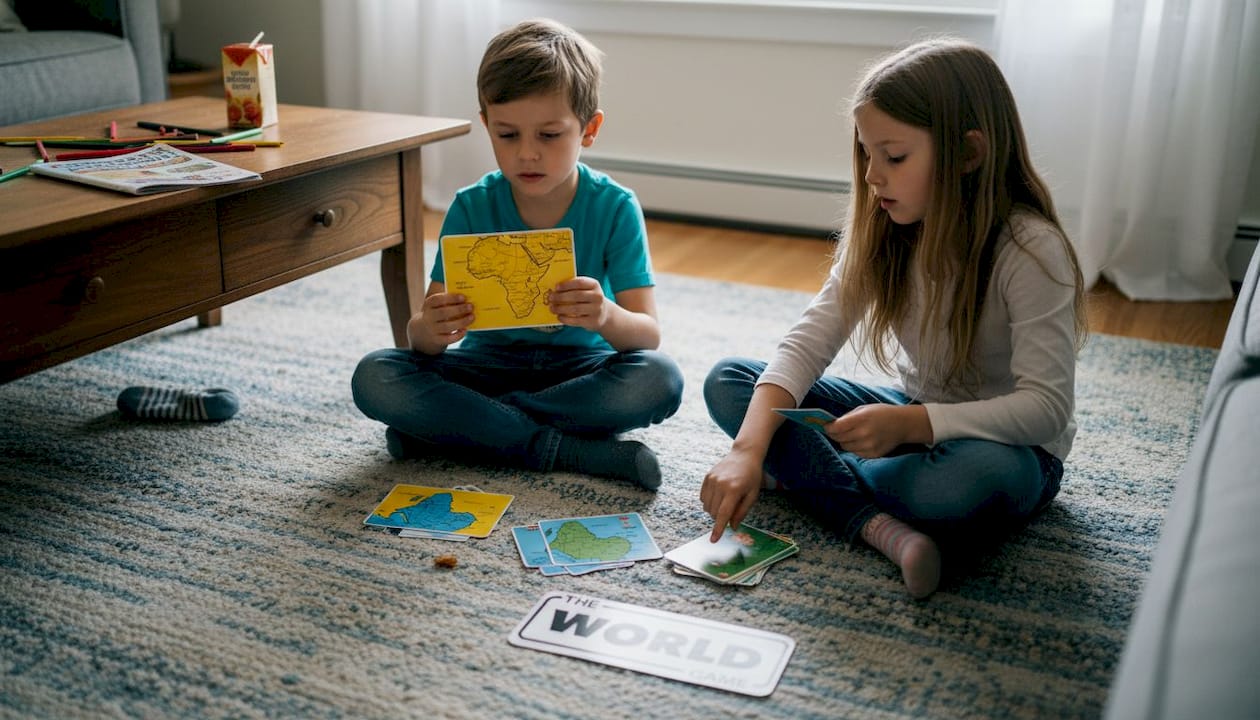
Game mechanics boost retention and critical thinking far more effectively than rote learning, while also strengthening family bonding. That’s a triple win: you’re learning, laughing, and connecting all at once.
Here’s a quick comparison of game styles and what they deliver:
| Game type | Core mechanic | Best for | Learning outcome |
|---|---|---|---|
| Continent Race | Color matching by region | Ages 6 and up | Continents, spatial grouping |
| The World Game | Draw a card, find it on a map | Ages 10 and up | Countries, capitals, locations |
| GeoBingo | Bingo with flags and facts | Mixed ages | Flags, country names, recognition |
| Trivia formats | Question and answer rounds | Teens and adults | Deep knowledge, current events |
Want to get the most out of your geography game nights? Here’s what works best:
- Start with mechanics that match your youngest player. Color-matching and picture-based games work great for younger kids.
- Layer in trivia as kids grow. Swap to flag or capital challenges once the basics are solid.
- Mix teams by age. Pairing older and younger players keeps it fair and sneaks in some mentoring.
- Rotate games regularly. Replayability matters. Games with randomized cards or map challenges stay fresh longer.
- Connect the game to something real. After playing, pull up a news story or a recipe from a country you just learned.
Pro Tip: Interactive books for kids pair beautifully with geography games. Reading about a country right after playing a game about it cements the knowledge in a totally different way.
For more on picking the right fit, check out why choose geography games for a breakdown of what to look for in a great family geography game.
How geography education methodologies have evolved
Building on the power of play, let’s examine how geography teaching has evolved to embrace active learning. The old model was pretty simple: memorize capitals, label a blank map, repeat. It worked for tests. It didn’t work for life.
Geography education methodologies have evolved significantly, moving through the High School Geography Project, the Five Themes framework, National Geography Standards (Geography for Life), and the Road Map for 21st Century Geography, with a strong emphasis on spatial thinking from early ages. Each shift moved further away from memorization and closer to reasoning.
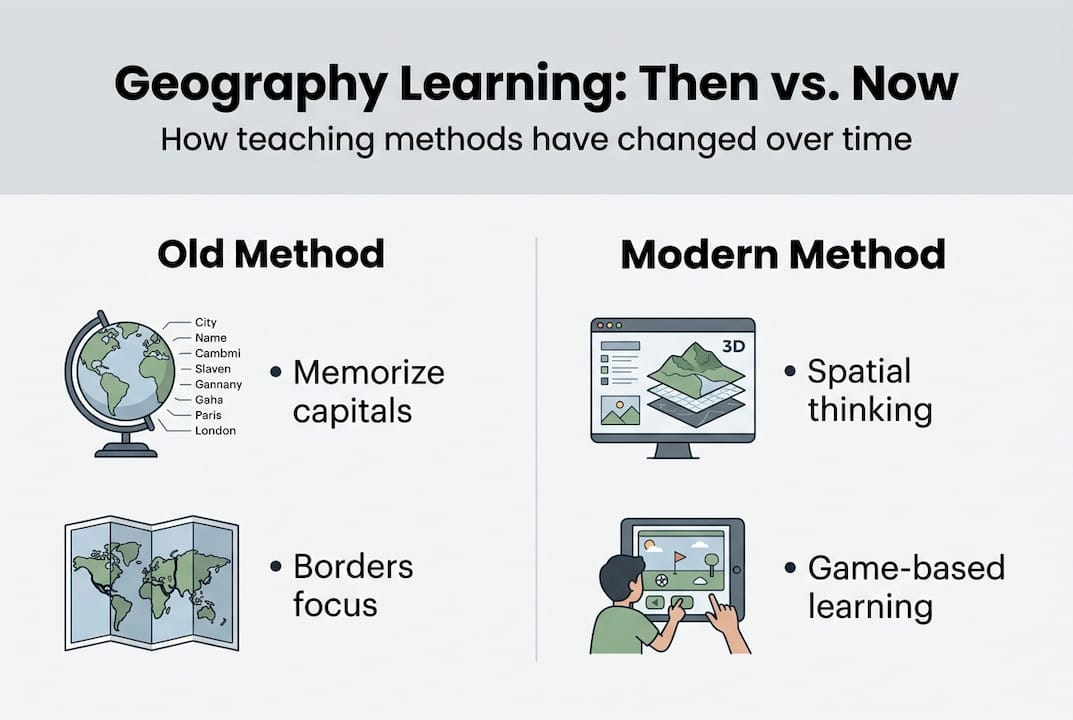
Here’s how the old and new approaches compare:
| Old methodology | Modern methodology |
|---|---|
| Memorize capitals and borders | Analyze spatial patterns and relationships |
| Map drills and labeling | Project-based and game-based challenges |
| Single correct answer focus | Open-ended critical thinking |
| Teacher-led instruction | Collaborative, student-driven exploration |
Active methods like games outperform lectures for building geographic attitudes and behavior, and experts recommend tools like daily globes, quiz bowls, and the Depth of Knowledge framework to push into higher-order spatial reasoning. That’s not just theory. Families see it play out in real time when a child who struggled with a map suddenly lights up during a fast-paced card game.
Modern geography games tap directly into these evolved frameworks. When kids match a card to a continent or race to find a country on a shared map, they’re practicing spatial analysis, not just recall. That’s exactly what the benefits of geography games research points to.
The shift also matters for educational success across all ages. When geography is framed as a living, dynamic subject rather than a static list of facts, learners of every age stay curious longer.
From knowledge gaps to game night wins: Tips for making geography stick
With new methods and games available, here’s how families can actively close the geography gap together. The best part? Most of these tips cost nothing and take almost no prep time.
Integrating geography with reading improves comprehension, especially for English language learners in elementary and middle schools. That means pulling out a globe during story time or pointing to a country on a map while reading the news isn’t just a nice touch. It’s genuinely effective.
Project-based learning in geography is more effective than traditional methods for developing environmental values, attitudes, and pro-environmental behavior in primary students. Games are a natural form of project-based learning. They’re hands-on, goal-oriented, and deeply engaging.
Here are practical ways to make geography a regular part of family life:
- Keep a globe or wall map in a common area. Visibility leads to curiosity. Kids will ask questions unprompted.
- Connect the news to the map. When a story comes on, find the location together. It takes 30 seconds and builds a habit.
- Use geography games as a warm-up. A quick round of GeoBingo before dinner is low-pressure and high-reward.
- Ask “why” questions, not just “where.” Why do people live near rivers? Why is this country small but powerful? These questions spark real thinking.
- Celebrate discovery, not just correct answers. When a child finds an unexpected connection, make a big deal of it.
Pro Tip: Pair your game nights with children’s educational books that feature maps or global settings. The combination of narrative and geography creates memory anchors that last far longer than a single game session.
For even more ideas, we really love the practical guidance over at real benefits of geography games. It’s full of actionable tips for families at every stage.
Our take: Beyond the map—what most families miss about geography education
Here’s something we genuinely believe: most families think geography games are just a clever way to sneak in studying. We think they’re actually something bigger.
When you sit around a table and race to find a country, you’re not just learning a location. You’re building the habit of curiosity. You’re practicing the skill of questioning what you think you know. You’re also, without realizing it, pushing back against the kind of passive screen time that makes the world feel smaller and flatter.
GPS is incredible. But it also means a whole generation is growing up without ever needing to orient themselves in space. Geography games quietly restore that instinct. They make the world feel textured and real again.
We also think family play is one of the most underrated contexts for real connection. Shared discovery, the moment someone finds a country they’ve never heard of, creates a memory. That memory sticks to the knowledge. That’s the magic that no worksheet can replicate.
Our honest advice? Don’t stop at the board. Try a geography scavenger hunt around the house, run a quiz bowl at your next family dinner, or teach geography through games in ways that feel natural and joyful. The goal isn’t a perfect score. It’s raising kids (and adults) who are genuinely curious about the world they live in.
Turn family night into an adventure: Explore geography games together
If this article has you itching to level up your next game night, you’re in exactly the right place. Geography games are one of the easiest ways to make family time feel both meaningful and genuinely fun, without anyone feeling like they’re back in school.

At Playworldgame.com, we curate fast, social games designed for real family nights, not dusty classrooms. Our geography and world games are built for mixed ages, easy to learn, and seriously replayable. Whether you’re shopping for a gift or planning your next gathering, discover geography games that your whole crew will actually want to play again and again. Fun, connection, and a little world knowledge? That’s a game night worth having.
Frequently asked questions
What are the best geography games for all ages?
Games like Continent Race, The World Game, and GeoBingo offer engaging mechanics for mixed age groups, supporting learning on flags, capitals, and countries. Each uses a different style of play, so there’s something for every kind of learner at the table.
How do games boost kids’ geography knowledge faster than just using maps?
Active methods like games outperform lectures for building geographic attitudes and behavior, because play adds challenge, competition, and immediate feedback that passive map study simply can’t match.
What real-world skills does learning geography through games support?
Geographic literacy empowers individuals to interpret global systems, spatial relationships, and human-environment interactions, which translates directly into stronger critical thinking and news literacy skills.
How can parents incorporate geography into everyday reading?
Pair a globe or map with story time so kids can locate settings as you read together. Integrating geography with reading boosts comprehension, especially for younger learners still building vocabulary and world context.