


Every parent faces the challenge of making geography come alive for their child while keeping screen time positive and productive. Finding ways to blend fun and learning can feel tricky, especially when everyone wants to spend time together as a family. Educational games offer an engaging mix of interactive play and meaningful learning objectives, letting children explore world maps, landmarks, and cultures in ways that spark curiosity and teamwork at home.
Table of Contents
- Defining Educational Games In 2026
- Emerging Types And Game Formats
- Interactive Features And Learning Methods
- Family Engagement And Social Impact
- Financial, Safety, And Accessibility Factors
Key Takeaways
| Point | Details |
|---|---|
| Transformative Role of Educational Games | By 2026, educational games serve as integral learning tools that enhance cognitive skills and foster immersive learning experiences. |
| Diverse Game Formats | The emergence of serious games, gamification, and game-based learning creates varied pathways for effective educational engagement. |
| Importance of Interactive Features | Key features like personalized learning agents and real-time feedback mechanisms are crucial in adapting to learners’ needs. |
| Family Engagement Benefits | Educational gaming promotes collaboration and meaningful interactions between family members, enhancing social-emotional learning. |
Defining Educational Games in 2026
Educational games have emerged as transformative learning tools that blend interactive entertainment with intentional pedagogical objectives. In 2026, these games represent far more than simple digital diversions - they are sophisticated platforms designed to enhance cognitive skills, motivate learners, and create immersive educational experiences across multiple domains.
The landscape of educational video games (EVGs) has significantly evolved, with researchers developing more nuanced frameworks for understanding their potential. A comprehensive design approach now emphasizes creating user-centered environments that integrate emotional engagement with structured learning outcomes. These games are no longer viewed as supplementary tools but as core educational strategies.
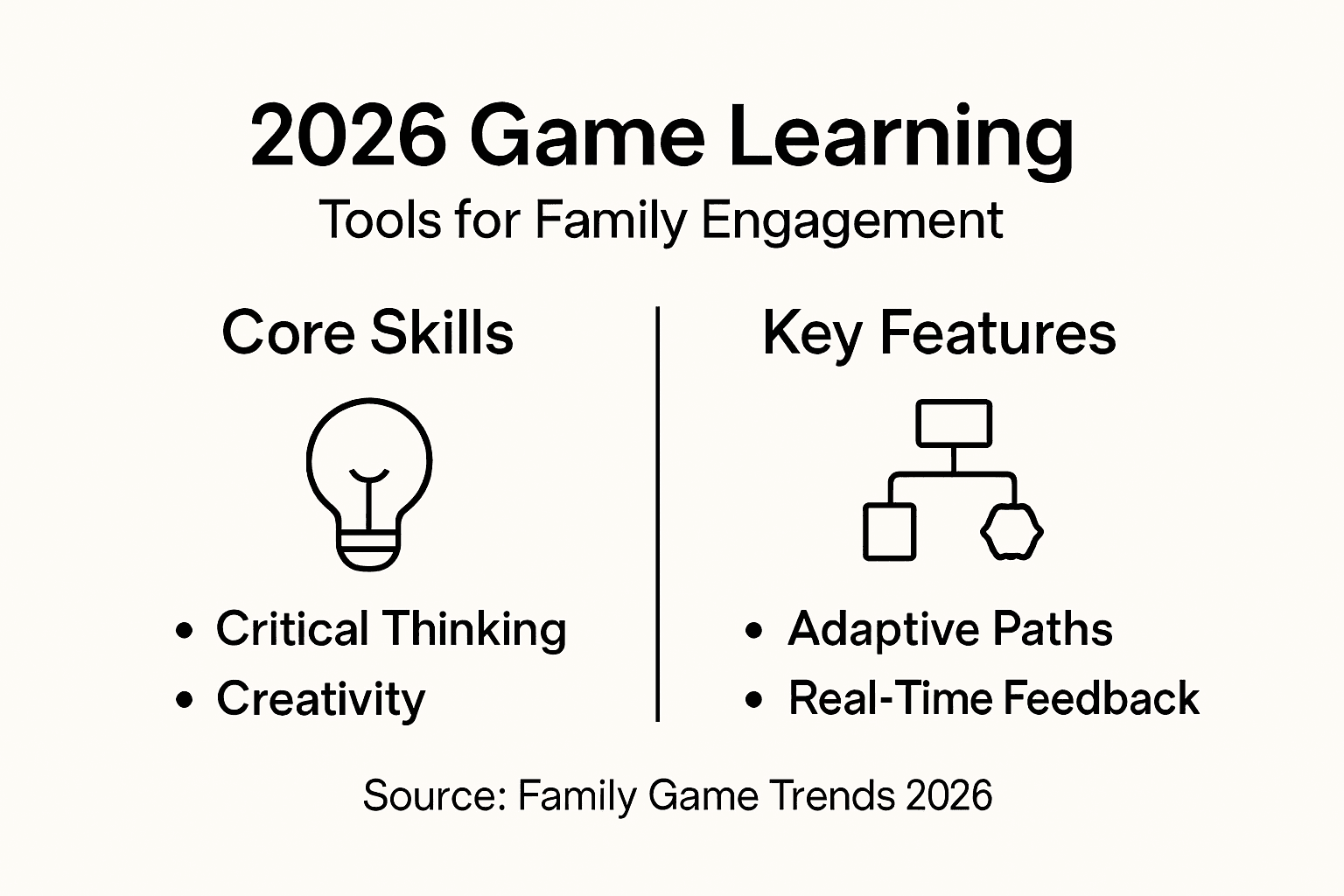
Key characteristics of modern educational games include:
- Adaptive learning pathways that adjust difficulty based on individual performance
- Integrated cognitive skill development modules
- Immersive storytelling that contextualizes academic concepts
- Real-time feedback mechanisms
- Collaborative gameplay elements that encourage social learning
Learning mechanics in these games go beyond traditional rote memorization. Advanced EVG frameworks now focus on promoting critical thinking, problem-solving, and knowledge application through engaging, interactive experiences. The goal is to create gameplay that feels inherently rewarding while subtly embedding educational content.
Pro tip: When selecting educational games for children, prioritize titles that offer dynamic learning experiences over static, repetitive gameplay.
Emerging Types and Game Formats
The world of educational gaming has expanded dramatically, introducing diverse formats that transform traditional learning experiences. Educational game types now encompass multiple sophisticated approaches designed to engage learners across different cognitive and emotional dimensions.
Three primary categories of educational game formats have emerged:
- Serious Games: Purposefully designed learning experiences with explicit educational objectives
- Gamification: Applying game-design elements to non-game learning contexts
- Game-Based Learning: Integrating commercial games into structured educational environments
Each format offers unique advantages for skill development. Serious games provide direct, intentional learning pathways, gamification enhances motivation through interactive rewards, and game-based learning leverages existing commercial game mechanics to create compelling educational experiences. The most effective approaches blend emotional engagement with structured pedagogical techniques.
The following table summarizes how the three main educational game formats differ in purpose, approach, and typical use scenarios:
| Format Type | Primary Purpose | Typical Implementation | Best Used For |
|---|---|---|---|
| Serious Games | Explicit skills instruction | Custom-built learning software | Direct curriculum integration |
| Gamification | Increase learning motivation | Points, badges, rewards in apps | Enhancing routine study tasks |
| Game-Based Learning | Leverage commercial games | Using popular existing games | Supplementing classroom lessons |
Modern educational games prioritize complex skill development beyond traditional academic content. They focus on fostering critical thinking, problem-solving, and collaborative learning through immersive, interactive experiences that feel more like play than traditional instruction. By creating emotionally resonant gameplay, these games transform learning from a passive to an active, participatory process.
Pro tip: Select educational games that challenge players to think critically and solve problems dynamically, rather than those offering simplistic, repetitive learning models.
Interactive Features and Learning Methods
Interactive educational games have revolutionized learning by integrating sophisticated engagement mechanisms that transform traditional educational approaches. Intelligent game-based learning environments now incorporate advanced features designed to personalize and optimize the learning experience for individual students.
Key interactive features that enhance educational gaming include:
- Personalized Learning Agents: AI-driven characters that adapt to individual learning styles
- Dynamic Incentive Systems: Reward mechanisms that motivate continuous learning
- Adaptive Navigation: Intelligent pathways that adjust difficulty based on player performance
- Real-Time Feedback Mechanisms: Immediate response systems that provide constructive guidance
- Collaborative Gameplay Elements: Interactive challenges that promote teamwork and social learning
These interactive features are not merely technological add-ons but sophisticated psychological tools. Gamification principles leverage points, badges, and leaderboards to create engaging learning environments that reduce student anxiety and boost cognitive engagement. By transforming educational content into interactive experiences, these games turn learning from a passive to an active, participatory process.

The most effective educational games create immersive environments that seamlessly blend entertainment with substantive learning objectives. They challenge players to develop critical thinking skills, solve complex problems, and engage with content through multiple sensory and cognitive channels. This approach goes beyond traditional instructional methods, creating learning experiences that are inherently motivating and deeply interactive.
Pro tip: Choose educational games that offer personalized learning paths and real-time adaptive challenges, ensuring a more engaging and individualized learning experience.
Family Engagement and Social Impact
Educational games have emerged as powerful tools for strengthening family connections and promoting holistic child development. Family involvement research demonstrates that interactive gaming experiences can significantly enhance social-emotional learning and create meaningful shared experiences between parents and children.
Key benefits of family-centered educational gaming include:
- Collaborative Learning: Shared gameplay that encourages communication and teamwork
- Skill Development: Joint problem-solving experiences that build cognitive abilities
- Emotional Bonding: Creating shared moments of discovery and achievement
- Inter-Generational Knowledge Transfer: Parents learning alongside children
- Positive Communication Channels: Safe, engaging environments for family interaction
Comprehensive family engagement strategies reveal that interactive educational games can profoundly impact children’s academic and social outcomes. These games provide more than entertainment, serving as dynamic platforms for learning, communication, and mutual understanding. By creating interactive experiences that parents and children can enjoy together, educational games break down traditional learning barriers and foster a more participatory approach to education.
The social impact of family-engaged educational gaming extends beyond immediate learning objectives. These experiences help develop critical social-emotional skills, reduce communication barriers between generations, and create shared vocabulary around learning and problem-solving. Such games become powerful tools for building resilience, encouraging curiosity, and developing collaborative skills that are essential in today’s interconnected world.
Pro tip: Select educational games that encourage active participation from multiple family members, creating opportunities for shared learning and meaningful interactions.
Financial, Safety, and Accessibility Factors
Navigating the complex landscape of educational gaming requires careful consideration of financial investments, digital safety, and inclusive design. Financial literacy through serious games demonstrates how strategic game mechanics can transform educational experiences while providing substantial learning value for families.
Key considerations for families include:
- Cost-Effectiveness: Comparing educational game prices and learning outcomes
- Safety Protocols: Ensuring age-appropriate content and digital protections
- Technological Requirements: Understanding minimum device specifications
- Subscription vs. One-Time Purchase Models: Evaluating long-term financial investment
- Free vs. Paid Learning Resources: Balancing quality and budget constraints
Game accessibility research highlights critical needs for inclusive design, particularly for players with diverse abilities. Modern educational games must address multiple accessibility dimensions, including visual, auditory, and motor skill adaptations. This approach ensures that educational gaming becomes a universal learning tool that accommodates different learning styles and physical capabilities.
The intersection of financial investment and educational value requires thoughtful evaluation. Families should consider not just the immediate cost of educational games, but their potential long-term benefits in skill development, cognitive growth, and engagement. Accessibility features and inclusive design are no longer optional extras but essential components that determine a game’s educational effectiveness and social impact.
Below is a quick reference for major accessibility features to evaluate in educational games:
| Accessibility Need | Example Feature | Benefit for Learners |
|---|---|---|
| Visual Impairments | High-contrast modes | Improves on-screen readability |
| Hearing Impairments | Subtitles, captions | Ensures all instructions heard |
| Motor Limitations | Custom key mapping | Enables easier game controls |
| Learning Differences | Adjustable text speed | Supports diverse reading rates |
Pro tip: Prioritize educational games that offer flexible pricing models and comprehensive accessibility features, ensuring maximum learning potential for all family members.
Discover Engaging Educational Games That Bring Families Together
The 2026 trend of educational games highlights the crucial role of interactive and family-centered learning experiences in developing critical thinking, collaboration, and cultural knowledge. If you are looking to transform screen time into meaningful moments with your children while enhancing their understanding of geography and world cultures, our collection offers the perfect solution. Our games emphasize dynamic learning with immersive storytelling and collaborative elements designed to motivate players of all ages.

Explore our full range of thoughtfully crafted card and board games at Browse All Games | The World Game. Start building lasting family connections today with fun educational entertainment that supports critical thinking and social engagement. Visit playworldgame.com now to bring home interactive learning experiences that your family will treasure. Don’t wait – make every game night a step toward stronger bonds and smarter minds.
Frequently Asked Questions
What are educational games?
Educational games are interactive tools designed to enhance learning by blending entertainment with pedagogical objectives. They aim to develop cognitive skills and create immersive experiences across various educational domains.
How do educational games impact family engagement?
Educational games promote collaboration between parents and children by creating shared learning experiences. They enhance communication, encourage teamwork, and help build emotional bonds through joint gameplay.
What types of educational games are available in 2026?
In 2026, educational games primarily fall into three categories: Serious Games, which are explicitly designed for skills instruction; Gamification, which applies game elements to non-game learning; and Game-Based Learning, which incorporates commercial games in structured educational contexts.
How can I ensure an educational game is safe and accessible for my child?
To ensure safety and accessibility, evaluate the game’s age-appropriateness, check for digital protection protocols, and seek games with features that accommodate diverse abilities, such as adjustable text speed or customizable controls.