


Every parent and couple knows the value of unplugging and spending real time together, but finding activities that engage everyone can feel challenging. Board games offer more than just entertainment—they create opportunities for genuine connection, laughter, and social learning through play. Whether gathered around the kitchen table or connecting with distant friends online, these games spark communication and cooperation, helping families and couples strengthen bonds while having fun.
Table of Contents
- Social Learning Through Games Explained
- Types Of Social Games: Face-To-Face And Virtual
- Essential Social Skills Gained From Gaming
- Real-World Benefits For Families And Friends
- Risks, Misconceptions, And What To Avoid
Key Takeaways
| Point | Details |
|---|---|
| Social Learning Through Gaming | Games facilitate social skills development through natural interaction, allowing players to learn empathy and communication without formal instruction. |
| Types of Social Games | Face-to-face games foster immediate, unfiltered interactions, while virtual games offer flexibility and accessibility to connect with others. |
| Essential Skills Gained | Games enhance skills like empathy, communication, and conflict resolution, which translate to improved daily interactions and relationships. |
| Choose Wisely | Not all games foster genuine connection; select those that require interaction and collaboration to maximize social learning benefits. |
Social learning through games explained
Social learning through games isn’t about flashcards or worksheets—it’s about what happens naturally when people play together. Games create a space where you pick up social skills, emotional awareness, and connection without anyone standing in front of a classroom saying “today we’re learning empathy.”
When you play a game with friends or family, you’re engaging in peer learning. You watch how others react, adapt your strategy based on their moves, and navigate social dynamics in real time. How games teach social-emotional skills shows that games naturally facilitate this kind of learning through active participation and social interaction.
Here’s what happens during social game play:
- You observe others’ decision-making and responses
- You communicate ideas and negotiate outcomes
- You experience consequences of your choices in a safe environment
- You build emotional awareness through competition and collaboration
- You develop patience, adaptability, and perspective-taking
The magic is that people absorb these lessons while having fun, not because someone told them they had to. Games create what researchers call flow state—that feeling of being completely focused and engaged. When flow happens alongside cooperative play, learning sticks because it feels intrinsic, not forced.
Think of it this way: if you’re playing a trivia game with your partner and they know something you don’t, you’re literally learning from them in that moment. If you’re playing a strategy game and a friend makes a move you didn’t anticipate, you’ve just learned something about their thinking style.
Social learning through games works because it combines three things:
- Active engagement - You’re not passively watching; you’re making decisions
- Immediate feedback - The game responds to your actions right away
- Authentic interaction - You’re genuinely interacting with real people, not a screen prompt
This is why family game nights and couples’ games matter beyond just passing time. You’re building connection while naturally developing social awareness and emotional intelligence together.
Social learning works best when the game creates situations where people have to respond to each other—not follow instructions from outside the game.
Pro tip: Pick games where players interact directly (negotiating, reacting, responding) rather than playing in isolation—that’s where real social learning happens.
Types of social games: face-to-face and virtual
Not all social games work the same way. Some happen around your kitchen table, while others connect you with people across the world through a screen. Both deliver real connection and social learning, but they create different kinds of experiences.
Face-to-face games are the traditional route. You gather people in one room, and the magic unfolds through direct interaction. You read body language, hear tone of voice, and feel the energy of the group. These games rely on immediate, unfiltered communication.
Here’s what makes in-person games stand out:
- You pick up on facial expressions and physical reactions
- Conversation flows naturally without lag or typing delays
- Trust builds faster through shared physical space
- You can adjust games on the fly based on group dynamics
- Distractions are easier to control in one location
Virtual games open up a different set of possibilities. They connect people separated by distance, time zones, or schedules. Both face-to-face and virtual games foster distinct social learning outcomes, though through different interaction dynamics.
Virtual games offer unique advantages:
- Accessibility for people who can’t gather in person
- Flexibility to play across distances
- Ability to include more people than one room allows
- A structured format that some find less intimidating
- No travel time or scheduling logistics
The key difference comes down to communication style. In-person games reward quick thinking, reading the room, and spontaneous reactions. Virtual games often shift toward more deliberate communication, typed responses, or turn-based play.
Both types teach social skills. Face-to-face gameplay encourages direct cooperation, while virtual formats open up collaboration across broader networks. Your family game night builds connection through presence; your online game with friends builds it through intentional interaction.
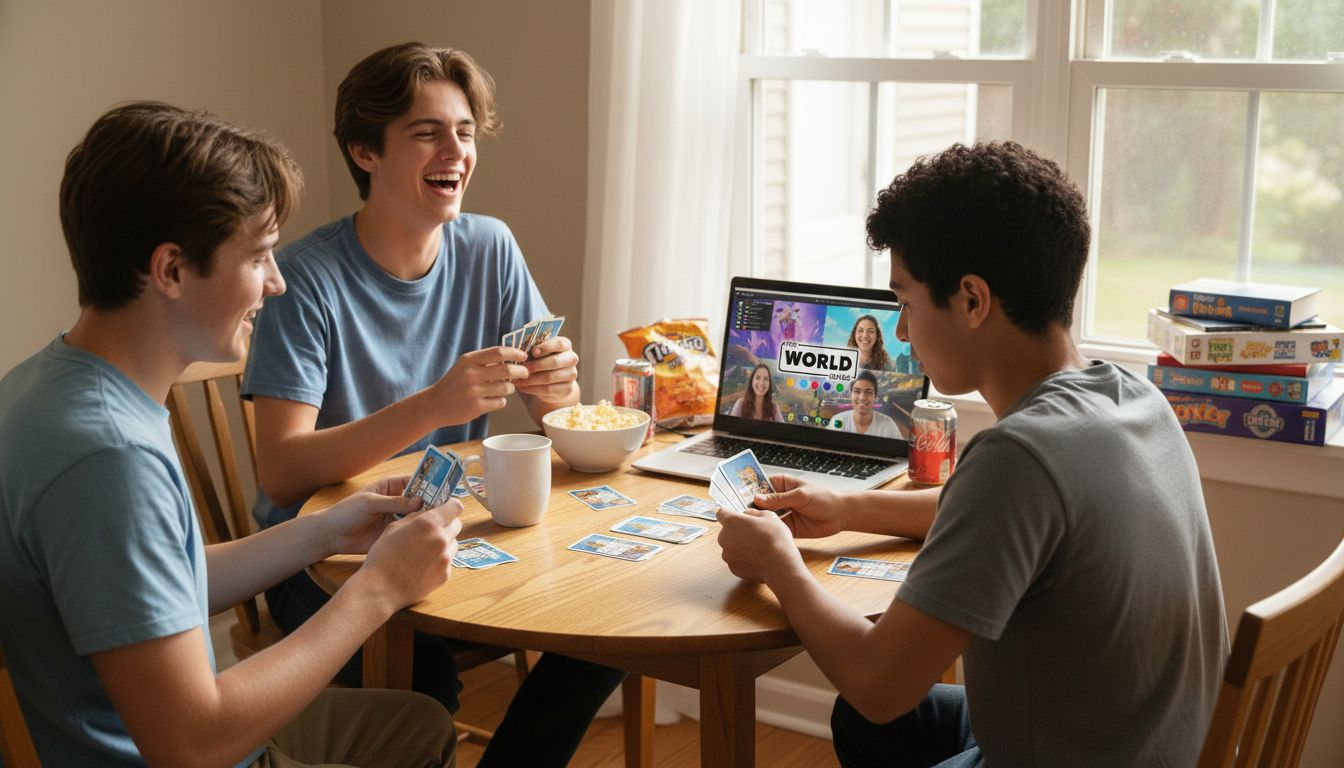
Here’s a quick comparison of face-to-face and virtual social games:
| Aspect | Face-to-Face Social Games | Virtual Social Games |
|---|---|---|
| Communication Style | Spontaneous, verbal, and physical | Typed, audio, or video-based |
| Group Dynamics | Immediate feedback and reactions | Delayed responses, structured turns |
| Accessibility | Limited by location and schedule | Connects across distances |
| Emotional Cues | Body language and expressions | Mostly digital cues, less nuanced |
The best choice depends on your situation:
- For deepest in-the-moment connection: Face-to-face wins
- For flexibility and reaching distant people: Virtual works better
- For combining both: Mix them throughout your month
Real connection happens in both settings—the difference is how the game structures interaction, not whether connection actually occurs.
Pro tip: Choose face-to-face games when you want spontaneous laughter and immediate reactions, and save virtual games for nights when distance or schedules make gathering difficult.
Essential social skills gained from gaming
Games aren’t just fun—they’re skill-building workshops disguised as entertainment. Every time you play with someone else, you’re practicing real social abilities that matter in relationships, work, and life.
The biggest skill? Communication. When you play a game, you have to explain your thinking, ask questions, and listen to what others say. You learn to articulate ideas clearly under pressure and adjust your message based on how people respond.
Empathy develops naturally too. As you play against or alongside others, you start reading their emotions and understanding their perspectives. You see how your moves affect them, what frustrates or delights them, and how to respond with awareness.
Here are the core social skills games build:
- Turn-taking and patience - Waiting your turn teaches impulse control
- Cooperation - Collaborative games require working toward shared goals
- Emotion regulation - Managing wins and losses without spiraling
- Perspective-taking - Understanding other players’ strategies and feelings
- Conflict resolution - Disagreements happen; games teach how to handle them
Games create natural opportunities to practice emotion regulation and cooperation in a low-stakes environment. You can lose without real consequences, celebrate without overstepping, and navigate social dynamics in a structured space.
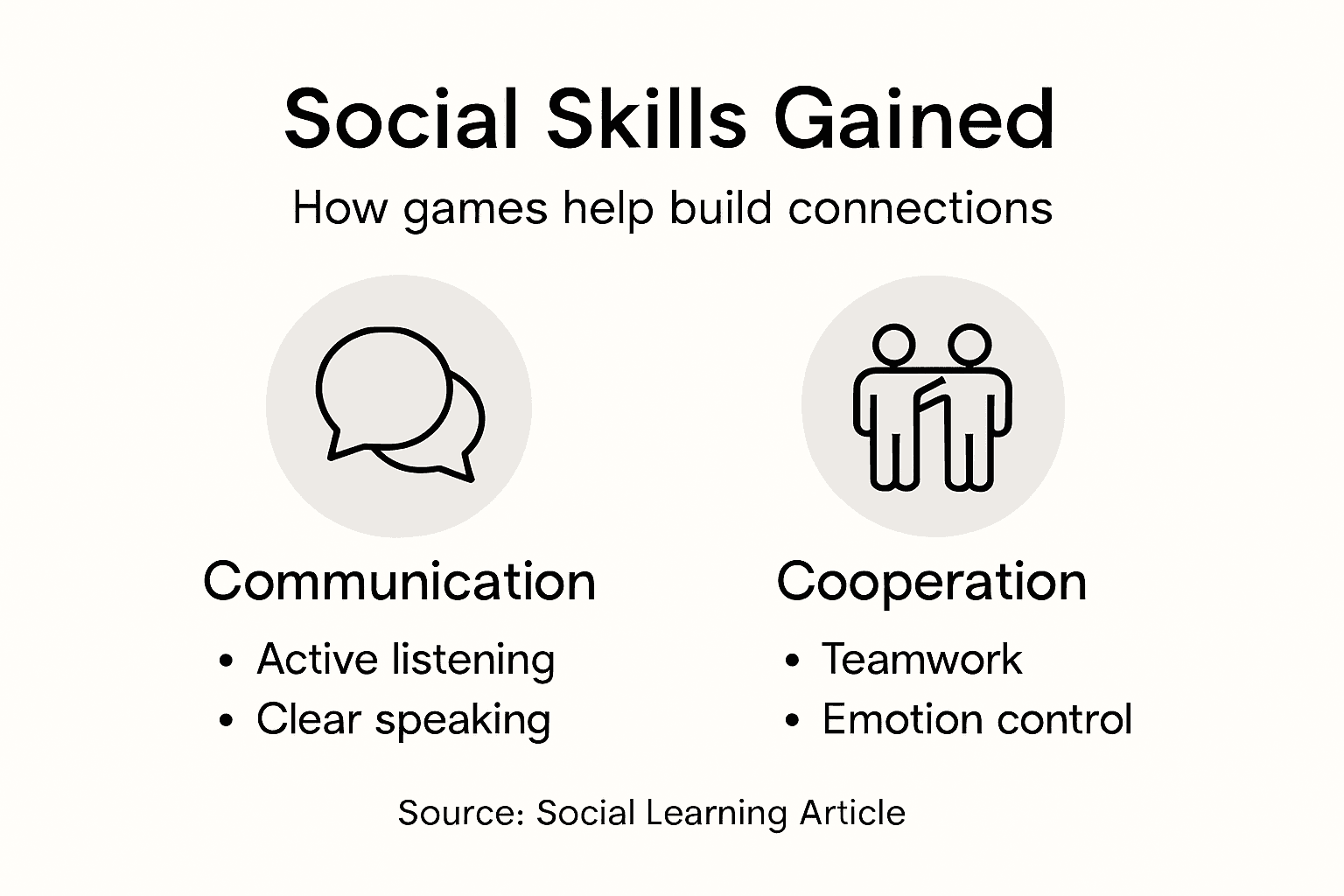
Self-control matters too. Games have rules, and following them teaches you to manage impulses. When you’re tempted to cheat or lash out at a loss, the game structure reminds you to stay in bounds.
Communication and cooperation develop through gameplay because the game itself demands these skills. You can’t win by staying silent; you need others to play with you.
Think about what happens during a typical game night:
- You negotiate rules and clarify confusion
- You respond to unexpected moves from other players
- You celebrate others’ successes or commiserate their losses
- You handle frustration without quitting
- You adapt when someone plays differently than expected
Each of these is a social skill you’re actively using and strengthening. Games that emphasize collaboration build these abilities faster because the goal is shared success.
The table below summarizes key social skills gained through gaming and how they benefit daily life:
| Social Skill | Developed Through Games | Everyday Benefit |
|---|---|---|
| Empathy | Reading others’ emotions | Improves understanding at work |
| Communication | Explaining strategies clearly | Enhances conversations at home |
| Conflict Resolution | Handling disagreements calmly | Reduces tension with friends |
| Patience & Self-Control | Waiting turns, following rules | Aids stress management |
The skills you practice in games aren’t separate from real life—they’re the exact same skills you need everywhere else.
Pro tip: Pick games where everyone must communicate openly to win—games with negotiation, hidden information you must reveal, or shared objectives build social skills faster than pure competition.
Real-world benefits for families and friends
The benefits of gaming don’t stay at the game table. What you practice during gameplay translates directly into how you relate to each other in everyday life. That’s the real payoff.
When families play together regularly, they communicate better overall. The conversation skills you develop while negotiating rules or explaining strategy carry over to dinner table discussions and conflict resolution. You get better at listening because the game demands it.
Stronger relationships form faster when you share gaming experiences. You’re laughing together, celebrating wins, managing losses as a team. These shared moments build trust and understanding that strengthen bonds in ways casual hangouts don’t quite reach.
Here’s what changes in real relationships:
- Better conflict resolution when disagreements happen
- Increased empathy for how others think and feel
- Improved patience and emotional control during stressful times
- Stronger sense of teamwork and shared goals
- More genuine laughter and connection
Shared gameplay experiences improve social bonding and mutual understanding between family members and friends. You’re not just playing a game; you’re practicing the exact skills you need in relationships.
Friendship deepens too. Games create reasons to gather consistently, which is how friendships grow. You develop inside jokes, understand each other’s competitive styles, and build a history together through repeated play.
For couples, gaming offers something valuable: focused time together doing something fun. No phones, no distractions—just interaction. Gaming helps couples strengthen cooperative habits that carry into everyday decision-making and problem-solving.
Parents notice changes in their kids too. Children who play social games develop better emotional regulation, meaning fewer meltdowns and more resilience when frustrated. They learn to handle losing, celebrate others’ wins, and navigate group dynamics with more grace.
Think about the ripple effect:
- You play a game and negotiate a rule conflict together
- You practice staying calm and listening to another perspective
- Next week, a real disagreement happens at home
- You handle it more skillfully because you’ve practiced
These aren’t separate skills—they’re the same interaction patterns showing up in different contexts.
The strongest families aren’t the ones who never disagree; they’re the ones who’ve practiced resolving disagreements in a fun, low-pressure environment first.
Pro tip: Schedule game nights consistently, not just occasionally—regular gameplay builds relationship skills faster because you’re repeatedly practicing the same communication and cooperation patterns.
Risks, misconceptions, and what to avoid
Not every game creates social connection, and not every gaming session builds meaningful skills. Understanding the pitfalls helps you choose wisely and avoid wasting time on experiences that don’t deliver.
The biggest misconception? That all gameplay is automatically beneficial. Just because a game exists doesn’t mean it fosters real social learning. Some games isolate players despite being played in groups, or they create tension rather than bonding.
Screen time concerns matter, especially with virtual games. Excessive screen time and social isolation are real risks if gaming replaces in-person interaction rather than complementing it. Balance matters. One game night a week strengthens connection; gaming every night alone in your room does the opposite.
Watch out for these pitfalls:
- Games that create real conflict or hurt feelings between players
- Titles that reward cheating or aggressive behavior
- Games with no meaningful interaction (just individual tasks in parallel)
- Experiences designed primarily for extrinsic rewards, not genuine fun
- Virtual games that encourage toxic communication or bullying
Another trap: superficial gamification. Games loaded with points, badges, and leaderboards sometimes undermine actual social connection. Games without authentic engagement fail to foster real social learning. You chase rewards instead of building relationships.
Some games reinforce negative stereotypes or poor social models. If a game teaches that winning matters more than fairness, or that aggression is the path to success, it’s working against genuine social development.
Choosing the right games prevents these problems:
- Look for games where interaction is required, not optional
- Pick titles where social connection feels like the natural outcome
- Avoid games with rules that punish sharing information or cooperation
- Skip anything designed to frustrate or humiliate players
- Balance digital games with face-to-face play
Moderation is key. Gaming is powerful because it’s fun and engaging, but too much of anything becomes unhealthy. The goal is building connection, not creating another obligation or screen dependency.
Also remember: not every game fits every group. A game that works brilliantly for competitive friends might create frustration for a family with young kids. Know your audience and choose accordingly.
The best games create situations where players naturally want to interact with each other—not situations where they tolerate each other to reach a score.
Pro tip: Test a game with your group before committing to regular play; watch for whether people are actually talking to each other or just focused on their individual performance.
Unlock Real Connection Through Social Games That Bring People Together
The article explains how social learning through games helps build empathy, communication, and cooperation naturally while having fun. If you want to turn your family game nights or gatherings into powerful moments of connection and skill-building, choosing the right games matters. Avoid the traps of isolated or competitive gameplay by selecting games that demand active engagement and authentic interaction.

Discover a curated collection of fast, social card and board games at Playworldgame.com designed specifically for real game nights. Whether you want skill-based challenges, couples conversation starters, or party games that get everyone laughing and talking, our lineup supports exactly the social learning and connection you need. Start building stronger relationships today by exploring our selection of games that turn playtime into lasting connection moments. Don’t wait—make your next game night meaningful and fun with Playworldgame.com.
Frequently Asked Questions
What is social learning through games?
Social learning through games refers to the natural process where players pick up social skills, emotional awareness, and connections while engaging in gameplay, rather than through formal instruction.
How do games facilitate emotional intelligence?
Games create opportunities for players to experience competition and collaboration, allowing them to build emotional awareness, develop patience, and practice perspective-taking in a fun environment.
What are the differences between face-to-face and virtual social games?
Face-to-face games rely on direct, spontaneous communication, allowing for immediate feedback and emotional cues, while virtual games offer flexibility and accessibility, often relying on typed or structured communication.
What essential social skills can be learned through gaming?
Gaming helps develop communication, empathy, turn-taking, patience, cooperation, conflict resolution, and emotion regulation, which are valuable skills in both personal and professional relationships.