


TL;DR:
- Cooperative games promote teamwork, shared goals, and inclusive fun across all ages.
- Playing together reduces tension, builds bonds, and enhances problem-solving and communication skills.
- Starting with simple, designed-for-cooperation games and setting clear expectations encourages lasting tradition.
Most people assume that a great game night needs a winner. Somebody has to crush the competition, right? Here’s the thing: some of the most memorable, laugh-filled nights we’ve ever had came from games where everyone was pulling in the same direction. Cooperative games improve vaccine knowledge and real-world sharing behaviors, which tells us that playing together does something genuinely powerful to our brains and relationships. In this article, we’ll break down what collaborative play actually is, why it matters for your group, how it changes the vibe at game night, and how to make it a regular tradition your whole crew will love.
Table of Contents
- What is collaborative play?
- How collaborative play changes the game night experience
- Research-backed benefits of collaborative play
- How to start your own collaborative play tradition
- A new perspective: Why collaborative play means more than winning
- Discover more ways to strengthen your game nights
- Frequently asked questions
Key Takeaways
| Point | Details |
|---|---|
| Collaborative play defined | It centers on working together to achieve a shared goal, not on individual competition. |
| Perfect for families | Cooperative games create more inclusive, friendly, and less stressful gatherings. |
| Proven real-world benefits | Research links collaborative play to better learning, sharing, and teamwork. |
| Easy to begin | Anyone can add collaborative play to game night by choosing the right games and focusing on group fun. |
What is collaborative play?
Collaborative play is exactly what it sounds like: everyone at the table works together toward the same goal. Instead of racing to beat each other, players combine their skills, share information, and solve problems as a team. One person winning doesn’t mean everyone else loses. Either the whole group succeeds, or the whole group doesn’t.
This is a pretty big shift from what most of us grew up with. Traditional competitive games like Monopoly or Risk put players directly against each other. Collaborative games like Pandemic, Forbidden Island, or even cooperative charades flip that entirely. You’re not fighting your friends. You’re fighting the game itself.
What makes a game truly collaborative? Here are the core features:
- Shared goals: Everyone is working toward the same outcome, not personal victory.
- Teamwork mechanics: The game design forces players to communicate and coordinate.
- Joint problem-solving: Challenges are meant to be figured out together, not individually.
- No elimination: Players stay involved and engaged from start to finish.
- Flexible roles: Different strengths can shine, so no one feels useless.
These features are what separate a collaborative game from a game that just happens to be played in teams. The design itself pushes the group dynamic in a specific, cooperative direction.
Research backs this up in a meaningful way. Studies show that collaborative games boost problem-solving and group achievement by measurable margins, with some groups showing up to 34% higher collaborative problem-solving scores after playing cooperative games together. That’s not a small bump.
“When everyone at the table is working toward the same goal, the game stops being about who’s smartest or luckiest and starts being about what you can build together.”
If you want to see these concepts in action, check out our guide on games that build teamwork for real examples our families have loved. Collaborative play isn’t a trend. It’s a genuinely different way to experience a game night, and once you try it, you’ll wonder why you didn’t start sooner.
How collaborative play changes the game night experience
Understanding the basics of collaborative play sets the stage. Now let’s talk about how these games actually change the feel of a gathering, because the shift is more significant than most people expect.
The biggest thing we notice is how much more relaxed everyone is. Competitive games can create real tension, especially when family members have very different skill levels or when someone takes losing personally. Cooperative play fosters bonds and teamwork while competitive formats can generate friction that outlasts the game itself. Nobody wants to drive home in awkward silence after Grandma got eliminated in round two.
Here’s a quick look at how the three main game formats compare:
| Feature | Collaborative | Competitive | Hybrid |
|---|---|---|---|
| Shared goal | Yes | No | Partial |
| Player conflict | None | High | Medium |
| Group success | Always | Rarely | Sometimes |
| Inclusion for all ages | Very high | Variable | Moderate |
| Post-game mood | Unified | Mixed | Mixed |
The inclusion factor is huge. Collaborative games naturally accommodate different skill levels because each player contributes what they can. A younger kid might not strategize perfectly, but they can still play a card, make a call, or hold a piece of the puzzle. That keeps everyone in the game emotionally, not just technically.
Pro Tip: Watch out for “quarterbacking,” which is when one strong player starts directing everyone else’s moves. It kills the collaborative spirit fast. The fix? Before the game starts, agree that every player makes their own decisions. Suggestions are welcome, but commands are off the table.
Collaborative games are especially good for:
- Mixed-age groups where skill gaps are wide
- Friends who get too competitive with each other
- Younger kids who are still learning to manage losing
- Groups where some players are new to board games
- Gatherings where the goal is connection, not competition
When the group wins, everyone wins together. And when the group loses, there’s no one to blame. That shared outcome is what makes collaborative play such a natural fit for families trying to strengthen family bonds rather than test them.
Research-backed benefits of collaborative play
Moving from personal stories to science, let’s look at what research actually says about the impact of playing together.
The data is genuinely encouraging. Multiple studies have examined how cooperative game formats affect players’ real-world skills, and the results hold up across age groups.
| Outcome measured | Result from collaborative play |
|---|---|
| Knowledge retention | Significantly higher than solo learning |
| Sharing behaviors | Measurably improved post-play |
| Teamwork skills | Stronger coordination and communication |
| Problem-solving scores | Up to 34% higher in group settings |
| Confidence in decisions | Higher across most age groups |
Stat callout: Research shows that group games improve knowledge, sharing behaviors, and teamwork skills simultaneously, making them one of the most efficient tools for building social-emotional skills outside of a classroom.
Here’s what that means for your actual game night, broken down simply:
- Better learning: Players absorb and retain information more effectively when they’re working with others toward a goal.
- More generous behavior: Collaborative play encourages sharing resources, information, and credit, which spills over into everyday interactions.
- Stronger communication: Players who have to explain their thinking and listen to others get better at both, fast.
- Greater confidence: Making group decisions in a low-stakes environment builds real confidence for higher-stakes situations.
- Healthier group dynamics: Shared wins and losses normalize teamwork and reduce the fear of failure.
Think about what that looks like at your family table. Kids practice patience and listening. Adults model graceful collaboration. Everyone gets a turn to contribute something meaningful. If you want to combine this with some active, physical energy, our deep dive into physical games for family fun pairs really well with the collaborative approach.
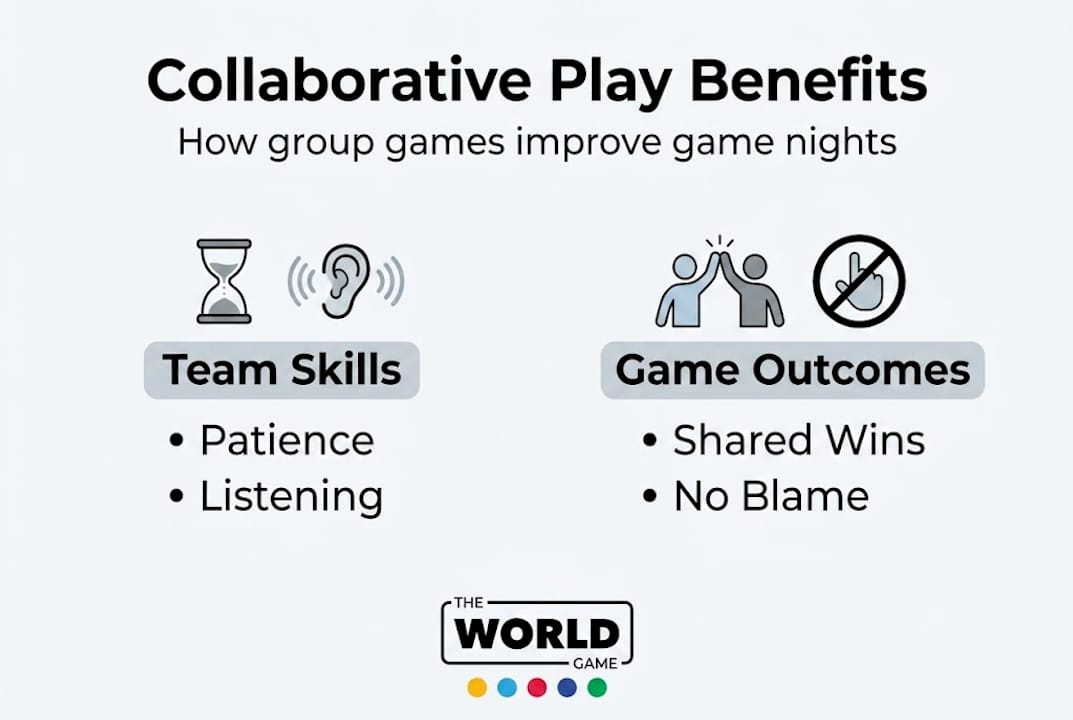
The science isn’t saying competitive games are bad. It’s saying that collaborative play adds something genuinely different to the mix, and most families are leaving those benefits on the table by never trying it.
How to start your own collaborative play tradition
With the benefits clear, you might be wondering how to actually bring this into your next gathering without it feeling forced or weird. Good news: it’s easier than you think.
- Pick the right first game. Start with something designed specifically for collaboration, not a competitive game with “team mode” slapped on. Pandemic, Forbidden Island, and cooperative card games are great entry points. Keep the complexity low for your first session.
- Set expectations before you start. Tell everyone upfront: “We win together or we lose together.” This mental reset matters, especially for players used to competitive formats.
- Assign loose roles. Give each player a way to contribute uniquely. This prevents one person from dominating and helps quieter players feel like they have a stake in the outcome.
- Make it a regular thing. One game night won’t cement a tradition. Commit to a monthly “team night” where collaborative games are the rule. Consistency is what builds the real ritual.
- Debrief afterward. Spend five minutes talking about what went well and what didn’t. This is where the real bonding happens, and it makes the next session even better.
Pro Tip: Rotate who picks the game each session. This gives everyone ownership over the tradition and naturally introduces variety. Plus, it’s a great way to discover games nobody else would have chosen.
One hesitation we hear a lot: “What if my group is too competitive for this?” Honestly, those groups often love collaborative games the most once they try them. The shared frustration of losing together (and the shared thrill of winning together) scratches the same competitive itch without leaving anyone feeling crushed. Collaborative play helps families avoid rivalry and stress, making everyone feel genuinely welcome at the table.
If you want more ideas on keeping engagement high across your whole group, our guide on how to build teamwork with games has a ton of practical strategies. Also worth exploring: what happens when you mix collaborative games with some benefits of physical games for a full-evening game night rotation.
A new perspective: Why collaborative play means more than winning
Here’s something worth sitting with: what does “winning” actually mean when your whole group is the team?
We’ve watched families play collaborative games and still walk away frustrated because they felt they personally didn’t contribute enough. That’s the old competitive mindset sneaking in through the back door. The real shift collaborative play asks you to make is letting go of individual scorekeeping, not just on paper, but emotionally.
The surprising thing? When families do make that shift, the game night changes completely. Suddenly the quietest player at the table is celebrated for a clutch move. The youngest kid’s instinct saves the group. Someone who “isn’t good at games” turns out to be the best communicator in the room.
That’s the actual win. Not the card flip or the final score. It’s the moment where someone who usually sits on the sidelines becomes essential. Family teamwork stories are full of these moments, and they stick with people far longer than any individual trophy. Collaborative play doesn’t just make game nights better. It makes your group better at being a group.
Discover more ways to strengthen your game nights
Ready to take your game nights to the next level? At Play World Game, we’re all about helping families and friend groups find the games that actually bring people closer together, not just fill time.

Whether you’re looking for fast social card games, conversation starters, or something with a team challenge twist, our collaborative play resources are a great place to browse. We’ve pulled together games that are easy to learn, genuinely fun, and built for real people with real schedules. Check out our more teamwork strategies guide to keep the momentum going. Your next unforgettable group win is waiting.
Frequently asked questions
What is collaborative play in board and card games?
Collaborative play means all players work together toward a shared objective instead of competing against each other. Shared goals and joint problem-solving are the defining features that separate it from competitive formats.
Why choose collaborative games for family and friend gatherings?
They foster teamwork, reduce rivalry, and let everyone enjoy the experience regardless of skill level. Cooperative play fosters bonds and teamwork while competitive games can create tension that lingers long after the game ends.
Do studies show any benefits to collaborative play?
Yes, research shows that group games improve knowledge, sharing behaviors, and teamwork skills. Players across age groups show measurable gains in problem-solving and confidence from cooperative formats.
What’s a simple way to start collaborative play?
Choose an age-appropriate cooperative game, set the expectation that everyone wins or loses together, and agree on shared goals before your next game night.