


Over 80 percent of American parents look for educational games that make learning fun and memorable. Geography card games transform global facts into playful challenges, sparking curiosity and teamwork among kids aged 6 to 12. These engaging games help families go beyond textbooks and discover the joy of exploring countries and cultures together, turning each round into an opportunity for laughter, learning, and stronger family connections.
Table of Contents
- Defining Geography Card Games For Kids
- Types And Popular Formats For Families
- How Card Games Foster Core Learning
- Boosting Cultural Awareness Through Play
- Social, Cognitive, And Family Advantages
- Common Pitfalls And How To Avoid Them
Key Takeaways
| Point | Details |
|---|---|
| Engaging Learning Method | Geography card games make learning about world cultures and landscapes fun and interactive for children. |
| Skill Development | These games foster critical thinking, spatial reasoning, and social collaboration in a low-pressure environment. |
| Cultural Awareness | Players gain cultural insights and empathy through exploration of diverse global perspectives during gameplay. |
| Family Bonding | Geography card games create shared learning experiences that enhance connections and discussions among family members. |
Defining Geography Card Games for Kids
Geography card games represent an innovative educational approach that transforms learning about global landscapes, countries, and cultures into an engaging, interactive experience for children. These specialized games blend entertainment with geographical knowledge, creating a playful environment where kids can explore the world through strategic gameplay. Gamified learning strategies have proven remarkably effective in helping children develop spatial awareness and global understanding.
At their core, geography card games are designed to make learning about world regions, countries, capitals, and geographical features feel like an exciting adventure rather than a traditional study session. These games typically incorporate various gameplay mechanics such as matching, trivia, resource management, and strategic placement that challenge players to use geographical knowledge as a core game strategy. Unlike standard educational tools, these card games actively encourage children to think critically about spatial relationships, cultural diversity, and global interconnectedness.
The educational value of geography card games extends far beyond simple memorization. By transforming abstract geographical concepts into interactive experiences, these games help children develop complex conceptual understanding through hands-on engagement. Players learn to recognize country shapes, understand geographical features, compare population densities, and explore cultural differences while having fun. The games create opportunities for children to develop cognitive skills like pattern recognition, strategic thinking, and information processing in a low-pressure, enjoyable environment.
Pro tip: When selecting a geography card game for your child, look for options that balance educational content with engaging gameplay mechanics to ensure sustained interest and learning.
Types and Popular Formats for Families
Geography card games come in a diverse array of formats designed to engage families and children with interactive learning experiences. Family-friendly geography games offer multiple play styles that transform geographical learning into an entertaining group activity. These game formats typically range from trivia challenges to matching and identification games, each providing unique approaches to exploring world cultures and landscapes.
The most popular geography card game formats include trivia-based games, where players answer questions about countries, capitals, and geographical features. Matching games challenge participants to connect flags with nations or pair geographical landmarks with their correct locations. Challenge-based formats encourage strategic thinking by requiring players to complete geographical puzzles or create specific map-related sequences. Some games incorporate educational elements like country fact cards, while others focus on visual recognition of global diversity through colorful illustrations and engaging gameplay mechanics.
Interactive geography card games often feature different complexity levels to accommodate various age groups and knowledge backgrounds. Younger children might enjoy simpler games focusing on continent identification or basic country shapes, while older kids can engage with more complex games involving population statistics, economic details, or cultural trivia. These varied formats ensure that families can find games that not only educate but also provide enjoyable shared experiences that spark curiosity about the world.
Pro tip: Select geography card games that offer multiple difficulty levels to grow with your child’s learning progression and maintain long-term engagement.
Here’s a look at popular geography card game formats and their unique benefits:
| Format Type | Key Gameplay Mechanic | Educational Focus | Best Age Range |
|---|---|---|---|
| Trivia-Based | Question and answer rounds | Fact recall and knowledge | 7 years and up |
| Matching | Pairing countries/landmarks | Visual recognition skills | 5 to 10 years old |
| Puzzle/Challenge | Map building, sequences | Critical thinking, strategy | 8 years and older |
| Visual Fact Cards | Illustrated information | Culture and diversity | 6 years and up |
How Card Games Foster Core Learning
Geography card games are powerful educational tools that go far beyond simple entertainment, strategically engaging multiple cognitive domains through interactive gameplay. These games create dynamic learning environments where children develop essential skills like visual-spatial reasoning, memory retention, and strategic thinking. By transforming abstract geographical concepts into tangible, playful experiences, card games help children connect complex information in meaningful and memorable ways.

The learning mechanics of geography card games are particularly effective in developing critical thinking and problem-solving skills. Active geographical learning encourages students to approach geographical challenges through exploration and strategic decision-making. Players must analyze information, make connections between different geographical elements, and develop mental mapping skills that extend far beyond traditional classroom instruction. These games create scenarios where children learn to read maps, understand spatial relationships, and think critically about global contexts in an engaging, low-pressure environment.
Moreover, geography card games excel at promoting collaborative learning and social skills. Many game formats require players to share information, negotiate strategies, and work together to achieve common goals. This cooperative aspect helps children develop communication skills, learn to exchange knowledge, and understand different perspectives. The games also build confidence by allowing children to demonstrate their geographical knowledge in a fun, competitive setting that celebrates learning as an exciting adventure rather than a tedious academic exercise.
Pro tip: Choose geography card games that include collaborative and competitive elements to maximize both educational value and engagement for children.
Compare how geography card games foster learning across domains:
| Skill Developed | How Card Games Help | Example Game Features |
|---|---|---|
| Spatial reasoning | Players interpret maps and locations | Map puzzles, layout cards |
| Memory retention | Repetition and pattern recognition | Trivia rounds, matching pairs |
| Social collaboration | Teamwork, negotiation, communication | Cooperative missions |
| Cultural empathy | Exposure to global traditions/values | Country fact storytelling |
Boosting Cultural Awareness Through Play
Geography card games serve as powerful tools for introducing children to the rich tapestry of global cultures, transforming learning into an immersive and engaging experience. Cultural learning through interactive play allows children to explore diverse traditions, customs, and perspectives in a natural, unintimidating manner. By presenting world cultures as fascinating narratives rather than dry facts, these games spark curiosity and help children develop a genuine appreciation for global diversity.
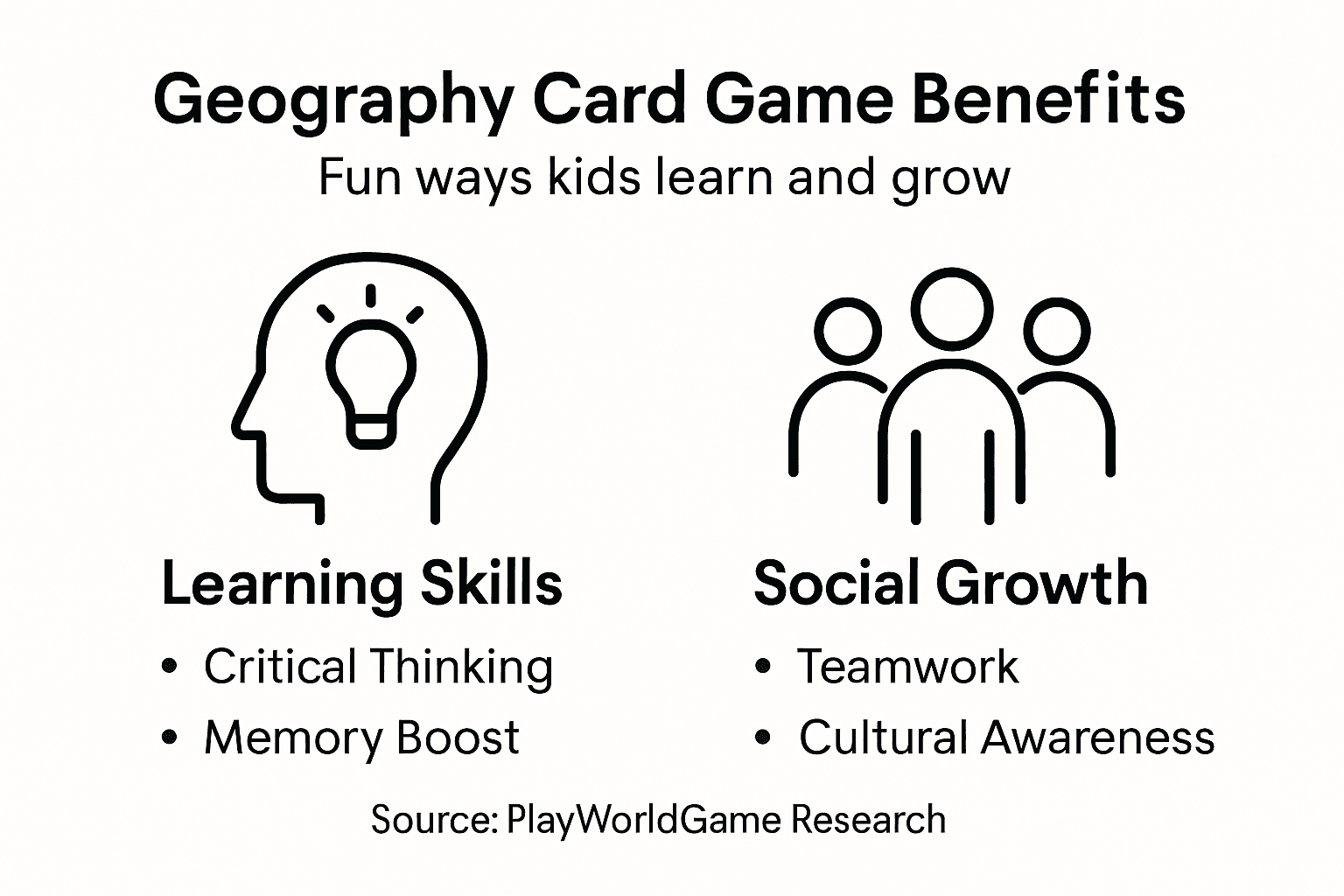
Through carefully designed gameplay mechanics, geography card games encourage players to explore cultural nuances beyond surface-level understanding. Children learn to recognize national flags, understand unique landmarks, and discover interesting traditions that define different societies. This approach goes far deeper than traditional classroom learning, transforming cultural education into an interactive experience where players actively engage with global information. The games create opportunities for meaningful discussions about cultural differences, helping children develop empathy, respect, and a more nuanced understanding of global interconnectedness.
Moreover, these games provide a unique platform for families and educators to initiate conversations about cultural diversity, global citizenship, and mutual understanding. As players explore different countries and regions, they naturally encounter opportunities to discuss historical contexts, social practices, and the rich complexity of human experiences around the world. The interactive nature of card games makes these learning moments feel organic and enjoyable, allowing children to absorb complex cultural information without feeling overwhelmed or lectured.
Pro tip: Encourage children to share interesting facts they learn during gameplay to transform the experience into a collaborative cultural exploration.
Social, Cognitive, and Family Advantages
Geography card games deliver remarkable multidimensional benefits that extend far beyond simple entertainment, offering profound developmental advantages for children and families. Social problem-solving strategies are naturally cultivated through these interactive experiences, where players must communicate, negotiate, and collaborate to achieve game objectives. This social learning environment helps children develop critical interpersonal skills while simultaneously exploring geographical concepts in an engaging, low-pressure setting.
Cognitively, these games serve as powerful tools for stimulating mental development. Players engage complex mental processes including strategic thinking, memory retention, and spatial reasoning as they navigate game challenges. The immediate feedback mechanisms inherent in card game designs provide continuous learning opportunities, helping children refine their analytical skills and develop more nuanced approaches to problem-solving. Collaborative spatial scenarios further enhance this cognitive development by encouraging players to think critically about geographical relationships and interconnected systems.
Perhaps most importantly, geography card games offer exceptional family bonding opportunities. These games create shared experiences that transcend traditional learning models, allowing parents and children to learn together in an atmosphere of mutual curiosity and excitement. By transforming educational content into an interactive family activity, these games break down generational barriers and create meaningful conversations about global perspectives, cultural diversity, and geographical understanding.
Pro tip: Rotate game roles and responsibilities to ensure every family member experiences different learning perspectives and maintains engagement.
Common Pitfalls and How to Avoid Them
Navigating the world of geography card games requires understanding potential challenges that can undermine their educational effectiveness. Learning game implementation strategies reveal critical considerations parents and educators must address to maximize these interactive learning tools. One primary pitfall is treating card games as standalone entertainment rather than integrated educational experiences that require thoughtful guidance and purposeful engagement.
A significant challenge involves selecting age-appropriate games that genuinely challenge children without causing frustration. Game moderation techniques emphasize the importance of matching game complexity to children’s cognitive development and geographical knowledge. Parents should preview games, understand their learning objectives, and be prepared to provide supportive guidance. Avoid games that are either too simplistic, which might bore children, or excessively complex, which could discourage learning and participation.
Another critical consideration is balancing gameplay with meaningful reflection and discussion. Geography card games should not be viewed as replacement for structured learning but as complementary tools that spark curiosity and deeper exploration. Successful implementation requires parents and educators to create opportunities for children to discuss what they’ve learned, ask questions, and connect game experiences to broader geographical understanding. This approach transforms casual gameplay into a rich, interactive learning experience that extends beyond the game itself.
Pro tip: Spend 10-15 minutes after gameplay discussing interesting discoveries and encouraging children to share their most surprising geographical insights.
Elevate Your Child’s Geography Learning with Engaging Card Games
The article highlights common challenges parents and educators face when trying to make geography engaging and educational for kids. Many struggle to find games that balance fun gameplay with meaningful learning without overwhelming or boring children. Geography card games that foster spatial reasoning, cultural awareness, and collaborative skills can be hard to find but are essential for nurturing curiosity and global understanding.
At PlayWorldGame, we understand these needs and offer a wide selection of carefully crafted geography and knowledge-based card games designed specifically to address these challenges. Our games combine interactive play with educational depth, helping children develop critical thinking and explore diverse cultures naturally. Whether you are looking for trivia formats, matching games, or puzzle challenges, you will find options that grow with your child’s learning and keep the entire family engaged.
Discover the difference that purposeful, entertaining geography card games can make in your home or classroom today.

Browse our full collection at PlayWorldGame and start turning screen time into a global adventure. Join thousands of families who trust us to make learning exciting. Act now to bring home the best educational card games that blend knowledge, culture, and fun.
Explore more benefits of interactive learning on our homepage and see why so many parents and educators recommend PlayWorldGame for engaging geography education.
Frequently Asked Questions
What are geography card games?
Geography card games are educational tools designed to make learning about global landscapes, countries, and cultures engaging and interactive for kids. They combine entertainment with geographical knowledge to create a fun learning experience.
How can geography card games foster critical thinking in children?
These games encourage players to analyze information, make connections, and develop mental mapping skills. By navigating geographical challenges through exploration and strategy, children enhance their critical thinking and problem-solving abilities.
What age groups are geography card games suitable for?
Geography card games come in various formats and complexity levels suitable for different age groups. Younger children may enjoy simpler identification games, while older kids can engage with more complex challenges that include critical trivia and strategic thinking.
How do geography card games contribute to cultural awareness?
They introduce children to diverse traditions and perspectives in an engaging manner. Through interactive gameplay, players learn about cultural nuances, fostering empathy and a greater appreciation for global diversity.