


TL;DR:
- Educational board games build critical thinking, social skills, and emotional regulation naturally through play.
- They benefit all ages and learning styles, especially aiding neurodiverse children and fostering family connection.
- Effective use relies on engagement, variety, adult facilitation, and balancing fun with educational goals.
Most families crack open a board game thinking it’s pure fun, and honestly, that’s a great starting point. But here’s the thing: educational games do a whole lot more than pass the time on a Friday night. They quietly build real skills, spark genuine conversations, and create the kind of shared moments that stick with people for years. We’ve seen it happen around our own table, and the research backs it up. This article walks you through what educational entertainment actually means, who benefits most, what the science says, and how to make your next game night count for everyone at the table.
Table of Contents
- What is educational entertainment and why does it matter?
- How educational games boost cognitive and social skills
- Who benefits most: Age groups, learning styles, and neurodiversity
- Success factors: What makes educational entertainment truly work?
- The limits and best uses of educational entertainment
- Our take: Why the experiences around the table matter more than the game itself
- Discover new ways to play and learn together
- Frequently asked questions
Key Takeaways
| Point | Details |
|---|---|
| Blends fun and learning | Educational games make skill-building enjoyable for people of all ages. |
| Backed by research | Studies show real benefits for cognitive, social, and emotional development. |
| Inclusivity for all | Games engage diverse learning styles and neurodiverse players in meaningful ways. |
| Works best as supplement | Best results come when games support, not replace, structured learning. |
What is educational entertainment and why does it matter?
Let’s clear something up right away. Educational entertainment (sometimes called “edutainment”) isn’t a watered-down category of boring games dressed up in bright colors. It’s the sweet spot where genuine fun and real learning overlap. When we talk about what educational entertainment means, we’re talking about games designed so that the mechanics themselves teach something, whether that’s through strategy, storytelling, wordplay, or teamwork.
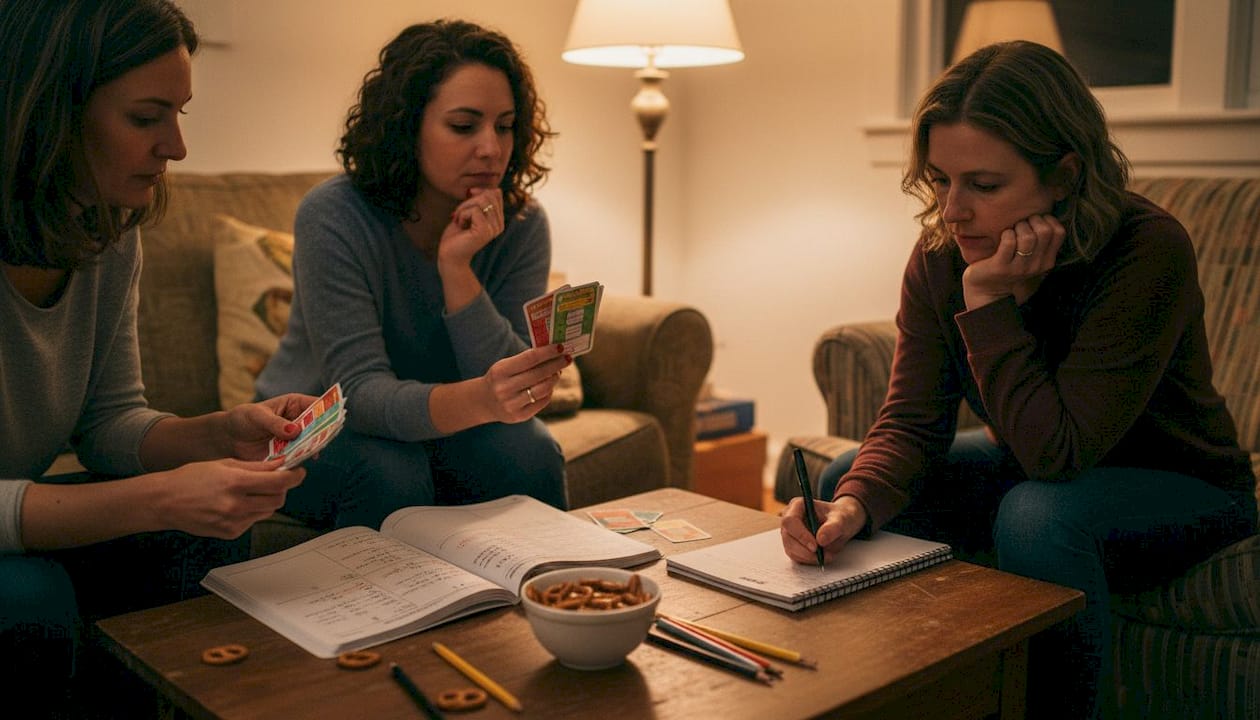
Card and board games are a particularly powerful format for this. Think about what happens during a single round of a well-designed game. Players take turns (patience and social awareness), read cards or instructions (language skills), make decisions under pressure (critical thinking), and react to other players (emotional regulation). None of that feels like homework. It feels like play. That’s the magic.
Here’s a misconception we hear a lot: “Games aren’t real learning.” We get it. If you grew up with flashcard drills and textbook chapters, a card game might feel like a detour. But educational board and card games develop language skills, math abilities, critical thinking, and problem-solving through the very mechanics that make them fun. The learning isn’t separate from the fun. It IS the fun.
Some specific skills that show up again and again in well-designed games:
- Logic and strategy: Planning moves ahead, weighing options, predicting outcomes
- Social-emotional skills: Reading the room, handling a loss gracefully, celebrating others
- Teamwork: Cooperative games especially push players to communicate and divide tasks
- Language and vocabulary: Word games, trivia, and storytelling formats build these naturally
- Math and pattern recognition: Scoring systems, card counting, and sequencing all count
Pro Tip: When shopping for games, look for ones that list both “educational” and “family-friendly” in their descriptions. That combo usually signals a game designed to engage a wide age range without feeling like a classroom exercise.
How educational games boost cognitive and social skills
Okay, so games are more than fun. But what exactly are families gaining? Let’s get into the real benefits, because this is where things get genuinely exciting.
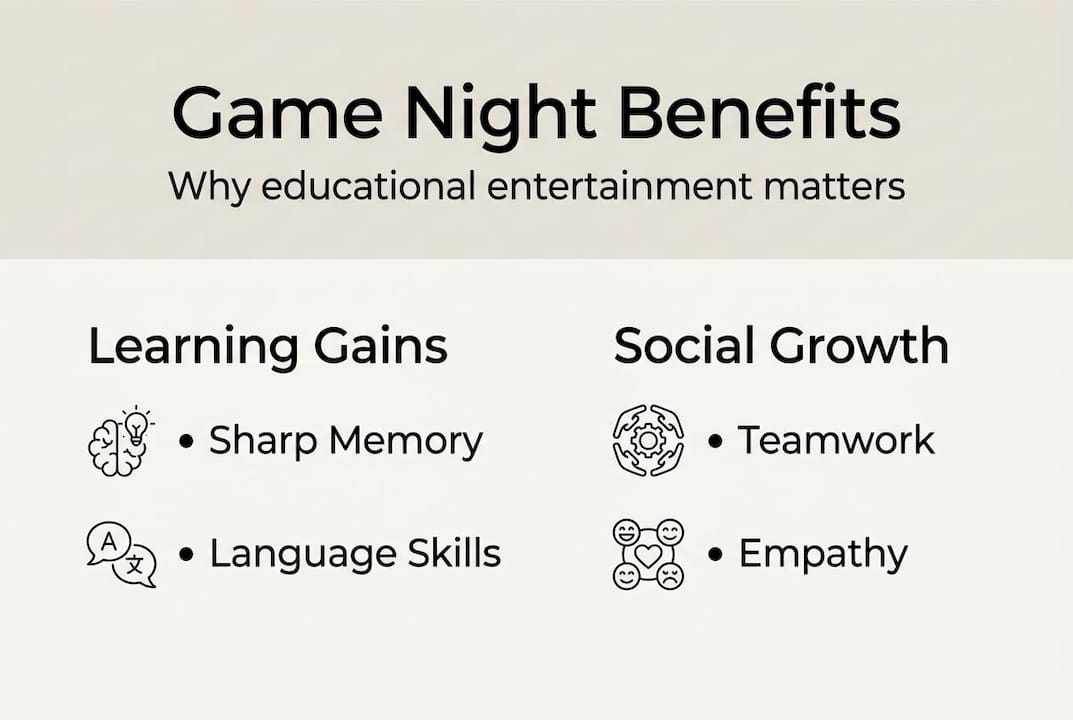
On the cognitive side, board game skill benefits include sharper memory, stronger language use, faster problem-solving, and better critical thinking. These aren’t vague claims. They show up in how kids explain their moves, how adults strategize, and how groups negotiate decisions together. Even a simple trivia game pushes players to retrieve information, make connections, and think fast.
On the social-emotional side, the gains are just as meaningful. These games improve emotional regulation, empathy, teamwork, and the ability to handle frustration, all through the natural push and pull of competitive and cooperative play. Losing a round and bouncing back? That’s resilience. Helping a younger player figure out their turn? That’s empathy in action.
The research is pretty striking:
Empirical studies show that game-based learning produced over 85% mastery in phonics skills compared to control groups, and card games improved test scores and retention by 20 to 30 percent in subjects like neurology and physiology.
Here’s a quick look at the key benefits families can expect:
- Memory and recall: Repeated game mechanics reinforce information naturally
- Language development: Reading, listening, and explaining rules all build vocabulary
- Critical thinking: Strategy games push players to analyze and adapt
- Empathy: Cooperative formats encourage perspective-taking
- Frustration tolerance: Losing (and winning graciously) builds emotional strength
- Teamwork: Group games require communication and shared decision-making
Both kids and adults see these gains. In fact, adults who play regularly often report sharper focus and better social connection. Game night isn’t just for the kids. It’s for everyone.
Who benefits most: Age groups, learning styles, and neurodiversity
One of the best things about educational games is how flexible they are. They don’t just work for one type of learner or one age group. Building on those universal benefits, let’s look at who sees the biggest impact and how you can match the right game to the right player.
| Player type | Key benefits observed |
|---|---|
| Young children (ages 4 to 7) | Language growth, turn-taking, basic math, color and pattern recognition |
| Older kids (ages 8 to 12) | Critical thinking, strategy, teamwork, vocabulary expansion |
| Teens | Problem-solving, social dynamics, competitive reasoning, emotional regulation |
| Adults | Memory retention, social connection, stress relief, creative thinking |
| Neurodiverse players (ADHD, etc.) | Attention improvement, structured engagement, academic skill gains |
That last row is worth pausing on. Holist-style learners benefit more from board games than serialist learners, and games have shown real effectiveness for children with ADHD in both attention and academic performance. That’s a meaningful finding for families who’ve struggled to find learning tools that actually hold their child’s interest.
Multi-age play also adds something special. When a grandparent and a 9-year-old sit down to the same game, something shifts. The older player models patience and strategy. The younger player brings energy and creativity. Both leave with a stronger sense of connection and understanding. That’s empathy built in real time, not taught from a worksheet.
Pro Tip: Mix up your game types to engage everyone in the group. Trivia works great for analytical thinkers. Storytelling and word games pull in social learners. Strategy games challenge teens and adults. Rotating formats keeps every game night fresh and inclusive.
Success factors: What makes educational entertainment truly work?
Not every game labeled “educational” delivers the same results. So what separates the ones that genuinely work from the ones that collect dust? Now that you know who benefits, here’s what actually makes the difference.
The biggest factor is engagement. A game that holds attention naturally creates more learning opportunities than one that feels like a chore. Analog games consistently outperform traditional teaching methods in engagement and retention across multiple subjects. That’s not a small thing. It means the format itself is doing some of the heavy lifting.
Here are the top ways to mix fun and learning for maximum impact at home:
- Pick games with clear objectives: Players learn better when the goal is obvious and achievable
- Prioritize replayability: Games you can return to again and again reinforce skills over time
- Debrief after playing: Spend five minutes talking about what happened, what worked, what surprised you
- Involve a facilitator: A parent or older player who guides without dominating makes a real difference
- Rotate game types: Don’t stick to just one format. Mix strategy, trivia, and storytelling
- Keep it low pressure: The moment it feels like a test, the magic disappears
Here’s how specific game attributes tend to affect learning and engagement:
| Game attribute | Effect on learning | Effect on engagement |
|---|---|---|
| Strategy elements | Builds critical thinking and planning | High, especially for teens and adults |
| Teamwork mechanics | Develops communication and empathy | High across all ages |
| Storytelling components | Expands vocabulary and creativity | Very high for social learners |
| Trivia format | Reinforces knowledge and recall | High for competitive players |
| Cooperative play | Encourages emotional regulation | High for younger kids and neurodiverse players |
Adult involvement matters more than most people realize. A facilitator who asks good questions (“Why did you make that move?” or “What would you do differently?”) turns a fun game into a genuine learning moment.
The limits and best uses of educational entertainment
We love a good game night as much as anyone, but we also want to be honest with you. Educational entertainment works best in specific contexts, and it’s not a magic fix for every learning challenge.
Here are the scenarios where it really shines:
- Supplementing homework or school topics: A math card game after a tough homework session reinforces concepts without the groan factor
- Family game nights: Low-stakes, high-fun environments are ideal for natural learning
- Social group events: Friends playing together build skills through friendly competition and cooperation
- Introducing new concepts: Games are a great first exposure before more formal instruction kicks in
- Keeping skills sharp over summer: Prevents the “summer slide” without feeling like school
But here’s the honest part:
Overemphasis on fun can sometimes prioritize entertainment over depth. Educational games work best as supplements to formal learning, not as complete replacements for structured instruction.
That’s not a knock on games. It’s just reality. A trivia game won’t replace a history class. A word card game won’t substitute for dedicated reading time. What games do brilliantly is reinforce, motivate, and make concepts stick in ways that textbooks often can’t.
For neurodiverse learners especially, teacher or parent guidance is key for optimal integration. The game itself is a tool. The adult in the room helps make it meaningful. When you understand the limits of educational games, you can use them more effectively, and enjoy them more too.
Our take: Why the experiences around the table matter more than the game itself
Here’s something we genuinely believe after years of game nights: the game is almost secondary. What actually matters is what happens around it.
When a family sits down together, phones away, and focuses on a shared challenge, something real happens. People laugh. They argue (kindly, usually). They surprise each other. A quiet kid suddenly becomes the strategist. A competitive adult learns to let a younger player lead. Those moments don’t show up in any study, but they’re the reason we keep coming back to the table.
The board game bonding benefits go way beyond test scores. They’re about curiosity, connection, and the kind of empathy that only comes from genuinely playing together. True learning happens through shared challenge and reflection, not just knowledge transfer. So yes, pick games that teach something. But more importantly, show up, play fully, and let the table do its thing. The growth follows naturally.
Discover new ways to play and learn together
If this article got you thinking about what your next game night could look like, we’re glad. There’s a whole world of games out there designed to do exactly what we’ve been talking about: entertain, connect, and quietly build skills along the way.

At Playworldgame.com, we’ve curated a lineup of fast, social card and board games that work for families, friend groups, and everyone in between. Whether you’re after something skill-based, trivia-driven, or just wonderfully silly, you’ll find options that fit your crew. Explore family learning games and find your next favorite for game night. Because the best learning happens when nobody realizes it’s happening at all.
Frequently asked questions
Are educational board games only for children?
No, educational board and card games are designed to benefit all ages, encouraging learning and connection among adults and children alike. Multi-age play actually enhances empathy and skill development for everyone at the table.
What skills can families expect to build through educational games?
Families can expect improvements in language, math, critical thinking, problem-solving, teamwork, and emotional regulation. Educational card and board games build these skills through the mechanics of play itself, not separate drills.
How can adults maximize learning from game nights with friends?
Choose games that challenge logic or teamwork, involve everyone, and discuss takeaways after playing to deepen the learning experience. Analog games consistently outperform traditional methods in engagement and retention, so the format already has you covered.
Are educational games effective for children with ADHD or different learning styles?
Yes, research shows significant benefits for children with ADHD and for diverse cognitive styles with the right support and game choice. Holist-style learners in particular see strong gains from board game formats compared to more linear learning methods.
Can board games replace traditional learning methods?
Educational games are best as supplements to formal learning, not complete replacements, offering engagement and retention when balanced with structure. Overemphasis on entertainment can reduce depth, so the sweet spot is using games alongside, not instead of, structured instruction.