


TL;DR:
- General knowledge games are inclusive and foster social interaction across all ages.
- Games like Trivial Pursuit and iKNOW differ in mechanics but both promote bonding and learning.
- Flexibility and playful adaptation are key to making game nights fun and socially rewarding.
Most people assume general knowledge games are strictly for trivia buffs who memorize encyclopedias for fun. That’s just not true. These games are actually some of the best tools we have for pulling a room together, getting grandma and the teenagers laughing at the same time, and turning a regular Friday night into something people talk about for weeks. Whether you’re hosting a holiday party, a family reunion, or just a casual hangout, the right general knowledge game can do a lot of heavy lifting. This guide breaks down how these games work, which ones are worth your time, and how to make every round a win for everyone at the table.
Table of Contents
- What are general knowledge games?
- How Trivial Pursuit and iKNOW work: Mechanics explained
- Making general knowledge games fun for everyone
- Benefits of general knowledge games for social connection and learning
- What most people miss about general knowledge games
- Ready to upgrade your next game night?
- Frequently asked questions
Key Takeaways
| Point | Details |
|---|---|
| Games for everyone | General knowledge games adapt easily for all ages and any group size. |
| Simple to host | Most games need little setup and can be customized with house rules or themes. |
| Inclusive play | Editions like Family Trivial Pursuit let kids and adults compete fairly together. |
| Boosts learning and bonding | These games sharpen minds and strengthen friendships in a lively, low-pressure way. |
What are general knowledge games?
General knowledge games are exactly what they sound like: games where players answer questions drawn from a wide range of topics. History, science, pop culture, geography, sports, food, music. No one needs to be an expert in any single subject to play, which is a big part of why they work so well at social gatherings.
The formats vary a lot, and that’s a good thing. You can go with a classic board game setup, pull out a card game, fire up an app on your phone, or even run a quick pen-and-paper quiz. The flexibility means you can match the format to your crowd without much effort.
As why choose general knowledge games explains, general knowledge games foster fun across all ages and naturally encourage group interaction. That’s the magic. They create a level playing field where a 10-year-old can beat a 40-year-old on a pop culture question, and everyone gets a moment to shine.
Here’s why these games are a staple at so many gatherings:
- Accessible to everyone. No reading a thick rulebook for an hour. Most general knowledge games are pick-up-and-play.
- Naturally social. Questions spark conversations, debates, and shared memories.
- Flexible difficulty. You can swap questions, use team formats, or adjust rules to fit your group.
- Replayable. With hundreds or thousands of questions, you rarely hit the same round twice.
- Works in almost any setting. Living room, backyard, classroom, office party. These games travel well.
“The best game night isn’t about who knows the most. It’s about who laughs the hardest.”
The importance of trivia games goes beyond entertainment. They keep minds active, encourage curiosity, and give people a shared experience to bond over. That’s a lot of value packed into a box of cards.
How Trivial Pursuit and iKNOW work: Mechanics explained
Two of the most well-known general knowledge games are Trivial Pursuit and iKNOW. They’re both trivia-based, but they feel completely different when you sit down to play them.
Trivial Pursuit is the classic. Players move around a circular board, landing on colored spaces that correspond to question categories (think: Science & Nature, Entertainment, History, and more). Answer correctly and you earn a colored wedge for that category. Fill all six wedges, make it to the center, and answer one final question to win. It’s category-based trivia movement at its most iconic.

iKNOW flips the script. Instead of a board, players use progressive clues. Each question starts vague and gets more specific with each clue revealed. Before the answer is shown, players can wager using iKNOW or iBET tokens, essentially betting on whether they know it or whether they think someone else will get it wrong. It’s wagering with progressive clues that adds a layer of strategy and social reading.
| Feature | Trivial Pursuit | iKNOW |
|---|---|---|
| Players | 2 to 6 | 2 to 6 |
| Core mechanic | Board movement + categories | Progressive clues + token betting |
| Win condition | Collect all 6 wedges + center question | Most points from correct answers and bets |
| Skill emphasis | Broad knowledge recall | Knowledge + strategy + reading opponents |
| Average play time | 60 to 90 minutes | 45 to 75 minutes |
Here’s how a typical turn flows in each game:
- Trivial Pursuit: Roll the die, move your token, land on a colored space, answer the matching category question, earn a wedge if correct, pass the die.
- iKNOW: Draw a card, read the first clue aloud, players place bets, reveal more clues one at a time, answer is revealed, tokens are scored based on bets.
For building social bonds through games, iKNOW’s betting mechanic is especially powerful. It gets people talking, bluffing, and reacting to each other in real time.
Pro Tip: If Trivial Pursuit is running long, set a wedge limit (say, first to 4 wins) or skip the center question requirement. House rules are your best friend for keeping energy high.
Making general knowledge games fun for everyone
Knowing the rules is one thing. Making sure everyone at the table is actually having a good time is a whole other skill. Here’s how we do it.
Pick the right version. The Family Edition adjusts difficulty based on a die roll, so kids and adults can play from the same deck without one side feeling overwhelmed. If you’re mixing ages, look for editions specifically designed for mixed groups.
Here are some of our favorite ways to keep things inclusive and lively:
- Team up. Pair a younger player with an older one. It balances knowledge gaps and creates natural mentoring moments.
- Time limits. Give players 30 seconds per question. It reduces overthinking and keeps the pace snappy.
- Partial credit. If someone gets close but not exact, give half a point. It rewards effort and keeps quieter players engaged.
- Themed rounds. Swap in questions about movies from the 80s, local geography, or your family’s inside jokes. Custom rounds make games feel personal.
- Quick-fire format. Go around the table rapid-fire style instead of waiting for full turns. Great for warming up the group.
For shy players, we always recommend starting with team formats. It takes the pressure off any single person and creates a collaborative vibe right from the start. Competitive players tend to dial it back naturally when they see the whole group is more important than winning.
The general knowledge advantages for groups really show up when you adapt the game to your crowd instead of forcing everyone to adapt to the game.
Pro Tip: Rotate the quiz master role every few rounds. The person reading questions gets a break from competing and often becomes the most enthusiastic cheerleader in the room.
Benefits of general knowledge games for social connection and learning
Beyond the fun factor, these games are quietly doing a lot of good work. Let’s talk about what’s actually happening when you play.
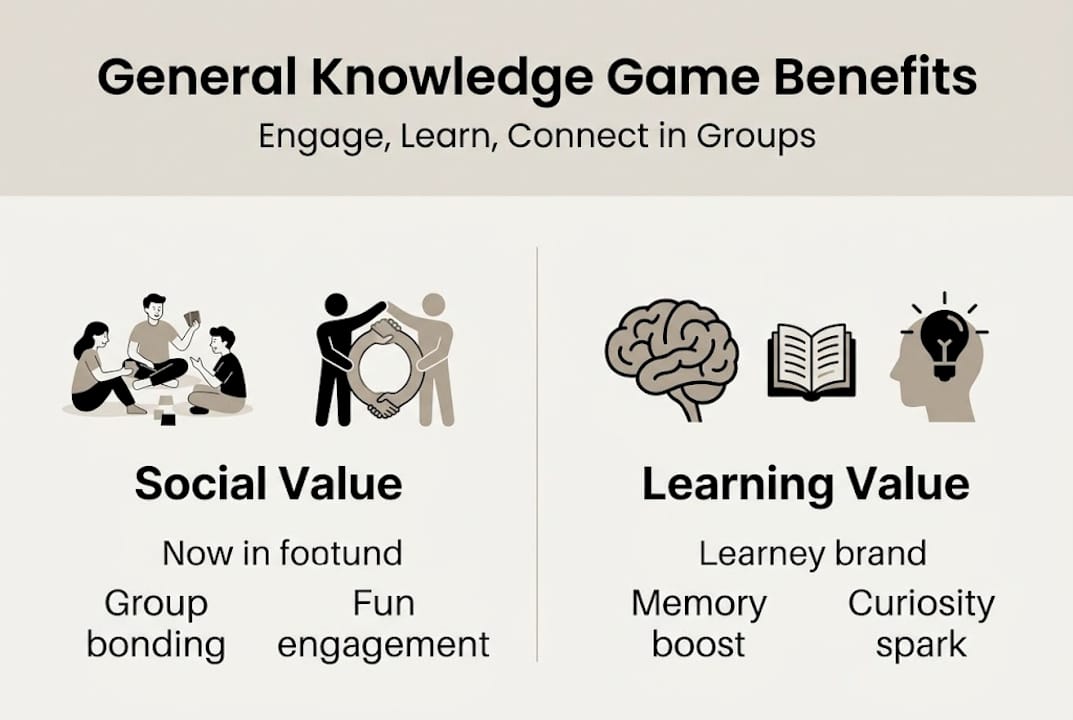
Cognitively, trivia games push your brain to retrieve information you haven’t thought about in years. That kind of memory exercise is genuinely valuable. Players also practice quick thinking, pattern recognition, and mental flexibility as they jump between topics.
Socially, something interesting happens around a trivia game. People cheer for each other, argue (nicely, usually), and share stories triggered by a question. A question about 1970s music can turn into a 10-minute conversation about a grandparent’s record collection. That’s not a distraction. That’s the point.
As noted in the iKNOW game rules, trivia games foster learning and strong social bonds through their replayable, dynamic structure. The combination of competition and cooperation keeps people coming back.
“The best trivia games aren’t tests. They’re conversations with a scoreboard.”
The importance of general knowledge games also extends to team-building settings. Quick-fire rounds work brilliantly as icebreakers for office events or classroom warmups.
| Benefit | Best game setting |
|---|---|
| Memory and recall | Any trivia format |
| Group discussion | iKNOW, open-answer formats |
| Friendly competition | Trivial Pursuit, team trivia |
| Icebreaking | Quick-fire rounds, app-based games |
| Intergenerational bonding | Family Edition, team play |
The social bond benefits are real and measurable. When people laugh together and share small victories, they feel closer. A good trivia game does that reliably, every single time.
What most people miss about general knowledge games
Here’s something we’ve noticed after a lot of game nights: the groups that have the most fun are almost never the ones who play strictly by the rules. They’re the ones who treat the game as a starting point.
When you focus too hard on finding the trivia buff in the room and letting them dominate, you lose everyone else. Game nights thrive on inclusion, not performance. The moment someone feels like they can’t contribute, they check out.
True engagement comes from reading your group and adjusting on the fly. Maybe you skip a category that’s too niche. Maybe you let a wrong answer slide because the story behind it was better than the correct one. That kind of flexibility is what building stronger social bonds actually looks like in practice.
Don’t undervalue the bluffing, the misdirection, and the friendly trash talk either. Sometimes the most memorable moments aren’t the correct answers. They’re the hilariously wrong ones.
Pro Tip: Use flexible scoring, playful themes, or one collaborative round per game night to keep the mood light and rivalries friendly. The goal is always connection first, competition second.
Ready to upgrade your next game night?
We’ve covered the mechanics, the strategies, and the real reasons these games work so well for groups of all sizes. Now it’s time to put it into practice.

At Playworldgame.com, we’ve put together a lineup of fast, social games built exactly for moments like these. Whether you’re after trivia, conversation starters, or something totally unexpected, you’ll find it when you discover more games on our site. Browse our full collection, grab something new for your next gathering, and let the good rounds begin. Your game night just got a serious upgrade.
Frequently asked questions
What is the main difference between Trivial Pursuit and iKNOW?
Trivial Pursuit uses board movement and categories to drive play, while iKNOW is built around progressive clues and wagering that reward both knowledge and strategy.
How can kids and adults play general knowledge games together?
Use editions with separate difficulty decks, like the Family Edition difficulty adjustment, or create house rules that make questions fair and fun for all ages.
Is there a way to speed up long trivia games?
Absolutely. Set time limits per question, skip categories that slow things down, or switch to quick-fire rounds. House rules for pacing are totally fair game.
Do general knowledge games really help with learning?
Yes, genuinely. They boost memory, encourage curiosity across topics, and promote learning through social play in a way that feels effortless because it actually is fun.