


Game nights are supposed to be the highlight of the week, but let’s be honest: sometimes they fall flat. The same old games, someone gets bored, someone gets confused, and suddenly you’re all just scrolling your phones. Step-by-step learning games fix exactly that problem. These games use progressive mechanics like leveling and scaffolding to build skills gradually, keeping everyone engaged from the first round to the last. Whether you’re playing with your kids, your partner, or a group of friends, this guide walks you through everything: what these games are, how to set them up, and how to squeeze every drop of fun and learning out of them.
Table of Contents
- What are step-by-step learning games?
- Tools and setup: Choosing the right game for your group
- How to play: Step-by-step instructions for a game night
- Troubleshooting and common mistakes in learning games
- What to expect: Outcomes and benefits of step-by-step learning games
- Ready to level up your next game night?
- Frequently asked questions
Key Takeaways
| Point | Details |
|---|---|
| Progressive play boosts learning | Games with step-by-step mechanics help all ages learn and have fun together. |
| Choose for your group | Select games and rules that match your group’s age, interests, and learning goals. |
| Balance challenge and ease | Adjust complexity and provide support to keep everyone engaged and motivated. |
| Troubleshoot for more fun | If play stalls or confuses, simplify the rules or change the difficulty to restore excitement. |
| Expect real results | These games can improve skills and strengthen relationships, making game nights rewarding. |
What are step-by-step learning games?
Step-by-step learning games are exactly what they sound like: games where the challenge grows as you play. You don’t get thrown into the deep end. Instead, you start simple and layer on complexity as players get comfortable. It’s the difference between a game that frustrates everyone in round one and a game that has the whole table cheering by round three.
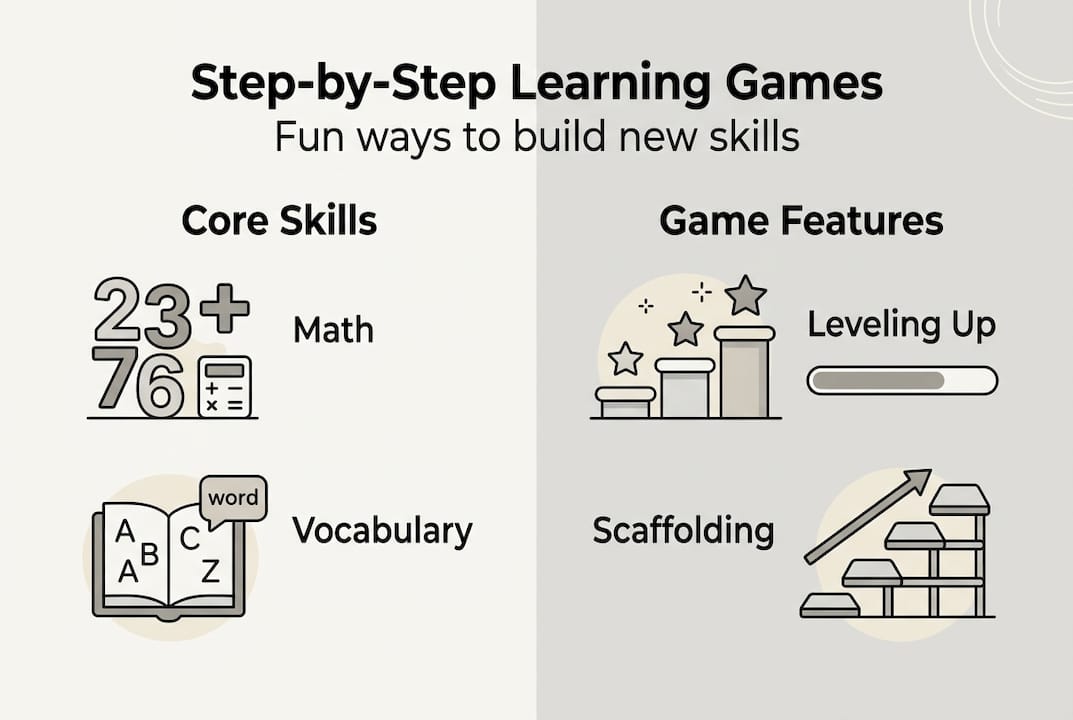
These games use mechanics like leveling, scaffolding, and tech trees to build skills gradually, whether that’s math, vocabulary, geography, or even relationship communication. Think of Brain Quest for kids building knowledge one question at a time, or Prime Climb turning multiplication into a colorful board race. For couples, games like TwoPlay or Monogamy use progressive prompts to deepen conversation naturally.
The benefits of educational board games go well beyond the obvious. They build patience, critical thinking, and social skills in a setting that feels like pure play. And because the difficulty scales, a 7-year-old and a 40-year-old can genuinely enjoy the same session.
Here’s a quick look at how different game types stack up:
| Game type | Best for | Skill focus | Example titles |
|---|---|---|---|
| Board games | Families, groups | Math, geography, strategy | Prime Climb, Ticket to Ride |
| Card games | Couples, small groups | Language, memory, communication | Scrabble Go, TwoPlay |
| Digital games | Solo or paired play | Personalized skill-building | Khan Academy Kids |
| Party games | Large groups | Trivia, social skills | Brain Quest, Codenames |
Key things that make these games stand out:
- Gradual progression keeps younger or newer players from feeling lost
- Adjustable difficulty means the game grows with your group
- Skill variety covers everything from phonics to relationship-building
- Short learning curves so you’re playing (not reading rules) within minutes
If you’re still on the fence about why board games work for kids and adults alike, the short answer is: they make learning feel like winning.
Tools and setup: Choosing the right game for your group
Now that you know the types of games and the mechanics involved, let’s look at how to pick and set up the perfect one for your event. The biggest mistake people make is grabbing whatever’s on the shelf without thinking about who’s at the table.
First, match the game to your group’s age range and skill focus. Prime Climb targets math, Scrabble builds language skills, and Ticket to Ride sneaks in geography and history. Each one has a different sweet spot, so knowing your crowd matters.

Second, decide between physical and digital. Physical board games support tactile bonding, while digital options like Khan Academy Kids offer personalized scaffolding that adjusts in real time. For a family game night, we almost always lean physical because there’s something about passing cards and moving pieces that keeps everyone present.
Here’s a simple setup checklist:
| Step | What to do |
|---|---|
| 1 | Choose a game suited to your group’s age and skill level |
| 2 | Read the rules yourself before game night (takes 5 minutes) |
| 3 | Set up the space: good lighting, enough seating, snacks ready |
| 4 | Prepare a notepad or phone for scorekeeping |
| 5 | Have a timer handy for timed rounds |
A few more things to keep in mind:
- Age appropriateness: Most games list a recommended age. Trust it, but also know your group.
- Group size: Some games shine with two players, others need six to really pop.
- Session length: Pick a game that fits your window. Most step-by-step games run 20 to 60 minutes.
- Comfort: Seriously, make sure everyone has a seat and can see the board. Uncomfortable players check out fast.
The educational board game advantages are maximized when the setup is right. A little prep goes a long way.
Pro Tip: Do a quick two-minute rules walkthrough before you start. Even experienced players appreciate a refresher, and it saves you from stopping mid-game to explain something basic.
How to play: Step-by-step instructions for a game night
Once the game and space are set up, it’s time to dive in with an easy-to-follow process. Here’s how we run a step-by-step learning game session from start to finish:
- Explain the core rules in plain language. Skip the rulebook monologue. Hit the three or four things everyone needs to know to take their first turn.
- Play a sample round together. Walk through one full round out loud so everyone sees how it works before the real game starts.
- Start with the easiest challenge level. Brain Quest uses progressive questioning where players advance by answering at or above their level. Start low and let players earn their way up.
- Add complexity each round. Once players are comfortable, introduce the next layer: harder questions, new rules, bonus cards, or timed turns.
- Pause for quick debriefs after big moments. When someone nails a tough question or makes a clever move, take 30 seconds to talk about it. Scaffolding and tiered challenges strengthen both learning motivation and knowledge retention.
- Use house rules to fine-tune the challenge. If the game feels too easy or too hard, adjust. Add bonus cards, change the time limit, or let younger players ask for hints.
- Wrap up with a quick recap. What did everyone learn? What was the funniest moment? This closes the loop and makes the experience stick.
The learning through board games process works best when it feels natural, not forced. Keep the energy light and let the game do the heavy lifting.
Pro Tip: Rotate who explains the rules each game night. It’s a sneaky way to reinforce understanding and gives everyone a chance to lead.
Troubleshooting and common mistakes in learning games
Minimizing stumbles can keep the experience positive and learning-focused. Here’s how to handle the most common bumps in the road.
The biggest issue we see? Difficulty mismatch. If players feel lost, they disengage fast. If it’s too easy, they get bored just as quickly. Over-scaffolding in games can actually reduce players’ perceived learning and motivation, so finding that sweet spot matters.
Here’s a quick troubleshooting list:
- Players seem frustrated: Drop back a difficulty level immediately. No shame in it.
- Rules confusion: Pause the game, answer questions, and replay the last round if needed.
- Someone’s checked out: Give them a special role (scorekeeper, timer, rule-checker) to re-engage them.
- Group dynamic stalls: Take a five-minute snack break and reset the energy.
- Younger players falling behind: Pair them with an older player as a team for a round or two.
“The best game nights aren’t the ones where everyone wins. They’re the ones where everyone wants to play again.”
Celebrate small wins loudly. When a younger player answers a tough question or a couple figures out a tricky puzzle together, make it a moment. Enthusiasm is contagious, and it keeps the table alive.
What to expect: Outcomes and benefits of step-by-step learning games
Having covered best practices and pitfalls, let’s look at the fun and practical payoffs you can expect from regular play. Spoiler: they’re pretty great.
The numbers back this up. Gamified progression boosted math scores by 12.7 points compared to just 6.8 points in control groups, with task accuracy hitting 84.2% and phonics mastery reaching 85%. That’s not classroom data. That’s what happens when learning is wrapped in a game.
Here’s what you and your group can realistically expect:
- Better knowledge retention: Skills learned through play stick longer than passive learning
- Stronger social bonds: Families and couples report feeling more connected after regular game nights
- Flexible play sessions: Most step-by-step games run 15 to 60 minutes, perfect for casual evenings
- Inclusive fun: Progressive difficulty maximizes engagement across all skill levels with minimal prep time
- Real-world skills: From math and vocabulary to communication and strategy, the skills transfer
We’ve seen it firsthand. A game that starts as a Friday night activity quietly becomes a weekly ritual. The learning sneaks in while everyone’s too busy laughing to notice.
Ready to level up your next game night?
If this guide has you excited to try something new, we’ve got you covered. At Playworldgame.com, we’ve put together a lineup of fast, social games built exactly for moments like these: family nights, couples evenings, and friend gatherings where you want everyone genuinely engaged.

From skill-based challenge games to trivia, couples conversation games, and music guessing games, there’s something for every group size and vibe. We know game nights work best when the game does the work, so every title in our collection is easy to learn and hard to put down. Browse our learning games and find your next favorite. And if you have questions or want a recommendation for your specific group, drop us a message. We love talking games.
Frequently asked questions
What are examples of step-by-step learning games?
Games like Brain Quest, Prime Climb, Scrabble, and Ticket to Ride use progressive steps to build skills in math, language, or geography, making them great picks for mixed-age groups.
How do step-by-step learning games help with learning?
They use leveling and scaffolding mechanics to introduce new skills gradually, so players build confidence and retain information without feeling overwhelmed.
Are these games suitable for adults as well as children?
Absolutely. Many step-by-step games adapt challenge and content for both kids and adults, especially titles with adjustable difficulty levels or multiple question tiers.
Can step-by-step games be played with just two people?
Yes! Games like TwoPlay and 7 Wonders Duel are built specifically for couples and offer light, progressive learning that works beautifully for a two-player night in.
What if my group loses interest or gets frustrated?
Adjust the difficulty, clarify any confusing rules, or switch to a shorter game format. Challenge adjustment is built into most learning games precisely so every group can find their fun zone.