


Every family knows the challenge of getting everyone engaged during game night, especially when ages and interests vary. Families across North America are discovering that general knowledge games turn group play into a lively, educational experience where everyone can shine. These games mix learning and laughter, creating real conversations and friendly competition that bring people together. If your family wants a way to connect meaningfully while having fun, general knowledge games offer the perfect mix of challenge and entertainment.
Table of Contents
- What Are General Knowledge Games?
- Popular Types and Gameplay Variations
- How They Boost Family Learning and Bonding
- Cognitive, Social, and Emotional Benefits
- Common Mistakes and How to Avoid Them
Key Takeaways
| Point | Details |
|---|---|
| Engaging Learning Experience | General knowledge games combine fun and competition, making learning enjoyable for all ages. |
| Variety of Gameplay | Different formats, such as trivia and puzzle-based games, cater to various player preferences and skill levels. |
| Strengthening Relationships | Playing these games promotes family bonding and enhances communication among participants. |
| Cognitive and Emotional Benefits | Regular gameplay improves memory, attention, and social skills, fostering a positive atmosphere for learning. |
What Are General Knowledge Games?
General knowledge games are interactive trivia and quiz games that test players’ knowledge across multiple subjects like history, geography, science, and culture. They’re designed to make learning fun and engaging while challenging everyone at the table.
These games work differently than traditional quizzes. Instead of sitting in silence with pencil and paper, you’re actively playing—answering questions, discussing answers, and earning points in real time. The atmosphere is social, competitive, and genuinely entertaining.
The core appeal is simple: You get to learn and compete simultaneously. Whether you’re 8 or 80, there’s something satisfying about knowing an answer or discovering you learned something new.
How They Work
General knowledge games typically follow this structure:
- One player or team answers a question from a broad topic area
- Correct answers earn points or advance gameplay
- Questions rotate through different categories or difficulty levels
- The game continues until someone reaches a point goal or time runs out
Interactive quiz formats come in both digital and card-based versions, depending on the game. Some games use boards and cards; others rely on apps or websites. The mechanics vary, but the goal remains the same: test knowledge across diverse topics.
Why They Stand Out from Other Games
General knowledge games differ from regular party games in one key way: they require actual knowledge rather than luck or strategy alone. You can’t win by chance—you need to know answers.
This creates a different kind of fun:
- Genuine competition based on what you actually know
- Conversations that matter because answers spark real discussion
- Everyone participates equally since questions work for mixed age groups
- Learning happens naturally without feeling forced
The best general knowledge games balance difficulty so everyone answers something correctly, keeping engagement high throughout the night.
Types of General Knowledge Content
Questioning covers a wide range of material:
- History and world events
- Geography and capitals
- Science and nature
- Literature and arts
- Pop culture and entertainment
- Sports and athletics
This variety means no single player dominates—someone who knows history might struggle with science trivia, while another player excels there. The diverse question pool keeps things competitive and interesting for everyone.
Pro tip: Choose games with adjustable difficulty settings if your group has mixed knowledge levels, so newer players stay engaged while experienced ones still feel challenged.
Popular Types and Gameplay Variations
General knowledge games come in many different formats, each offering a distinct way to test what you know. Some rely on pure trivia recall, while others blend in puzzles, strategy, or role-playing elements. The variety keeps game nights fresh and appeals to different player preferences.
Classic Trivia Games
Trivia games are the most straightforward format. One player reads a question, and other players race to answer correctly. Points go to whoever answers accurately, and the game continues until someone hits a score target.
These games work well because:
- Questions are self-contained and easy to understand
- Games can end quickly or last hours depending on your preference
- No complex rules to learn before playing
- Anyone can join mid-game without confusion
Trivia suits competitive groups who want direct, head-to-head knowledge challenges. The simplicity is the appeal.
Puzzle and Strategy Variations
Game mechanics that incorporate puzzles add a thinking layer beyond pure recall. Instead of answering a question directly, you might solve a riddle, complete a sequence, or use logic to reach the answer.
These games demand:
- Pattern recognition and problem-solving
- Longer thinking time per question
- Often higher difficulty than straight trivia
- Engagement from players who enjoy mental challenges
Strategy-based general knowledge games combine trivia with board game mechanics. You might earn resources, move on a board, or make tactical decisions that affect gameplay. These appeal to players who want more than just answering questions.
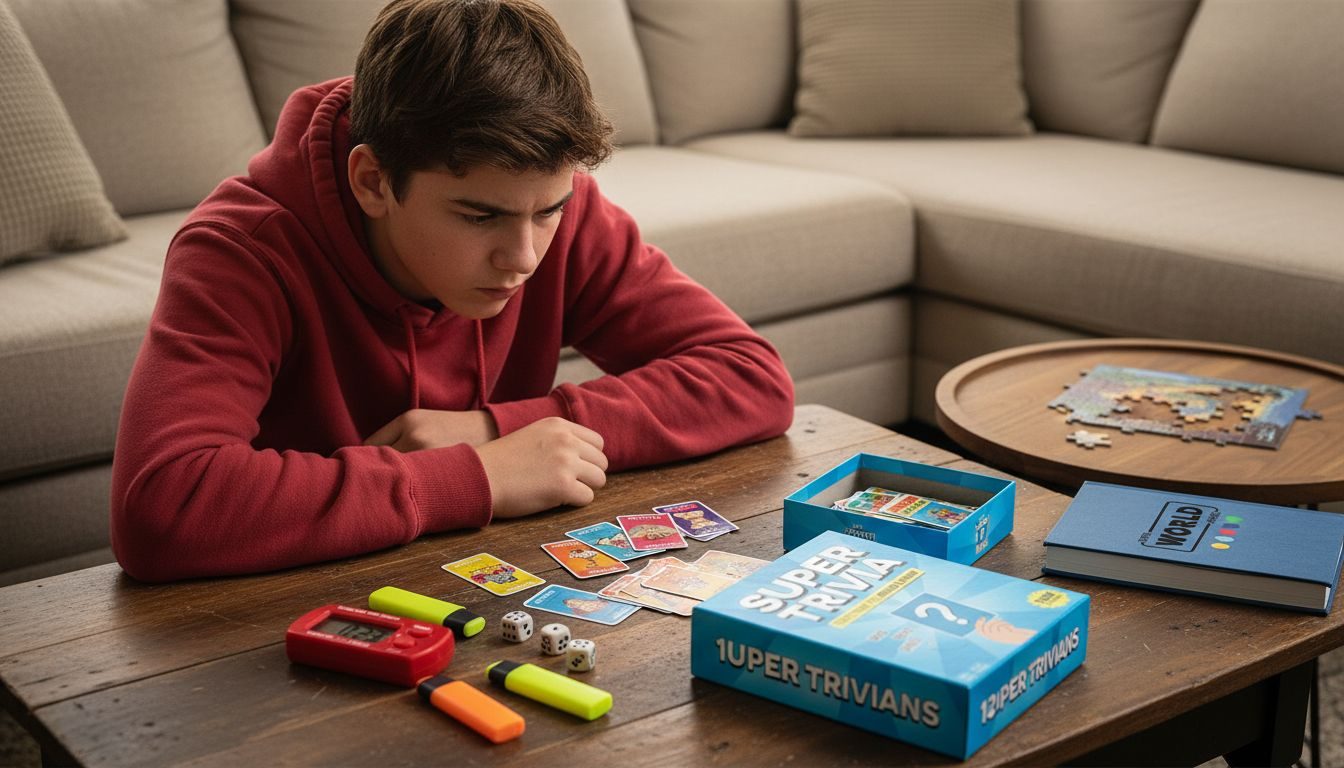
Team and Individual Play Formats
Gameplay varies based on player count and setup. Some games work best with pairs competing head-to-head, while others shine with larger group play.
Common participation structures include:
- Individual players competing separately
- Teams working together and discussing answers
- Rotating team members between rounds
- Mixed formats where some rounds are individual and others are team-based
The best general knowledge games let you choose how to play—solo competition or collaborative teams—so your group gets exactly the experience you want.
Team play encourages conversation and lets less confident players contribute without pressure. Individual play rewards solo knowledge. Many modern games offer both options so you customize based on who’s playing.
Digital and Hybrid Experiences
Digital platforms open new possibilities for general knowledge games. Apps and online versions can randomize questions, track scores automatically, and offer progressive difficulty that adjusts to player performance.
Hybrid games use cards with QR codes linking to digital content, or combine traditional cards with app-based scoring. These bridge physical and digital play seamlessly.
Pro tip: Start with classic trivia formats at your first game night, then experiment with puzzle or strategy variations once your group knows how you play together—this keeps early rounds simple and gradually introduces complexity.
Here’s a comparison of popular general knowledge game formats and their unique characteristics:
| Format Type | Main Focus | Typical Play Style | Ideal For |
|---|---|---|---|
| Classic Trivia | Direct knowledge recall | Competitive scoring | Fast-paced group fun |
| Puzzle-Based | Problem-solving and logic | Individual or small teams | Analytical thinkers |
| Strategy Hybrid | Board movement & tactics | Mixed, team or solo | Game night veterans |
| Digital/App | Adaptive content & scoring | Remote or in-person | Tech-savvy players |
How They Boost Family Learning and Bonding
General knowledge games do more than entertain—they create moments where families actually connect. When you play together, you’re talking, laughing, and sharing knowledge in a relaxed setting. This combination builds relationships while everyone learns something new.
Strengthening Communication
Trivia nights force conversation. Someone answers a question, someone else debates the answer, and suddenly you’re discussing history or science together. That back-and-forth is where real connection happens.
These games encourage:
- Open dialogue between parents and children
- Discussion about answers and reasoning
- Respectful debate and listening
- Sharing personal knowledge and experiences
Family engagement with general knowledge games creates natural opportunities for intergenerational conversation that might not happen otherwise. Kids learn how their parents think, and parents discover what their kids know. The game becomes the vehicle for genuine interaction.
Building Shared Knowledge Culture
When families play regularly, they develop a learning mindset together. It becomes normal to ask questions, admit you don’t know something, and celebrate when someone learns new information.
This culture shift includes:
- Normalizing curiosity across all age groups
- Creating a judgment-free space for wrong answers
- Celebrating learning moments together
- Building confidence in younger players
Parents who play with their children model that learning is lifelong and fun. Kids see that adults don’t know everything—and that’s okay.
Creating Lasting Memories
Game nights become traditions. Years later, families remember the night someone won with an obscure history fact or when the youngest player finally answered a difficult question correctly. These moments stick.
The bonding happens because:
- You’re all focused on the same activity
- Success is celebrated collectively
- Laughter comes naturally from the competitive spirit
- Everyone participates equally regardless of age
General knowledge games work because they combine learning, competition, and togetherness—the exact ingredients families need to feel closer.
Bridging Age Gaps
In many families, age differences create natural distance. Teens are in their rooms, younger kids are off playing, and adults are doing their thing. Games bring everyone to the same table.
A 10-year-old can outsmart a 40-year-old on pop culture questions. A teenager might surprise everyone with historical knowledge. This leveling of the playing field makes everyone feel valued.
Pro tip: Schedule game nights at a consistent time each week—Tuesday nights or Saturday afternoons—so it becomes a family tradition that everyone expects and looks forward to attending.
Cognitive, Social, and Emotional Benefits
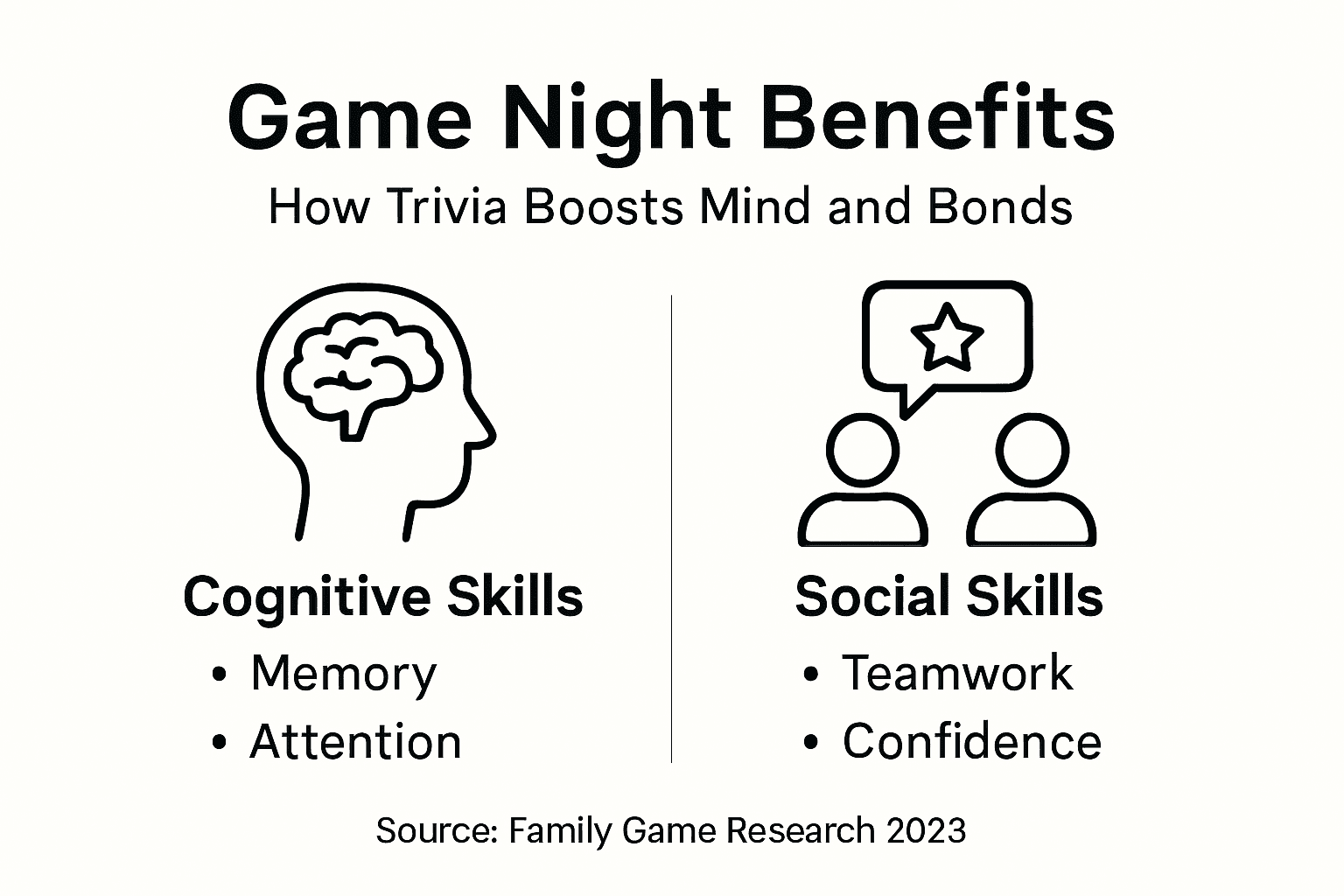
General knowledge games aren’t just fun—they actively strengthen your brain and your relationships. The combination of recall, reasoning, and interaction creates measurable cognitive and emotional gains that stick around long after game night ends.
Sharpening Memory and Attention
Answering trivia questions forces your brain to search memory banks and retrieve specific information. This repeated recall practice strengthens neural pathways related to memory storage and retrieval.
Regular play improves:
- Short-term and long-term memory retention
- Ability to focus during distractions
- Speed of information recall
- Capacity to retain new facts
Enhanced memory and improved attention are direct cognitive benefits of consistent gameplay. The more you play, the faster your brain retrieves answers. You’re literally training your mind like you’d train a muscle at the gym.
Building Executive Function Skills
Strategy-based general knowledge games demand more than just knowing facts. You must plan moves, anticipate opponents’ strategies, and make decisions under pressure.
These skills develop through gameplay:
- Strategic thinking and planning
- Decision-making under time constraints
- Problem-solving and logical reasoning
- Adapting tactics based on game progression
Executive function is the mental control system that helps you organize thoughts, manage time, and work toward goals. Games strengthen these abilities in a low-stakes, enjoyable environment.
Boosting Self-Esteem and Confidence
Winning feels good. Getting a difficult question right feels even better. Every correct answer builds confidence, especially for younger players still developing their sense of competence.
Emotional benefits include:
- Increased self-esteem from correct answers
- Resilience from handling wrong answers without judgment
- Confidence in speaking up during group activities
- Motivation to learn more across different topics
Failure in games carries no real consequences. This safe space to be wrong actually accelerates learning and builds emotional resilience.
Strengthening Social Bonds
Game-based learning improves social interaction skills by requiring players to communicate, negotiate, and cooperate. Even in competitive formats, you’re practicing turn-taking, listening, and responding thoughtfully.
Social skills that improve:
- Active listening and comprehension
- Taking turns and respecting rules
- Celebrating others’ successes
- Handling disappointment gracefully
General knowledge games provide a natural setting to practice social skills that matter in school, work, and life—all while having genuine fun.
Younger players learn how to handle competition respectfully. Adults reconnect through shared laughter and friendly rivalry. The social dynamics of game nights build stronger relational foundations.
Managing Stress and Building Enjoyment
Game nights offer a break from screens, work stress, and daily pressures. The focused fun of trivia provides genuine stress relief and mood improvement.
Pro tip: Start with easier difficulty levels so players experience early wins and confidence-building, then gradually increase complexity as comfort grows—this keeps motivation high and frustration low throughout the season.
The following table highlights key cognitive and emotional benefits from regular general knowledge game nights:
| Benefit Area | Skill Strengthened | Result for Players |
|---|---|---|
| Cognitive | Memory & attention | Faster recall, improved focus |
| Executive Function | Strategic planning | Better problem-solving abilities |
| Emotional | Self-esteem & resilience | Motivation and confidence boost |
| Social | Communication & teamwork | Stronger relationships |
Common Mistakes and How to Avoid Them
General knowledge games are straightforward, but a few common pitfalls can derail game night. Most mistakes stem from unclear rules, mismatched difficulty levels, or over-emphasizing competition at the expense of fun. The good news? They’re all easily avoidable.
Skipping the Rules Review
Players often jump into games without understanding mechanics. Someone misses a scoring rule, another disputes how questions work, and suddenly the flow breaks down.
Rule-related problems happen when:
- Players skip reading instructions before starting
- Complex rules aren’t clarified upfront
- House rules change mid-game without agreement
- Different players remember rules differently
Solve this by reading the rulebook aloud before your first game. Clarify confusing mechanics immediately. Write down any house rule changes so everyone stays aligned.
Ignoring Difficulty Mismatches
Picking a game that’s too hard frustrates weaker players. One that’s too easy bores skilled players. Pattern recognition and puzzle structures matter for maintaining engagement across your group.
Avoid this by:
- Choosing games with adjustable difficulty settings
- Mixing easy and harder questions in the same game
- Pairing newer players with experienced ones for team play
- Starting with moderate difficulty and adjusting based on feedback
A well-balanced game keeps everyone engaged. Pay attention to who’s winning and struggling after the first round.
Over-Relying on Competition
Leaderboards and aggressive scorekeeping can discourage sensitive players or those who know less trivia. When competition becomes the only focus, the bonding part gets lost.
Competitive elements require balancing with inclusive options. Consider:
- Playing some rounds cooperatively instead of competitively
- Using team formats so individual weak players aren’t exposed
- Celebrating learning moments alongside correct answers
- Keeping score loosely rather than obsessing over rankings
The goal is fun together, not winning at all costs.
Losing Sight of the Real Purpose
Some groups get so caught up in points that they forget why they’re playing—to connect and learn together. When competition overshadows bonding, game night feels like work.
Keep perspective by:
- Focusing on conversations and laughter first
- Using games as a vehicle for family time
- Pausing to celebrate interesting facts everyone learns
- Remembering that close matches are more fun than blowouts
The best game nights balance competition with connection—when people leave wanting to play again, you’ve succeeded.
Poor Question Selection
Trivia games with outdated or culturally biased questions alienate players. Questions that are too obscure or too simple kill engagement.
Pro tip: Before starting, do a quick rules walk-through by playing one sample round with everyone, then restart officially once everyone understands the mechanics and feels confident participating.
Bring Family Game Nights to Life with General Knowledge Games
The article highlights the power of general knowledge games to strengthen family bonds, boost learning, and create lasting memories through engaging, competitive fun. If you want to avoid common pitfalls like unclear rules and mismatched difficulties while enjoying genuine connection, the right game can make all the difference. Our collection offers a wide variety of skill-based challenge games and trivia options designed to keep everyone at the table involved and excited.

Discover how easy it is to turn your next get-together into a memorable experience packed with laughter, learning, and lively conversation. Explore our Browse All Games | The World Game to find the perfect general knowledge game tailored for your group. Don’t wait for another dull evening. Visit Playworldgame.com now to choose games that balance difficulty, encourage teamwork, and build confidence for players of all ages.
Frequently Asked Questions
What are general knowledge games?
General knowledge games are interactive trivia and quiz games that test players’ knowledge across various subjects like history, geography, science, and culture, making learning fun and engaging.
How do general knowledge games enhance learning in families?
These games promote open dialogue, encourage curiosity, and create a judgment-free space for discussing answers, allowing families to learn and bond together in a relaxed environment.
What types of questions are common in general knowledge games?
Common question types cover a wide range of topics, including history, geography, science, literature, pop culture, and sports, ensuring that no single player dominates and keeping the game interesting for everyone.
How can I choose the right general knowledge game for my group?
Consider selecting games with adjustable difficulty settings to engage players of mixed knowledge levels. Start with simpler formats for newcomers and gradually introduce more complex games as everyone’s comfort grows.
Recommended
- 7 Types of Educational Games Every Parent Should Know - The World Game
- 7 Types of Educational Games Every Parent Should Know - The World Game
- 7 Types of Educational Games Every Parent Should Know - The World Game
- 7 Types of Educational Games Every Parent Should Know - The World Game
- 7 Essential Family Camping Activities For Outdoor Learning - Tent Explorer