


Every parent faces the challenge of keeping geography lessons exciting while strengthening cultural understanding at home. Educational games go beyond simple fun, providing immersive and interactive tools that help children explore new places and cultures with curiosity. By integrating active participation and challenge-based experiences, game-based learning delivers clear academic benefits and encourages problem-solving for young minds. Discover how these dynamic activities can make geography and cultural studies memorable through engaging, interactive learning experiences.
Table of Contents
- Defining Educational Games In Homeschool Environments
- Types Of Games Used For Homeschooling
- Key Benefits For Children’s Learning
- Selecting And Integrating Games Effectively
- Common Challenges And Solutions
Key Takeaways
| Point | Details |
|---|---|
| Transformative Learning Approach | Educational games blend traditional instruction and interactive experiences, promoting cognitive development and skill acquisition. |
| Key Characteristics | Effective games foster active participation, feature aligned challenge-based content, and adapt to individual learning needs. |
| Cognitive and Emotional Benefits | Game-based learning enhances problem-solving, creativity, and social skills while reducing learning anxiety and building self-confidence. |
| Strategic Game Selection | Parents should evaluate educational games for alignment with learning goals and adaptability to maintain engagement and effectiveness. |
Defining Educational Games in Homeschool Environments
Educational games represent a transformative approach to learning that bridges traditional academic instruction with interactive, engaging experiences. In homeschool environments, these specialized learning tools go beyond simple entertainment, serving as powerful mechanisms for cognitive development and skill acquisition. Digital games in educational settings fundamentally reshape how children absorb and process information across multiple disciplines.
The core characteristics of effective educational games in homeschooling contexts include several critical components:
- Interactive learning experiences that promote active participation
- Challenge-based content aligned with academic learning objectives
- Immersive scenarios that encourage problem-solving skills
- Adaptive difficulty levels matching individual student capabilities
- Intrinsic motivation through game-based reward systems
Homeschool parents can leverage educational games as dynamic teaching instruments that transcend traditional textbook learning. These games transform abstract academic concepts into tangible, memorable experiences by creating scenarios where children actively construct knowledge through play. Complex subjects like geography, mathematics, and science become accessible through carefully designed interactive challenges that make learning feel like an exciting adventure rather than a mandatory task.
Game-based learning fundamentally differs from conventional educational approaches by prioritizing student engagement and intrinsic motivation. Unlike traditional instruction methods that often rely on passive absorption, educational games create environments where children become active participants in their learning journey. This approach not only enhances knowledge retention but also develops critical thinking, strategic planning, and collaborative skills.
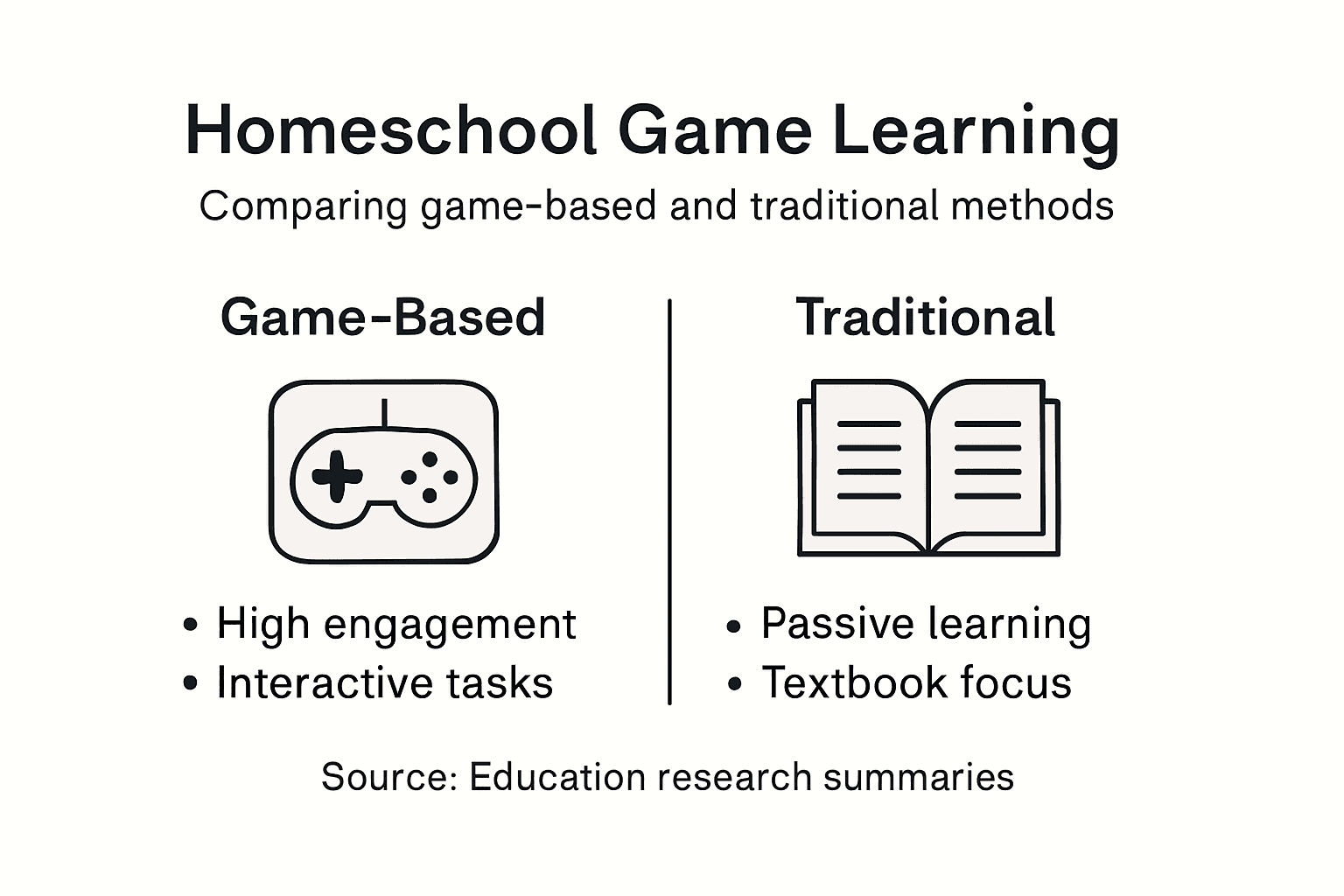
To help clarify the differences between game-based learning and traditional instructional methods, review this side-by-side comparison:
| Aspect | Game-Based Learning | Traditional Instruction |
|---|---|---|
| Student Engagement | High, interactive participation | Often passive, limited interaction |
| Motivation | Driven by intrinsic rewards | Depends on grades and external praise |
| Skill Development | Fosters critical thinking, strategy | Focuses on memorization and recall |
| Flexibility | Adaptive to student needs | One-size-fits-all curriculum |
| Retention | Learning is memorable and experiential | May lack long-term retention |
Pro tip: Select educational games that explicitly align with your current curriculum and provide clear learning outcomes to maximize educational value.
Types of Games Used for Homeschooling
Homeschooling parents have access to a diverse array of game types that can transform learning experiences across multiple disciplines. Entertainment video games applied in educational contexts offer unique opportunities for skill development and academic engagement. These game categories range from digital platforms to physical board games, each serving distinct educational objectives and learning styles.
The primary types of educational games used in homeschooling environments include:
-
Digital Games
- Puzzle games that develop logical thinking
- Strategy games promoting critical decision-making
- Role-playing games enhancing narrative comprehension
- Sandbox games encouraging creative problem-solving
-
Physical Games
- Board games targeting specific academic skills
- Escape room-style challenges developing collaborative abilities
- Geography and history simulation games
- Mathematical and scientific concept games
Homeschool parents can strategically select games that align with specific learning goals. Game-based learning mechanics provide opportunities to transform complex academic concepts into engaging, interactive experiences. By carefully curating game selections, educators can create immersive learning environments that make education feel more like an exciting adventure than a traditional study session.
Cognitive Development through game-based learning extends beyond simple entertainment. These interactive experiences help children develop essential skills such as problem-solving, strategic thinking, and collaborative communication. Video games and board games alike offer structured challenges that encourage learners to approach complex scenarios with creativity and analytical thinking.
Here’s a summary of how digital and physical games contribute to homeschool learning across key domains:
| Game Type | Academic Support | Skill Strengths | Typical Learning Domains |
|---|---|---|---|
| Digital Games | Customized challenges | Logic, creativity, analysis | Math, science, languages |
| Physical Games | Hands-on experience | Collaboration, reasoning | History, geography, social |
Pro tip: Rotate between different game types to maintain student engagement and target multiple learning domains effectively.
Key Benefits for Children’s Learning
Educational games in homeschooling represent a transformative approach to learning that goes far beyond traditional educational methods. These interactive experiences provide multifaceted benefits that support children’s cognitive, emotional, and academic development in ways traditional instruction cannot match. By creating engaging and adaptive learning environments, educational games help children develop critical skills while maintaining enthusiasm for learning.
The key benefits of game-based learning for children include:
-
Cognitive Development
- Enhanced problem-solving skills
- Improved logical and strategic thinking
- Better information processing and retention
- Increased creativity and innovative thinking
-
Emotional and Social Benefits
- Reduced learning anxiety
- Increased self-confidence
- Better collaborative skills
- Positive attitude toward challenges
Educational video games support comprehensive skill development by providing immersive environments that encourage active learning. These interactive platforms help children understand complex processes through direct engagement, transforming abstract concepts into tangible experiences. By simulating real-world scenarios, games enable children to practice and internalize skills in a safe, controlled setting.

Motivation plays a crucial role in educational games. Unlike traditional learning methods that can feel repetitive or disconnected, game-based learning creates intrinsic motivation by making educational challenges feel like exciting adventures. Children become active participants in their learning journey, developing a growth mindset that views challenges as opportunities for exploration and personal development.
Pro tip: Select games that gradually increase in complexity to maintain consistent challenge and engagement levels for your child.
Selecting and Integrating Games Effectively
Selecting educational games for homeschooling requires a strategic approach that goes beyond simple entertainment. Homeschool parents must carefully evaluate game elements to ensure they align with specific learning objectives and individual student needs. The process involves understanding each game’s potential to enhance cognitive skills, support curriculum goals, and maintain student engagement.
Key considerations for game selection include:
-
Educational Alignment
- Match game mechanics to specific learning outcomes
- Verify curriculum compatibility
- Assess skill development potential
- Ensure age-appropriate complexity
-
Game Evaluation Criteria
- Adaptability to student learning styles
- Intrinsic motivational elements
- Complexity of problem-solving challenges
- Interactive and collaborative features
Adaptive game-based learning emphasizes the importance of personalization in educational gaming. Successful integration means continuously adjusting game content to match the learner’s evolving skills and knowledge levels. This dynamic approach ensures that educational games remain challenging, relevant, and engaging throughout the learning journey.
Curriculum Integration demands a thoughtful approach where games become complementary learning tools rather than standalone activities. Effective homeschool parents view educational games as flexible resources that can be modified to reinforce specific academic concepts, track progress, and provide alternative methods of skill assessment.
Pro tip: Create a game evaluation spreadsheet that scores potential educational games across multiple learning dimensions to make systematic selection easier.
Common Challenges and Solutions
Challenges in educational gaming represent complex obstacles that homeschool parents must strategically navigate. While educational games offer tremendous learning potential, implementation requires careful consideration and proactive problem-solving. Understanding these challenges helps parents create more effective and engaging learning experiences.
Common challenges in game-based homeschool learning include:
-
Technological Barriers
- Limited access to digital platforms
- Inconsistent internet connectivity
- Hardware compatibility issues
- Age-appropriate technology management
-
Motivational Challenges
- Over-reliance on extrinsic rewards
- Maintaining sustained student interest
- Balancing entertainment and educational content
- Managing screen time effectively
Strategic gamification design offers comprehensive solutions to these implementation challenges. By developing targeted approaches that prioritize intrinsic motivation and learning outcomes, homeschool parents can transform potential obstacles into opportunities for enhanced educational experiences. This requires a nuanced understanding of game mechanics and learning psychology.
Pedagogical Adaptation demands that parents become active facilitators rather than passive observers. Successful game integration involves continuous learning, flexibility, and a willingness to experiment with different approaches. Parents must develop skills in game selection, monitoring student progress, and creating supportive learning environments that maximize educational potential.
Pro tip: Develop a flexible tracking system that monitors both game engagement and learning outcomes to continuously refine your educational gaming strategy.
Enhance Your Homeschooling Success with Engaging Educational Games
The article highlights the powerful role of games in boosting children’s learning through interactive, immersive experiences that develop critical thinking and intrinsic motivation. Many homeschool parents face challenges such as maintaining consistent engagement and integrating meaningful educational content aligned with curriculum goals. At Play World Game, we understand these pain points and offer a unique collection of card and board games focused on geography and general knowledge that turn abstract concepts into fun adventures your child will love.

Discover how our carefully designed educational games provide hands-on learning and foster cognitive skills while keeping motivation high. Explore our diverse selection by visiting Browse All Games | The World Game to find games that perfectly complement your homeschooling curriculum. Don’t wait to transform study time into memorable learning moments. Visit https://playworldgame.com today and join a community dedicated to making education both effective and enjoyable.
Frequently Asked Questions
What are educational games and how do they benefit homeschooling?
Educational games are interactive tools that combine learning with gameplay, making education engaging and enjoyable. They foster cognitive development, improve problem-solving skills, and enhance motivation, helping children retain knowledge through active participation.
How can I select the right educational games for my homeschool curriculum?
When selecting educational games, consider their alignment with your learning objectives, age-appropriate complexity, and capacity to adapt to your child’s learning style. Evaluate the game’s mechanics to ensure they are well-suited for the skills you aim to develop.
What types of games are most effective for homeschooling?
Effective games for homeschooling include digital games like puzzle and strategy games, and physical games such as board games and escape room challenges. Each type addresses various academic domains and learning styles, providing diverse educational experiences.
How do educational games differ from traditional learning methods?
Educational games prioritize student engagement and intrinsic motivation by creating interactive learning environments. Unlike traditional instruction, which often relies on memorization, game-based learning emphasizes active participation and critical thinking, leading to better knowledge retention.