


TL;DR:
- Trivia enhances long-term memory through active recall and spaced repetition, retaining up to 90% after a year.
- It engages learners socially and competitively, boosting motivation and making learning fun.
- Use trivia as a supplement, combining it with discussions and activities for deeper understanding.
Trivia gets a bad reputation as the thing you do between slices of pizza at a party. But here’s the surprising truth: playing trivia is one of the most effective ways to actually retain what you learn. Research backs this up, showing that trivia combines retrieval practice (which beats re-reading every time) with gamification to make knowledge stick. Whether you’re planning a family game night, organizing a party icebreaker, or just obsessed with trivia, understanding how trivia-based education works can completely change how you use it. This guide covers what it is, why it works, how to use it, and where most people go wrong.
Table of Contents
- Breaking down trivia-based education
- How trivia boosts memory and engagement
- Best settings and creative uses for trivia games
- Limitations and expert tips: when trivia is (and isn’t) enough
- A fresh perspective on using trivia for learning
- Ready to try trivia-based learning?
- Frequently asked questions
Key Takeaways
| Point | Details |
|---|---|
| Active recall advantage | Trivia games train your memory better than passive studying and keep learning lively. |
| Gamification powers | Points, leaderboards, and challenges add excitement and boost motivation to learn. |
| Long-term retention | Using spaced repetition in trivia helps you remember facts for a whole year or more. |
| Best as a supplement | Trivia works well with other methods; use it to reinforce, not just replace, deeper learning. |
Breaking down trivia-based education
Trivia-based education is exactly what it sounds like: using question-and-answer games to teach, review, and reinforce information in a fun, low-pressure setting. Instead of reading a textbook or watching a lecture passively, players actively recall facts to earn points, beat teams, or climb a leaderboard. That active piece is the whole secret.
At its core, this style of learning leans on a few powerful mechanics working together:
- Question-and-answer formats that force your brain to retrieve (not just recognize) information
- Points and leaderboards that make every round feel like a competition worth winning
- Teams and challenges that add a social layer, turning learning into a group experience
- Spaced repetition that brings topics back at intervals, reinforcing memory over time
- Active retrieval practice, which is consistently stronger than passive review for long-term retention
Platforms like Kahoot, Quizizz, and Gimkit have made this whole framework incredibly accessible. Teachers use them in classrooms, but families and party hosts are starting to catch on too. These tools let you customize topics, set timers, and even track who’s improving over time.
Here’s a quick look at how common trivia formats compare:
| Format | Best for | Engagement level | Retention potential |
|---|---|---|---|
| Live trivia night | Groups and parties | Very high | High |
| Digital platform (Kahoot) | All ages, adaptive | High | Very high |
| Card and board trivia games | Family nights | High | Moderate to high |
| Paper quiz sheets | Quiet gatherings | Moderate | Moderate |
One number that blew us away when we first saw it: players using spaced repetition in trivia-style formats can retain up to 90% of information after 12 months. That’s not a typo. Compare that to reading notes once and forgetting most of it within a week. If you’ve ever wondered why some knowledge from a great game night sticks with you for years, now you know why. That kind of educational entertainment isn’t just fun. It’s genuinely working.
How trivia boosts memory and engagement
Let’s get into the good stuff. Why does trivia actually work so well compared to other ways of learning?
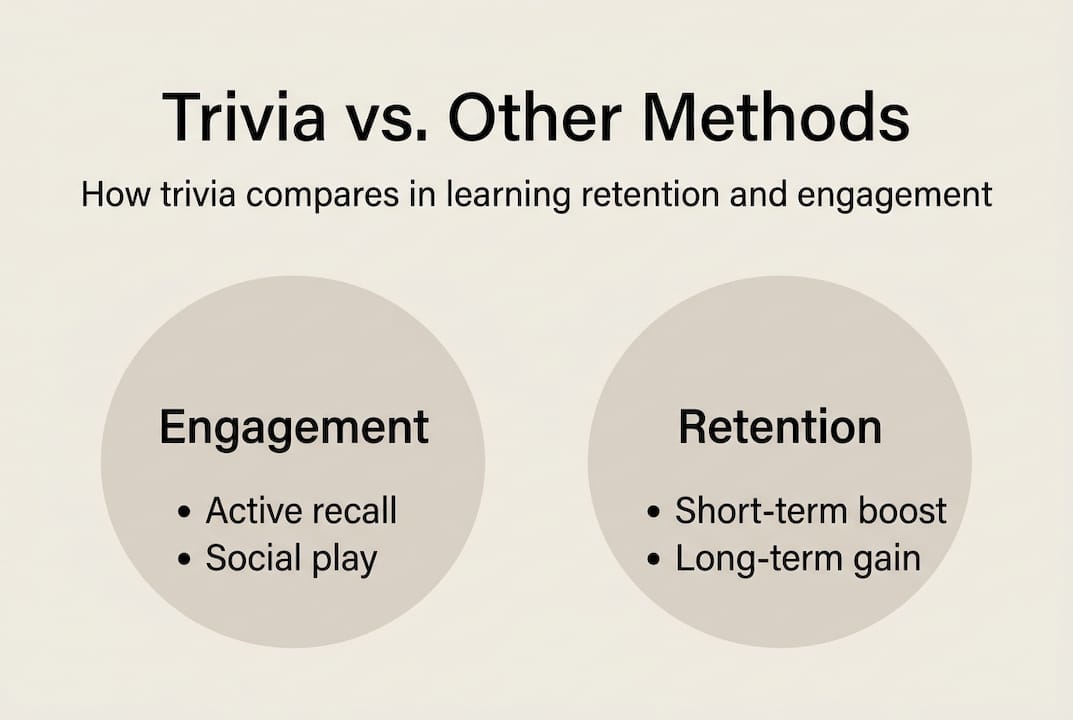
The core answer is active recall. When you try to pull an answer out of your memory (even if you’re wrong), your brain strengthens the neural pathway connected to that piece of information. Passive methods like re-reading or watching a video don’t create the same effect. Learning science confirms that trivia earns high marks for active recall compared to rote memorization, which leads to shallow retention and poor transfer to new situations.
Here’s how the methods stack up:
| Learning method | Engagement | Retention (short-term) | Retention (long-term) | Social factor |
|---|---|---|---|---|
| Trivia games | Very high | High | High (with spaced play) | Strong |
| Rote memorization | Low | Moderate | Poor | None |
| Passive video watching | Low | Low | Low | None |
| Discussion/projects | High | High | Very high | Strong |
Trivia also wins on the social side. Competing with friends or family raises the stakes just enough to keep everyone alert and invested. You remember the round where you beat your cousin on a geography question. You remember the answer because winning felt great. That emotional connection is part of why games that boost learning outperform solo study.
Here’s a practical breakdown of how to use trivia for maximum memory impact:
- Play in short bursts rather than marathon sessions. Twenty focused minutes beats an hour of passive scrolling.
- Return to topics over time. Revisit questions from two weeks ago to lock in spaced repetition benefits.
- Mix easy and hard questions. Easy wins build confidence; tough ones stretch the brain.
- Debrief after rounds. Talking through why an answer is correct deepens understanding.
- Use spaced boosters for retention, since regular trivia check-ins can push long-term retention toward that 90% mark.
“Trivia done right isn’t just a quiz. It’s a brain workout disguised as something you actually want to do on a Friday night.”
The catch? Trivia isn’t great for teaching complex reasoning or creative problem-solving on its own. Think of it as an incredible foundation layer, not the whole house.
Best settings and creative uses for trivia games
Now for the fun part. Knowing trivia works is great. Knowing where and how to use it is even better.
For family game nights, trivia is one of the easiest ways to sneak learning into an evening without anyone feeling like they’re in school. Geography rounds work brilliantly because everyone has an opinion about places. Science trivia sparks real conversations. Pop culture trivia keeps teenagers engaged (and occasionally humbles the adults). The variety keeps things fresh.
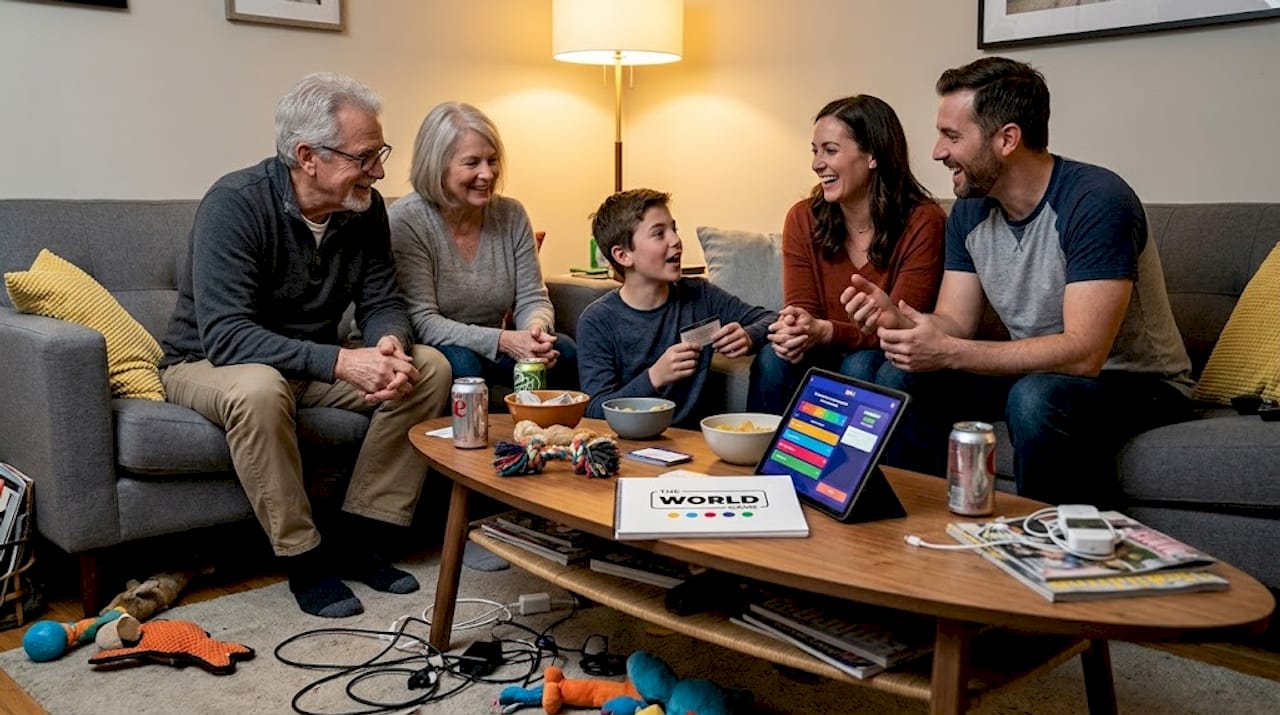
For parties and gatherings, trivia icebreakers are underrated. A quick three-round trivia game at the start of an event gets people talking, breaks social tension, and gives guests something to bond over immediately. Team-based trivia is especially good here because it mixes people who might not know each other and gives them an instant shared goal.
Here are some creative ways to build your next trivia experience:
- Theme it to the crowd. Movie buffs? Go cinema trivia. Foodies? Test kitchen knowledge. Sports fans? You already know.
- Go adaptive. Digital platforms like Kahoot, Quizizz, and Gimkit adjust difficulty automatically or let you set it manually based on age or skill level.
- Add physical challenges. Every wrong answer could mean doing five jumping jacks. Every winning team gets to pick the next round’s category.
- Create custom card decks. Building questions around your group’s shared interests makes the whole thing feel personal and way more memorable.
- Run themed months. Pick a topic (space, history, animals) and play a short round every week using spaced repetition naturally.
Pro Tip: Set a recurring trivia night on your calendar. Even a monthly fifteen-minute round with your family or friends creates the kind of spaced repetition that keeps knowledge fresh. Bonus: it gives everyone something to look forward to.
If you’re curious about the game creation process, building your own custom trivia decks is more accessible than most people think. Personalizing questions to your group’s age range and interests makes a huge difference in how much everyone enjoys (and learns from) the experience.
Limitations and expert tips: when trivia is (and isn’t) enough
Trivia is genuinely powerful. But using it as your only learning tool is a mistake. Here’s where it falls short and how to work around that.
Trivia excels at fact recall. Dates, names, definitions, quick formulas. It struggles with higher-order thinking: analyzing arguments, synthesizing ideas, creating original work. If you use trivia to teach a child about the American Revolution, they might nail every date and general’s name. But will they understand why it happened or what it changed? Not from trivia alone.
“The best educators we’ve seen use trivia as the spark, not the fire. It lights curiosity, then other activities fan it into real understanding.”
Here are the most common mistakes people make:
- Using trivia as the only teaching method. Pair it with discussion, projects, or storytelling for richer results.
- Making it too competitive too fast. Some players shut down when they feel outmatched. Balance the difficulty to keep everyone in the game.
- Playing the same questions repeatedly. Variation keeps the brain working. Rotate topics and formats.
- Skipping the debrief. Without a moment to talk through answers, the learning doesn’t fully land.
- Ignoring quieter players. Not everyone thrives in competitive formats. Mix in team play so everyone contributes.
Pro Tip: Pair trivia with a simple follow-up activity. After a history trivia round, watch a three-minute clip about the topic. After science trivia, try a quick experiment. The trivia primes the brain; the follow-up deepens the roots.
The smartest approach, as trivia experts confirm, is using trivia as a supplement rather than a standalone solution. Think of creating educational games as building a toolkit, not picking one perfect tool.
A fresh perspective on using trivia for learning
Here’s what most guides won’t tell you: trivia’s biggest power isn’t actually in the answers. It’s in the questions.
When someone hears a question they can’t answer, their brain enters a curious, activated state. Researchers call this the “desirable difficulty” effect. The struggle to retrieve something, even unsuccessfully, primes the brain to absorb the correct answer more deeply. So losing at trivia might actually be better for learning than winning easily.
We’ve seen this firsthand designing and playing trivia games across all kinds of groups. The rounds that generate the most laughter, debate, and follow-up conversation aren’t the easy ones. They’re the ones where nobody was sure and everyone had an opinion.
The uncomfortable truth is that trivia can feel intimidating for some players, especially those who fear looking uninformed in front of others. The fix isn’t dumbing it down. It’s building a culture where wrong answers are funny, not embarrassing. Team formats help enormously here.
Check out our educational entertainment insights for more on how to blend fun and real learning in ways that work for every kind of group.
Ready to try trivia-based learning?
If reading all this has you itching to run your own trivia night, we’re right there with you. The World Game is built exactly for moments like this: families who want game nights that feel fun AND meaningful, party planners who need something everyone will love, and trivia fans who want fresh, well-crafted challenges.
Our collection includes geography trivia, world knowledge games, and a whole range of fast, social games that work beautifully as icebreakers or centerpieces for any gathering. You can discover more trivia games that fit your group’s age range, interests, and vibe. No classroom required. Just good questions, good company, and maybe a little friendly competition.
Frequently asked questions
What types of topics work best for trivia-based education?
Fast facts in history, science, geography, pop culture, and language are ideal for trivia games because they reward direct recall. Trivia works best for concrete facts rather than complex reasoning tasks.
How can I make trivia games fun for all ages?
Customize questions by age, skill level, and interests using digital platforms or themed card decks. Adaptive difficulty settings on platforms like Kahoot help ensure nobody feels left behind or bored.
Does playing trivia really help long-term memory?
Yes, especially when combined with spaced repetition. Players using structured trivia formats can retain up to 90% of information after 12 months, far outperforming passive study methods.
Are digital trivia platforms better than classic paper games?
Digital platforms add leaderboards, adaptive questions, and real-time feedback, making them more interactive. But Kahoot, Quizizz, and Gimkit work best when you want personalization, while card and board games win for warmth and simplicity on a family game night.