


TL;DR:
- Social card games prioritize conversation, social interaction, and shared moments over strategy or points. They employ mechanics like bluffing, roleplay, and prompts to foster connection, laughter, and inclusivity in groups. These games are powerful tools for building community, reducing social anxiety, and creating lasting memories through fun and engaging play.
Most people assume card games are all about strategy, luck, or beating everyone else at the table. But there’s a whole category of games that tosses that idea right out the window. Social card games aren’t about who draws the best hand or racks up the most points. They’re about getting everyone talking, laughing, and actually enjoying each other’s company. In this article, we’re breaking down exactly what social card games are, how they work, what makes them tick, and how to find the perfect one for your next gathering.
Table of Contents
- What is a social card game?
- Core mechanics and types of social card games
- Why social card games shine at gatherings and game nights
- How to choose the right social card game for your group
- The unexpected power of social card games: more than just fun
- Bring more laughter to your next game night
- Frequently asked questions
Key Takeaways
| Point | Details |
|---|---|
| Definition focus | Social card games use cards to boost conversation and interaction, not just scoring. |
| Core mechanics | Common types feature roles, bluffing, deduction, or conversation prompts for group engagement. |
| Group fit | Choose games that match your group’s energy, comfort level, and age range. |
| Real benefits | These games not only entertain but also foster connections and social skills. |
What is a social card game?
Here’s the thing: social card games look like regular card games on the outside. There’s a deck, there are cards, and yes, sometimes there’s a winner. But the real magic happens in between the turns, when someone has to defend their bluff, share an embarrassing story, or convince the whole table they’re not the traitor.
As a genre, a social card game is generally defined as a card game whose primary value is social interaction among players, including discussion, persuasion, bluffing, or conversation, often through hidden information, roleplay, or prompt and guessing formats. That’s a mouthful, but in plain terms: the cards are a trigger, not the main event. The people around the table are the main event.
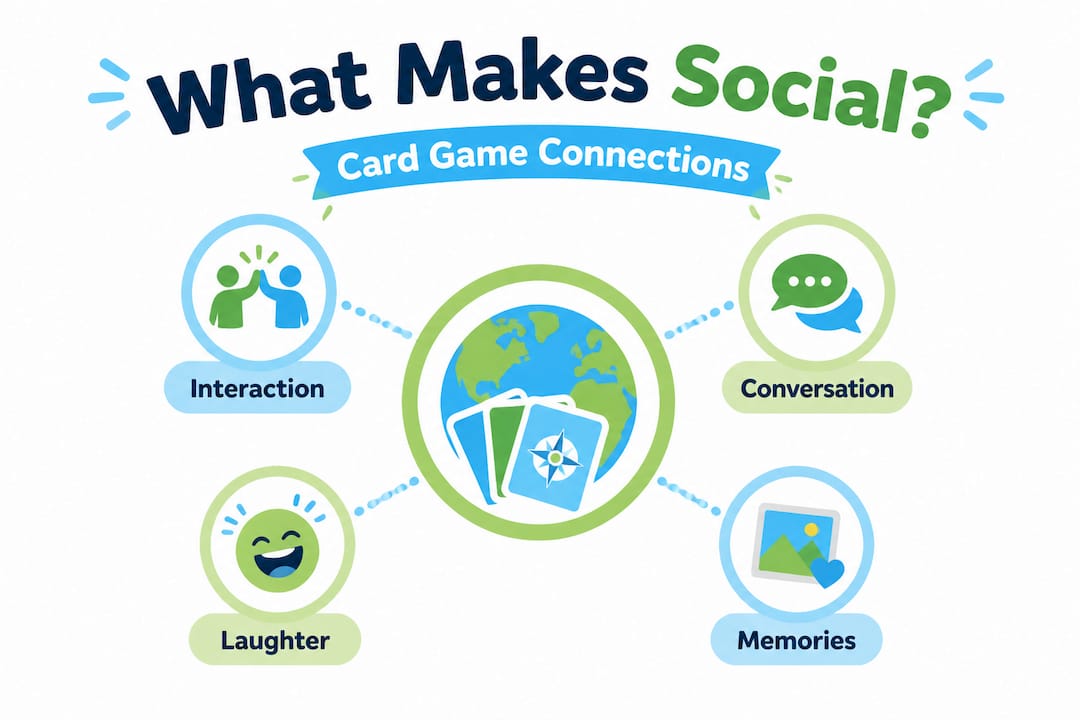
It’s also worth knowing that there is no single official definition for “social card game.” It works as a genre label for games that put social dynamics front and center while still using cards as a core component. That flexibility is actually what makes the genre so fun and so hard to pin down.
Here’s a quick look at how cards function differently in social games compared to traditional ones:
- As prompts: A card gives you a question or scenario, and the group reacts together.
- As secrets: One player holds hidden information (a role, a fact, a lie) that everyone else tries to uncover.
- As roles: Cards assign identities like “spy,” “villager,” or “detective” that shape how you interact.
- As conversation starters: Perfect for icebreakers or conversation card games that just want to get people talking.
“The cards are just the spark. What lights up the room is the conversation, the laughter, and the moments you didn’t see coming.” That’s the real value of a social card game.
The bottom line: if the card primarily drives discussion or creates a social moment rather than just moving you closer to a win condition, you’re probably playing a social card game.
Core mechanics and types of social card games
Now that you know social card games are designed for bringing people together, let’s break down the unique features that make these games so engaging. Not all social card games feel the same because they don’t use the same tools. The mechanics are what give each type its personality, and choosing the right mechanic for your group can make or break the night.
Common mechanics in this genre include hidden roles and deduction (known as social deduction), turn-based reading and guessing where players react to each other in real time, and conversation-prompt deck formats designed to spark dialogue among friends and families. Each of these creates a completely different table vibe.
Here’s a breakdown of the most popular types:
- Social deduction games: Players are assigned secret roles, and the group has to figure out who’s who through questioning, observation, and a bit of paranoia. Think werewolf-style dynamics. Great for competitive or mystery-loving groups.
- Conversation prompt games: Cards give players questions, scenarios, or challenges to respond to. No winners or losers, just genuine conversation. Perfect for icebreakers or first-time hangouts.
- Guessing and bluffing games: Players make claims, others try to catch the lie, and everyone gets to feel like a detective (or a very convincing fibber). These work well for groups that love a little friendly chaos.
- Roleplay or storytelling decks: Cards assign personas or situations, and players build a story together. A bit more creative, but wildly entertaining when the group leans in.
Here’s a quick comparison of the three main social card game types:
| Mechanic type | Core interaction | Skill involved | Best for |
|---|---|---|---|
| Social deduction | Hidden roles, voting, accusation | Bluffing, reading people | Competitive friend groups |
| Conversation prompts | Open questions, storytelling | Listening, sharing | Icebreakers, mixed groups |
| Guessing and bluffing | Claims, challenges, deduction | Deception, logic | Casual parties, families |
Understanding what defines party card games as a format helps you see why mechanics matter so much. A deduction game with a shy group can feel like pulling teeth. A conversation prompt deck with the same group? Instant laughs.
Pro Tip: For high-energy groups who love friendly competition, go with a deduction or bluffing mechanic. For quieter guests or brand-new social circles, a conversation prompt deck is a gentler on-ramp that still delivers tons of fun.
Why social card games shine at gatherings and game nights
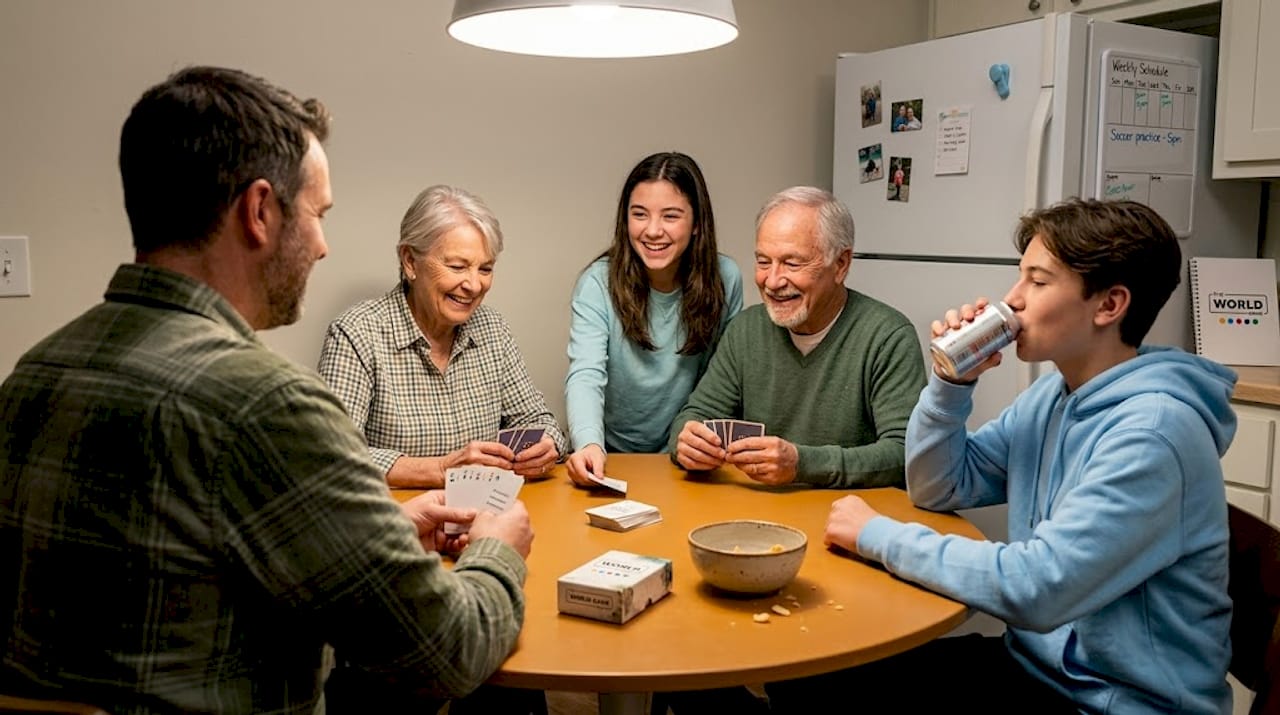
Now that you see the mechanics, let’s explore why these games make such a genuine difference in real social situations. We’ve played a LOT of games at gatherings, and we’ve noticed that social card games do something most other games can’t: they make everyone feel like they belong at the table.
One of the clearest ways to gauge whether a game is truly social is to ask a simple question: do the cards drive discussion, or are they just a scoring tool? According to the framework of social interaction in gaming, the cards must primarily act as the prompt, secret, or constraint that drives discussion rather than functioning as just a scoring mechanism. That distinction matters a lot when you’re planning a party and want everyone actually talking.
Here’s what we’ve seen happen at real game nights when social card games hit the table:
- Instant icebreakers: Even guests who don’t know each other well have something to respond to. The card does the hard work of starting the conversation.
- Shared laughter: Bluffing gone wrong, unexpected answers, and wild guesses create moments everyone remembers long after the night ends.
- Reduced pressure: Because the game gives you a prompt or a role, there’s less social pressure to “perform.” The structure makes it easy to participate.
- Stronger bonds: Studies on building social skills through play consistently show that shared experiences and laughter create lasting connections between people, even relative strangers.
- Inclusive participation: No one gets left out when the mechanic is conversation or roleplay. Everyone gets a turn that matters.
We’ve also noticed that social card games work especially well in mixed groups. Whether you’ve got grandparents and teenagers at the same table or a room full of coworkers who barely know each other, these games create a level playing field. Nobody needs to be an expert. Nobody needs to know complicated rules. You just need to show up and engage.
Pro Tip: Pull out a social card game at the beginning of your gathering, not after dinner when everyone is sleepy and full. Starting with a quick, fun round gets the energy up and sets a playful tone for the whole night.
How to choose the right social card game for your group
Understanding the benefits is great, but how do you actually pick the perfect social card game for your next gathering? This is where a lot of people get stuck. They walk into a store (or scroll through a website) and feel overwhelmed by options. We get it. Here’s how we think about it.
The most important first step is reading the room before you even look at a game box. Social deduction style games that create interaction through hidden roles and bluffing can be a blast for “higher engagement” groups, but they can be more sensitive to group comfort with suspicion and teasing. Not every group loves the idea of accusing their best friend of being a traitor, and that’s totally fine.
Use this quick checklist before choosing party games for your crowd:
- Age range: Are you playing with kids, adults, or a mix? Look for games labeled for the appropriate age group.
- Group size: Some social card games shine with 4 players, others need 8 or more to really sing.
- Play time: Got 15 minutes or 90? Match the game length to your actual schedule.
- Comfort with bluffing: Some groups LOVE the tension of deception. Others find it stressful. Know your crowd.
- Familiarity: First-time gamers need simple rules. Regular game-night crews can handle more complexity.
- Mood: Chill night in? Go with conversation prompts. High-energy party? Grab a guessing or deduction game.
Here’s a quick reference table of popular social card game types and when they work best:
| Game type | Best situation | Group size | Play time |
|---|---|---|---|
| Conversation prompts | First meetups, icebreakers, date nights | 2 to 8 players | 20 to 60 min |
| Social deduction | Game nights, friend groups, parties | 5 to 12 players | 30 to 60 min |
| Guessing and bluffing | Family nights, casual parties | 4 to 10 players | 15 to 45 min |
| Roleplay and storytelling | Creative groups, team events | 4 to 8 players | 30 to 90 min |
One more thing we always tell people: don’t overthink it. The best social card game is the one you’ll actually play. A game sitting on a shelf doesn’t do anyone any good. Pick something that matches the vibe of your group even loosely, and the social dynamics will take care of the rest.
The unexpected power of social card games: more than just fun
Having shared strategies for selecting games, let’s reflect on why these games matter more than most people assume. And honestly? We think this is something the broader board game conversation gets wrong a lot.
Most people file social card games in the “light entertainment” category. Something you pull out between dinner and dessert. Fun, sure. Memorable, maybe. But important? Not many people would use that word. We would.
Here’s our honest take: social card games are one of the most underrated tools for building real human connection. We’ve watched a shy teenager find their voice at a family game night because a prompt card gave them something to say. We’ve seen coworkers who barely talked at the office crack each other up over a bluffing round and come to work on Monday genuinely friendlier. We’ve watched new couples discover surprising things about each other through a conversation deck that neither of them would have brought up on their own.
The role of social interaction in building real community is something researchers and psychologists have long supported. But you don’t need a study to see it. You just need one solid game night.
What we’ve noticed is that the best social card games create shared memories, not just shared laughs. When you reference an inside joke from a game three months later and everyone at the table gets it instantly, that’s a group tradition being born. That’s community being built, one ridiculous bluff at a time.
We also think these games quietly teach skills that matter. Reading the room. Listening carefully. Knowing when to push and when to hold back. How to be a gracious loser and a humble winner. None of those lessons feel like lessons because they’re wrapped in fun. But they stick.
So yes, they’re a great time. But they’re also a genuinely powerful way to bring people closer, reduce social anxiety in new situations, and create the kind of evenings people actually talk about later. Don’t underestimate them.
Bring more laughter to your next game night
Ready to put all of this into action? Here’s where you can explore and find the perfect social card games for your group.
At Playworldgame.com, we’ve built our collection around exactly the kind of games we’ve been talking about throughout this article. Fast to learn, genuinely fun, and designed to get everyone at the table laughing and connecting.

Whether you’re looking for a conversation deck for couples night, a guessing game for a big family gathering, or a bluffing game to liven up your next friend hangout, we’ve got you covered. Our lineup includes something for every group size, age range, and energy level. Seriously, browse the social card and party game collection and you’ll find your next game night favorite in minutes. Stop scrolling through options that aren’t built for real people having real fun, and find the game that actually fits your crowd.
Frequently asked questions
What is the main difference between a social card game and a traditional card game?
A social card game focuses on interaction, conversation, and group dynamics, while a traditional card game typically emphasizes strategy, competition, or luck. In a social card game, the people and the conversation are the point, not just the final score.
Are social card games suitable for young children and mixed-age groups?
Yes, many social card games feature simple rules, teamwork elements, or conversation-based play that works across a wide range of ages. Look for games with a recommended age range that matches your youngest player, and you’re usually set.
Do you need to be outgoing to enjoy a social card game?
Not at all. In fact, one of the best things about these games is that the structure does the social heavy lifting for you. Prompts, roles, and guided mechanics help shy or quieter players jump in naturally, because social card games encourage participation from all players through built-in mechanics rather than requiring you to “perform” on your own.
What are some easy-to-teach social card games?
Conversation prompt decks are the easiest starting point since you just read a card and respond. Guessing and bluffing games are also quick to pick up, often explained in two minutes or less. If your group is new to the genre, skip complex deduction games for your first night and work up to those once everyone’s comfortable.
Recommended
- How party games build social skills and connections - The World Game
- Conversation card games for fun, bonding, and laughter - The World Game
- Social Interaction in Gaming: Boost Bonds 30% in 2026 - The World Game
- Birthday Party Match Game – US Novelty
- Cartes de conversation #01 : l’icebreaker ultra-simple et efficace · Vibes 🏳️🌈