


Classroom excitement can fade fast when lessons feel repetitive, but introducing card games brings fresh energy into geography classes. Card games are more than entertainment; they are structured activities combining strategy, skill, and chance, making learning interactive and memorable for growing minds. Educators will discover how these engaging tools foster collaboration and deepen geographic understanding, offering practical approaches to make lessons vibrant and meaningful for every student.
Table of Contents
- Card Games As Educational Tools
- Types Of Classroom Card Games
- Boosting Engagement And Participation
- Enhancing Geography Learning Outcomes
- Building Collaboration And Social Skills
Key Takeaways
| Point | Details |
|---|---|
| Educational Value | Card games enhance critical thinking, mathematical reasoning, and strategic planning, making learning engaging and enjoyable. |
| Game Selection | Teachers should choose games aligned with educational objectives to ensure effective learning outcomes. |
| Cognitive Skill Development | Card games foster memory enhancement, decision-making skills, and analytical thinking through interactive play. |
| Social Skills Enhancement | Playing card games promotes collaboration, communication, and conflict resolution skills among students. |
Card games as educational tools
Card games are far more than simple entertainment. They represent sophisticated learning platforms that engage students through strategic play, cognitive challenge, and interactive experiences. Systematic research on educational card games demonstrates their powerful potential for transforming classroom learning dynamics.
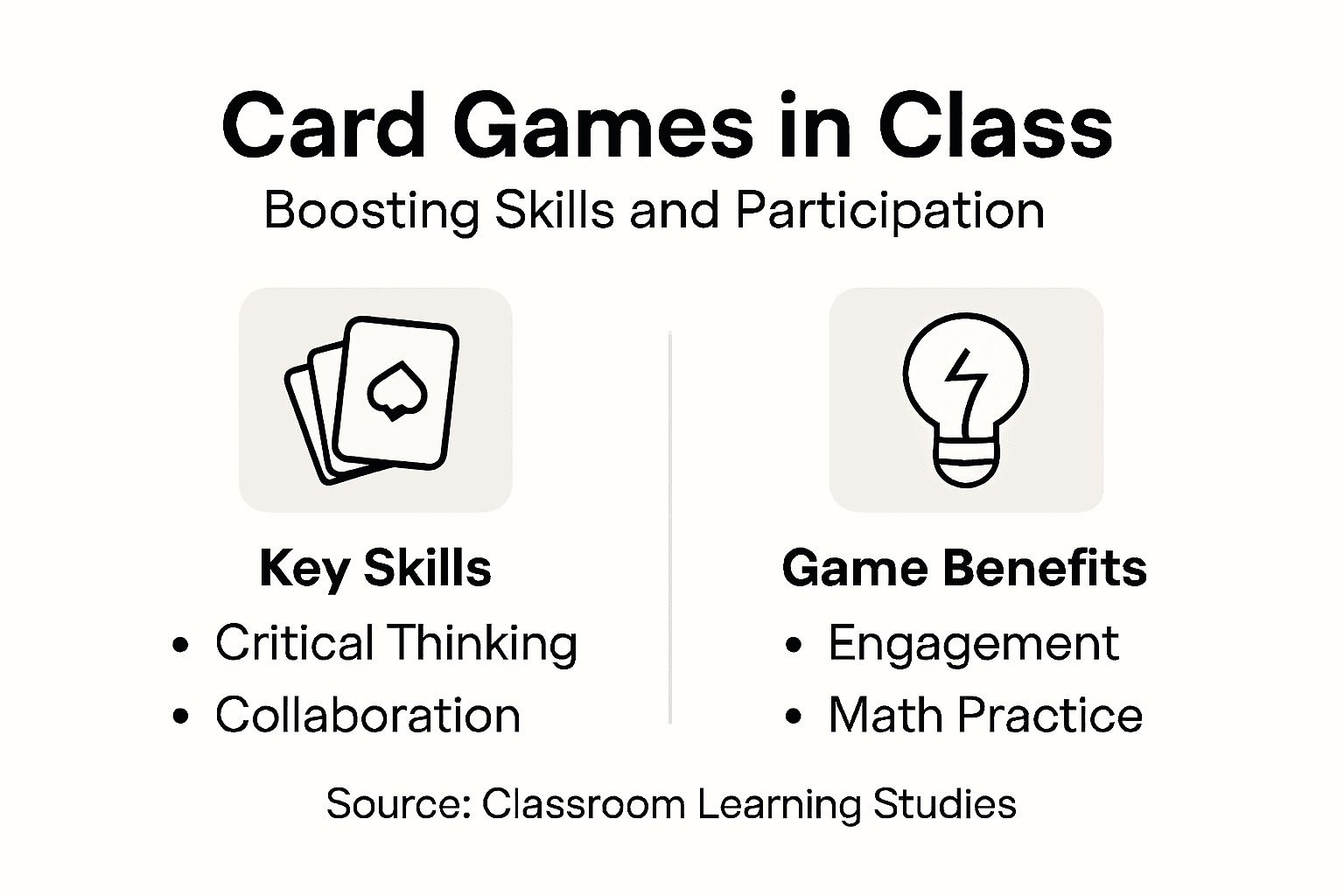
These interactive tools offer multiple cognitive benefits. Card games require players to develop critical thinking skills, practice mathematical reasoning, enhance memory capacity, and learn strategic decision making. By introducing elements of chance, competition, and skill, card games create dynamic learning environments where students voluntarily invest mental energy. Students naturally practice complex cognitive processes while experiencing enjoyment and social interaction.
The educational value of card games extends beyond traditional subject boundaries. Mathematical reasoning, pattern recognition, and strategic planning emerge as key learning outcomes. Academic research highlights card games as structured activities that simultaneously develop cognitive skills across multiple domains. Students learn probability, practice numerical computations, and develop analytical thinking through engaging gameplay mechanics.
Classroom implementation requires thoughtful design and clear learning objectives. Teachers must select games that align with specific educational goals, facilitate structured debriefing, and create opportunities for reflective discussion about gameplay strategies and outcomes.
Pro tip: Select card games with built-in complexity that allow progressive skill development and provide multiple pathways for student learning and engagement.
Here’s a summary of key cognitive skills fostered by card games in educational settings:
| Skill Developed | Example Card Game Activity | Classroom Impact |
|---|---|---|
| Critical Thinking | Evaluating opponents’ strategies | Improves problem-solving |
| Mathematical Reasoning | Calculating probabilities in play | Enhances numerical literacy |
| Memory Enhancement | Remembering card sequences | Supports retention and recall |
| Strategic Planning | Choosing timely moves | Builds decision-making skills |
Types of classroom card games
Card games in educational settings are diverse and strategically designed to support different learning objectives. Research on educational card games reveals two primary categories: commercial card games adapted for classroom use and custom-designed educational games tailored to specific learning outcomes.
The first category includes traditional commercial card games like UNO, which educators can modify to teach mathematical concepts, probability, and strategic thinking. These games provide a familiar framework that students find engaging, allowing teachers to introduce academic skills through gameplay. Other standard card games such as Uno, Rummy, and Blackjack can be adapted to teach numerical operations, pattern recognition, and basic mathematical reasoning.
A second category comprises specialized educational card games created explicitly for learning purposes. These games are intentionally designed with direct educational goals in mind, targeting specific cognitive skills, subject knowledge, or academic competencies. Examples include geography card games that teach global knowledge, science-themed card games exploring scientific concepts, and mathematics-focused games that challenge students’ computational and logical reasoning skills.
Classroom implementation requires careful selection and strategic game design. Successful educational card games balance challenge, entertainment, and clear learning objectives, ensuring students remain motivated while developing crucial cognitive skills.
Pro tip: Select card games that offer multiple difficulty levels to accommodate different student skill ranges and provide opportunities for progressive learning challenges.
Compare these two approaches for classroom card game selection:
| Approach | Description | Ideal For | Typical Examples |
|---|---|---|---|
| Commercial Game Adaptation | Modifying popular card games for learning | General skill development | UNO, Rummy, Blackjack |
| Custom Educational Game Design | Creating games for specific learning goals | Targeted academic outcomes | Geography or math games |
Boosting engagement and participation
Gamification elements in educational settings demonstrate remarkable potential for transforming student motivation and classroom dynamics. Card games represent a powerful interactive tool that naturally increases student engagement by introducing elements of competition, challenge, and immediate feedback.
The psychological mechanisms behind card game engagement are complex and multifaceted. Students experience intrinsic motivation through gameplay mechanics that provide clear goals, instant performance feedback, and progressive difficulty levels. These game structures create a safe environment where students can take intellectual risks, experiment with strategies, and learn from immediate consequences without traditional academic pressure.
Research on executive function development reveals that interactive card games stimulate cognitive processes beyond simple entertainment. These games enhance attention spans, improve working memory, and develop cognitive flexibility. By transforming learning into an active, participatory experience, educators can create classroom environments that students genuinely enjoy and voluntarily engage with.
Successful implementation requires thoughtful game selection, clear learning objectives, and strategic facilitation. Teachers must balance game mechanics with educational goals, ensuring that playful interactions translate into meaningful cognitive development.
Pro tip: Create a classroom reward system that recognizes both game performance and collaborative learning behaviors to maintain sustained student engagement.
Enhancing geography learning outcomes
Thematic card games in geography education demonstrate remarkable potential for transforming spatial understanding and geographic knowledge acquisition. By integrating interactive gameplay with geographic content, educators can create dynamic learning experiences that move beyond traditional memorization techniques.
Card games offer unique advantages in geographic skill development. Students engage with spatial relationships, country locations, cultural characteristics, and geographic terminology through hands-on, interactive experiences. The game mechanics encourage active learning, where players must process geographic information quickly, make strategic decisions, and recall complex spatial details under playful competitive conditions.
Card game pedagogical strategies reveal how structured gameplay can systematically improve learner engagement and knowledge retention. Geographic card games can be designed to target specific learning outcomes, such as understanding continent boundaries, recognizing national capitals, comparing population densities, or exploring cultural diversity. These targeted approaches transform abstract geographic concepts into tangible, memorable experiences.
Effective implementation requires carefully curated game designs that balance educational objectives with engaging gameplay. Teachers must select or develop card games that challenge students intellectually while maintaining an enjoyable, low-pressure learning environment.
Pro tip: Rotate geographic card game themes regularly to maintain student interest and cover diverse global learning objectives.
Building collaboration and social skills
Social and emotional learning strategies demonstrate that card games are powerful tools for developing interpersonal skills and collaborative competencies. These interactive experiences create structured environments where students learn to communicate, negotiate, and work together effectively.
Card games inherently require players to engage in complex social interactions. Students must learn to read social cues, communicate strategies, manage emotional responses to winning and losing, and collaborate or compete with peers in a controlled setting. These experiences help develop crucial social skills such as turn-taking, respectful communication, conflict resolution, and strategic thinking.

Collaborative learning through card games provides a unique platform for students to practice teamwork and interpersonal communication. Group card games encourage students to develop shared goals, negotiate rules, provide constructive feedback, and support each other’s learning. By creating scenarios that require active listening, empathy, and cooperative problem solving, these games transform social skill development into an engaging, enjoyable experience.
Successful implementation requires carefully designed game structures that balance competition with collaboration, ensuring that social learning remains positive and inclusive. Teachers play a critical role in facilitating these interactions, guiding students to recognize and practice constructive social behaviors.
Pro tip: Design card game activities with rotating team compositions to help students practice collaboration with diverse peer groups.
Unlock the Power of Card Games for Engaged Classroom Learning
The article highlights how card games boost critical thinking, strategic planning, and collaboration while making geography and general knowledge exciting for students. If you want to overcome challenges like low engagement and limited interactive tools in your classroom, it is vital to incorporate games that combine fun with education. Card games with progressive difficulty and real-world themes create immersive learning moments that inspire attention and teamwork.

Experience firsthand how thoughtfully designed card games can transform education by visiting PlayWorldGame. Explore a variety of games that teach about countries, cultures, and geography in engaging ways built to enhance memory and reasoning skills. Don’t wait to spark curiosity and motivation in your learners. Visit PlayWorldGame today and discover how these interactive educational tools can make a lasting difference.
Frequently Asked Questions
How can card games enhance critical thinking skills in students?
Card games require players to evaluate strategies, make decisions, and solve problems, thereby significantly boosting critical thinking skills in students.
What types of card games are ideal for teaching mathematical concepts?
Commercial card games like UNO and Rummy can be adapted to teach mathematical operations, while specialist educational games designed specifically for math help reinforce numerical and logical reasoning.
How do card games promote social skills in the classroom?
Card games encourage students to engage in social interactions, supporting the development of skills such as communication, negotiation, and turn-taking in a structured and enjoyable environment.
What factors should teachers consider when implementing card games in the classroom?
Teachers should align game selection with specific educational goals, ensure the games facilitate active participation, and create opportunities for reflective discussions about gameplay strategies.
Recommended
- Benefits of Geography Card Games for Kids - The World Game
- Benefits of Geography Card Games for Kids - The World Game
- Benefits of Geography Card Games for Kids - The World Game
- Benefits of Geography Card Games for Kids - The World Game
- 7 formas divertidas de aprender inglés y mejorar tus habilidades - Academia Atenea