


TL;DR:
- Truly educational toys are open-ended, promote creativity, and encourage social interaction.
- Match toys to developmental stages and prioritize safety, ignoring age labels on packaging.
- Cooperative games and intentional play foster better social skills and deeper learning outcomes.
Most parents and gift shoppers want playtime to be more than just fun. They want games and toys that teach, connect, and actually get used more than once. But walk down any toy aisle or scroll through an online store, and the choices feel endless and overwhelming. How do you know which ones will spark real learning and keep the whole group laughing and engaged? This guide breaks it all down, from what makes a toy genuinely educational to how to pick the right ones for family game nights, mixed ages, and group gatherings that everyone actually looks forward to.
Table of Contents
- What makes an educational toy genuinely engaging?
- Age, developmental stage, and safety: What you must know
- Step-by-step: Selecting toys for game nights and group play
- Common mistakes and how to avoid them
- Why intentional, cooperative play matters more than ever
- Ready to level up your family’s play and learning?
- Frequently asked questions
Key Takeaways
| Point | Details |
|---|---|
| Choose open-ended toys | Toys with flexible uses foster creativity, active play, and growth in children. |
| Prioritize developmental fit | Match toys to the child’s needs and abilities for maximum engagement and learning. |
| Go for cooperative play | Board and card games that encourage teamwork build communication and social skills at group gatherings. |
| Safety and quality matter most | Fewer, non-toxic, durable toys suited to your home environment are safer and less overwhelming for kids. |
What makes an educational toy genuinely engaging?
Not every toy with the word “educational” on the box earns it. The ones that truly deliver share a few key traits, and once you know what to look for, the difference becomes obvious fast.
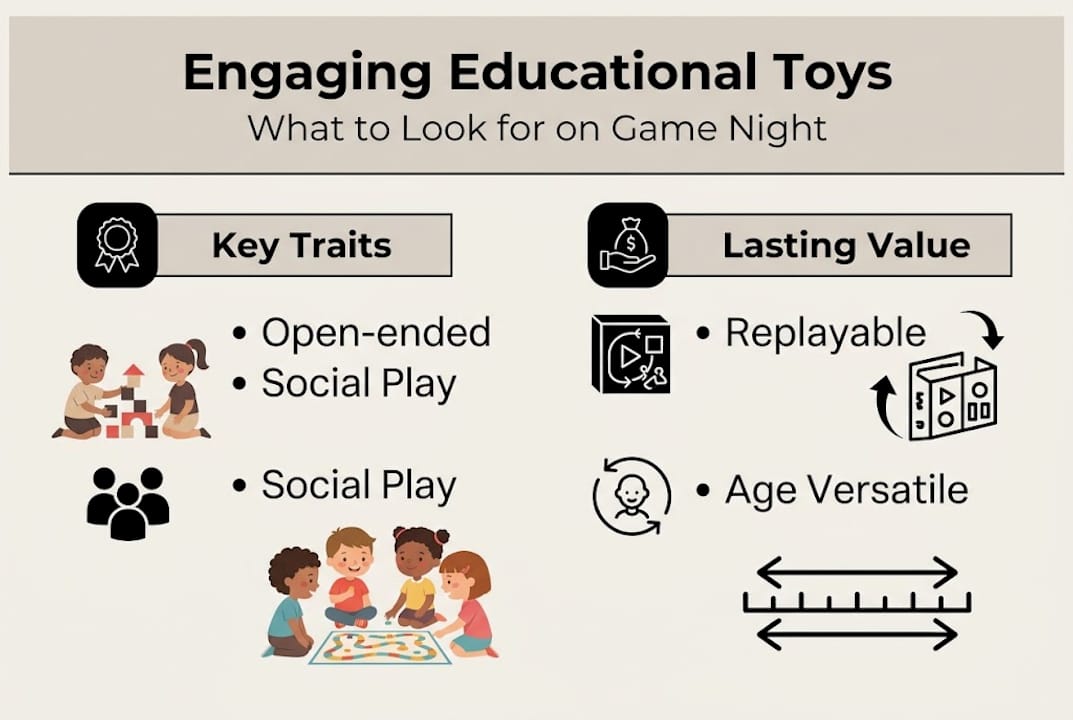
The biggest factor is open-ended design. Open-ended toys don’t have one correct outcome. Blocks, art supplies, pretend play sets, and card games with flexible rules all fall into this category. They invite creativity, problem-solving, and repeated play because the experience changes every time. Prioritize open-ended toys for sustained engagement and real developmental benefits. Compare that to a single-use electronic toy that plays the same five songs and lights up the same way every time. Kids figure it out once, then move on.
Here’s a quick comparison to show the difference:
| Toy type | Replay value | Social potential | Learning depth |
|---|---|---|---|
| Open-ended (blocks, card games) | High | High | Deep |
| Scripted electronic toys | Low | Low | Surface |
| Art and craft kits | Medium-High | Medium | Medium-Deep |
| Pretend play sets | High | High | Deep |
Social interaction is another huge piece of the puzzle. Toys and games that get kids playing together build something that solo screen time simply can’t. Social pretend play predicts better social maturity and stronger interpersonal skills over time. Group play also reduces conflict because kids practice negotiation, turn-taking, and reading social cues in real time.
The best educational toys for group settings check these boxes:
- Flexible rules that accommodate different ages and skill levels
- Hands-on interaction that keeps everyone physically involved
- Clear but simple mechanics so no one spends 20 minutes reading instructions
- Room for creativity so the experience feels fresh each time
- Natural conversation starters built into the gameplay
For families who love game nights, games that focus on fostering social skills are especially worth exploring. They hit the sweet spot between fun and meaningful.
Pro Tip: Watch how your child naturally plays when left alone. Do they build, perform, sort, or storytell? The best toy matches their instinctive play style, not just the age printed on the box.
Age, developmental stage, and safety: What you must know
Understanding what makes toys engaging is just the start. Ensuring the right fit for your child’s age and safety is equally important.
Here’s something most people get wrong: age labels on toy boxes are marketing guidelines, not developmental prescriptions. A five-year-old who hasn’t developed fine motor skills yet will struggle with a toy labeled for ages four and up. Match toys to your child’s developmental stage instead of relying on box ranges alone.
Here’s a practical stage-by-stage guide:
| Stage | Age range | Best toy types |
|---|---|---|
| Infant | 0 to 12 months | Soft rattles, high-contrast visuals, sensory mats |
| Toddler | 1 to 3 years | Stacking toys, simple puzzles, play dough |
| Preschool | 3 to 5 years | Pretend play, simple card games, building blocks |
| School-age | 6 to 12 years | Strategy games, cooperative board games, trivia |
For group play specifically, school-age children thrive with games that build teamwork because they have the cognitive and emotional tools to collaborate meaningfully.
Safety checks matter just as much as developmental fit. Before buying, run through this checklist:
- Look for non-toxic material certifications (ASTM F963 in the US is the standard)
- Check for small parts that pose choking risks for children under three
- Confirm the toy is durable enough to survive enthusiastic group play
- Avoid toys with sharp edges, loose strings over seven inches, or easily breakable components
- Check for non-toxic materials and choking hazard warnings on every label
Worth noting: For neurodivergent children or kids with sensory sensitivities, look for toys with muted colors, minimal unexpected sounds, and tactile variety. Open-ended, low-stimulation options like soft building sets or cooperative card games often work beautifully for a wide range of sensory needs.
Pro Tip: When shopping for group play with mixed ages, always calibrate to the youngest player in the group for safety, but choose a game complex enough to keep the oldest player genuinely interested.
Step-by-step: Selecting toys for game nights and group play
Now that you know what to look for, here’s exactly how to select the right toys to make group play nights both educational and fun.
Family game night is one of the best natural contexts for group learning. Everyone is already gathered, the stakes are low, and the mood is playful. That’s the perfect environment for cooperative learning to happen almost invisibly.
One of the first decisions to make is cooperative versus competitive play. Competitive games have their place, but cooperative games increase communication, sharing, and teamwork in family groups in ways that head-to-head competition rarely does. Research also shows that cooperative games produce superior positive social outcomes in group settings overall.
Here’s a step-by-step process for picking the right group toy or game:
- Define your group. Who’s playing? Note the age range, any sensory or learning needs, and how competitive the group tends to be.
- Set a play goal. Are you aiming for laughs, learning, or both? Knowing your goal narrows the field fast.
- Check the player count. Make sure the game works for your actual group size, not just two to four players when you have eight.
- Read the setup time. Games that take 30 minutes to set up rarely survive a busy family evening. Aim for under 10 minutes.
- Look for built-in flexibility. The best group games adapt easily for games for building teamwork across different skill levels.
- Try before you commit. If possible, borrow from a library or friend before buying.
Some great cooperative game examples for different ages:
- Ages 4 to 6: Simple matching or memory games where everyone wins together
- Ages 7 to 10: Storytelling card games, cooperative trivia, or creative challenge games
- Ages 10 and up: Strategy-based cooperative games, music guessing games, or social deduction games with team elements
- Mixed ages: Fast card games with simple rules that level the playing field naturally
For mixed-age groups, the golden rule is: simple enough for the youngest, interesting enough for the oldest. Fast-paced card games tend to nail this balance better than complex board games.
Common mistakes and how to avoid them
Selecting toys can still go wrong. Here’s how to dodge the most common errors for a successful playtime and learning experience.
The biggest mistake we see? Buying quantity over quality. A pile of cheap, single-use toys creates clutter and short attention spans. One well-chosen game that gets pulled out every Friday night is worth ten toys that get opened once.
Other mistakes that quietly derail game night:
- Ignoring age and developmental fit. A toy that’s too advanced frustrates kids. Too simple and they’re bored in five minutes.
- Chasing trends. That viral toy might be everywhere right now, but ask whether it has actual replay value or just hype.
- Overlooking sensory needs. Loud, flashy toys can shut down kids who are sensitive to overstimulation before the game even starts.
- Skipping safety checks. Small parts, flimsy construction, and unlabeled materials are real risks, especially in group settings with younger kids mixed in.
- Defaulting to screens. Screens and scripted electronic toys limit active learning and genuine social engagement. Kids consume rather than create.
The fix for most of these is the same: slow down the buying decision. Ask whether the toy invites the child (or group) to do something, make something, or communicate something. If the answer is yes, you’re on the right track.
Games that focus on building social skills through games are a reliable anchor for any toy collection because they grow with the group over time.
Pro Tip: Before buying, ask yourself: “Will this game still be fun in six months?” If you can’t confidently say yes, it’s probably not worth the shelf space.
Stat to know: Research consistently shows that hands-on, open-ended play produces deeper learning outcomes and longer engagement than passive or scripted toy experiences.
Why intentional, cooperative play matters more than ever
Here’s our honest take: most families are busier than ever, and that makes truly intentional playtime a rare and valuable thing. When you do carve out time for a game night or a group play session, the toys and games you choose carry more weight than people realize.
We’ve seen firsthand how one great cooperative game can shift the entire energy of a family gathering. Kids who usually argue start working together. Adults who feel awkward around kids suddenly have a shared language. That’s not magic. That’s good game design doing its job.
The contrarian truth is that the most impactful gifts are rarely the most expensive or the most talked-about. They’re the ones that get used, again and again, by real people in real moments. Choosing teamwork game strategies over flashy novelty is a small shift that pays off in relationships and memories.
Intentional toy selection isn’t overthinking it. It’s just giving play the respect it deserves.
Ready to level up your family’s play and learning?
You now have a solid framework for choosing educational toys that actually get used, spark real conversations, and make group play genuinely fun. The next step is finding the right games to put that knowledge into action.

At Playworldgame.com, we curate fast, social games built exactly for family game nights, gift-giving, and group gatherings. Whether you’re after a skill-based challenge, a music guessing game, or something that gets everyone talking and laughing, we’ve got options that deliver on both fun and learning. Discover family games that fit your crew and make your next game night one worth repeating.
Frequently asked questions
What are the top three qualities to look for in an educational toy?
Open-ended design, developmental fit, and support for social interaction are the three qualities that consistently produce the best educational value in toys and games.
Are electronic toys or apps ever a good choice for learning?
Occasionally, but screens and scripted toys generally limit active learning and creativity compared to hands-on, open-ended options that encourage real social interaction.
How do I pick toys safe for group play with different ages?
Check labels and certifications, avoid small parts for groups with young children, and lean toward cooperative games with simple rules that work across a wide age range.
What about toys for neurodivergent kids or sensory needs?
Choose sensory-friendly, open-ended toys tailored to individual preferences, and avoid toys with sudden loud sounds, bright flashing lights, or overly complex instructions that can cause overwhelm.