


TL;DR:
- Clear, concise instructions using goal, mechanics, and demo keep game nights lively and confusion-free.
- Preparing materials, setting rules early, and having backup games ensure smooth transitions and sustained energy.
- Flexibility and quick pivoting are key to maintaining engagement and creating memorable game experiences.
Nothing kills a game night faster than a five-minute rules lecture while everyone stares at their phones. We’ve all been there: the host pulls out a box, unfolds a giant rulebook, and suddenly the whole room loses that excited energy it had just moments before. The good news? You don’t need to be a professional emcee or a board game expert to explain games clearly and get everyone playing in under two minutes. This guide walks you through exactly how to deliver party game instructions that land fast, keep the vibe going, and make sure nobody feels left out or confused.
Table of Contents
- Why instruction style matters for party games
- Party game prep: What you’ll need for a smooth night
- Foolproof instructions for classic party games (with examples)
- Troubleshooting: Common mistakes and ways to recover mid-game
- A seasoned host’s take: What really works (and what doesn’t)
- Fuel your next game night with even more great games
- Frequently asked questions
Key Takeaways
| Point | Details |
|---|---|
| Keep instructions short | Explain only the essentials in under two minutes to keep everyone engaged. |
| Start with easy games | Choose collaborative or simple games to boost group confidence and fun. |
| Show, don’t tell | Demonstrate a round to help everyone learn the rules by doing. |
| Be ready to pivot | Switch games or roles quickly if energy drops or confusion sets in. |
Why instruction style matters for party games
Here’s something most hosts don’t think about until it’s too late: the way you explain a game matters just as much as the game itself. You can have the funniest, most perfectly chosen game in the world, and still watch it flop because the explanation took too long or left people more confused than when you started.
Long, complicated rule explanations are energy killers. The moment you start reading bullet points from a folded pamphlet, you’ve lost half the room. People start side conversations. Someone heads to the snack table. The momentum you built getting everyone together just evaporates.
The fix? A simple three-part instruction model: goal first, quick mechanics, demo round.
- Goal first: Start by telling people what they’re trying to accomplish. “You’re trying to score the most points by acting out words silently.” Done.
- Quick mechanics: Cover only the rules they need to START. Save edge cases for when they actually come up.
- Demo round: Play one round together, out loud, before keeping score. Nothing teaches a game faster than actually playing it.
As hosting guides consistently point out, short goal-first explanations, learning by doing, and having backup games ready are the keys to keeping the night from stalling. The best hosts treat instructions like a movie trailer, not a documentary.
A few common pitfalls we see inexperienced hosts fall into:
- Reading rules word-for-word from the box insert
- Explaining every exception before anyone has played a single turn
- Not demoing a round before “officially” starting
- Sticking rigidly to the full rulebook when players are clearly confused
“Start with a light warm-up game, keep rule explanations short, and pivot if energy drops.” This is genuinely the most practical game night energy tip we’ve come across.
Pro Tip: Always have a backup game in your pocket. If one game isn’t clicking, switching to something shorter or sillier can completely reset the room’s energy. Check out our board game night tips for more ways to keep the momentum going all evening.
With the importance clear, let’s get specific about what you need to prepare.
Party game prep: What you’ll need for a smooth night
The secret to smooth instructions is almost always good prep work done before anyone walks through your door. When you’ve already sorted the cards, set up the board, and mentally rehearsed your two-minute explanation, delivering it feels completely natural.
A solid approach is to plan your session as a 2 to 3 hour arc with 2 to 3 games plus breaks built in. This keeps things varied and gives you natural transition points between games.
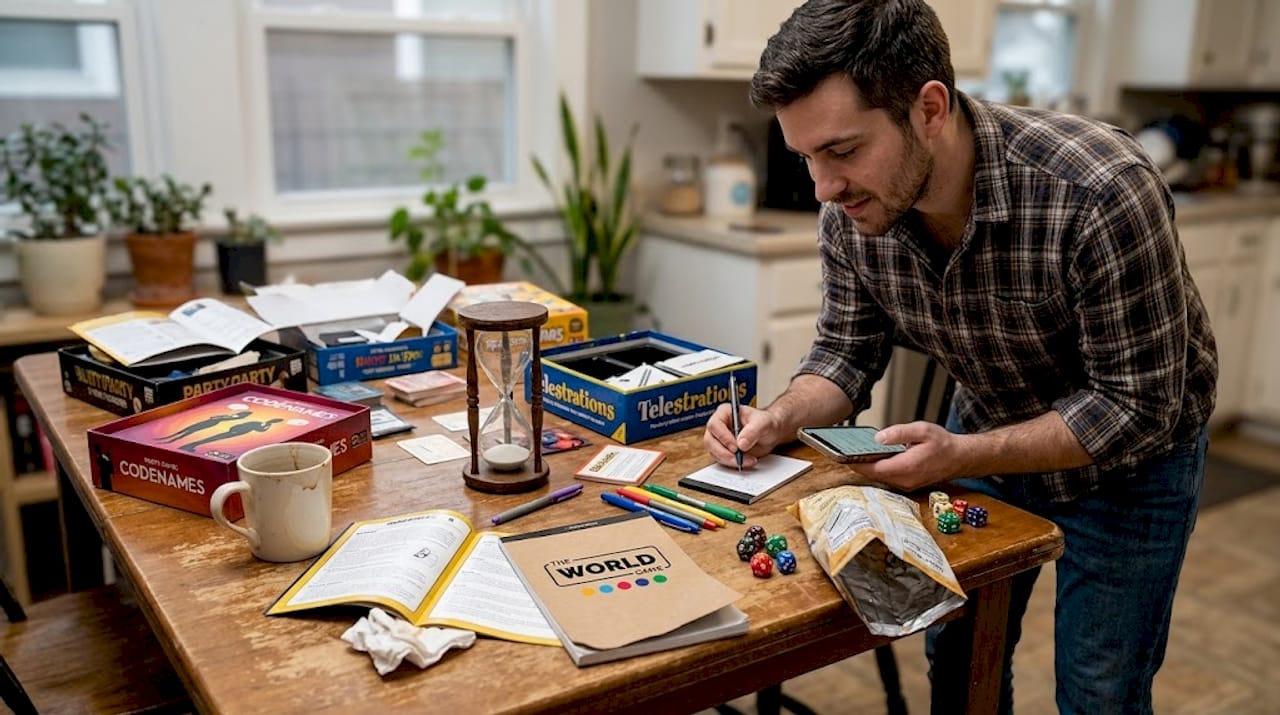
Here’s a quick reference table for common party games:
| Game | Players | Time needed | Materials required |
|---|---|---|---|
| Charades | 4 to 10+ | 20 to 40 min | Timer, word cards or phone app |
| Family Feud | 6 to 20 | 30 to 60 min | Question cards or printed prompts |
| Two Truths and a Lie | 3 to 12 | 15 to 25 min | None |
| Trivia | 4 to 16 | 30 to 60 min | Question deck or trivia app |
| Music Guessing Game | 4 to 20 | 20 to 45 min | Speaker, playlist, score sheets |
For prepping for game night, run through this checklist before guests arrive:
- Rules cards or quick-reference sheets printed or bookmarked on your phone
- All components sorted and ready (cards shuffled, boards set up, pens distributed)
- Snacks and drinks staged so people aren’t mid-game and asking where the chips are
- 2 to 3 game options selected, from lightest to most complex
- Turn order established before the room gets chatty
Also, take a moment to set the ground rules early. Tell people the basics: how to win, what counts as an illegal move, and whether phones are allowed for looking things up. Getting this out of the way before the first game means fewer interruptions later.
Pro Tip: For any game with a learning curve, assign a “demo leader,” someone (maybe yourself or a returning player) who plays their first turn out loud and narrates every decision. It’s worth the extra 90 seconds and saves you 10 minutes of confusion later.
Now that you’re set up, it’s time for simple, step-by-step instructions for top party games.
Foolproof instructions for classic party games (with examples)
Let’s get into the actual words you can use. Here’s a side-by-side comparison of three crowd favorites:
| Game | What to say first | Core action | How to win |
|---|---|---|---|
| Charades | “You’re acting out a word silently, no talking, no mouthing, no pointing at objects” | Actor performs, team guesses within time limit | Most correct guesses wins |
| Family Feud | “We’re finding the most popular survey answers, two teams, buzz in to respond” | Host reads prompt, captain picks who answers Face Off | Team with most points after all rounds wins |
| Two Truths and a Lie | “You share three statements about yourself, two true and one false” | Group votes on which statement is the lie | Player with most fooled guesses wins |
Here’s how we’d actually deliver each one to a room full of people:
Charades (step by step):
- Split into two even teams.
- One person picks a card and acts it out silently. No talking, no mouthing words, no pointing, and no using props unless agreed beforehand.
- Set a 60 to 90 second timer.
- First team to guess correctly earns a point.
- Teams alternate turns. Highest score after an agreed number of rounds wins.
Family Feud (step by step):
- Divide into two equal teams with a captain for each.
- Host reads a prompt, both team captains buzz in, and whoever’s first picks who answers.
- Teams try to name the most popular survey answers.
- Three wrong answers and the other team gets a chance to steal.
- Most points at the end wins.
Two Truths and a Lie (step by step):
- Everyone writes down two true statements and one lie about themselves.
- You read all three aloud, the group guesses which one is the lie.
- Reveal the truth and give a point to everyone who guessed wrong (or to the reader, depending on your house rules).
- Rotate until everyone has had a turn.
Aim to keep your full explanation under two minutes per game. If you’re going over that, cut a rule and deal with it when it comes up organically.
But even the best rules can go awry. Here’s how to handle common hiccups and keep things moving.
Troubleshooting: Common mistakes and ways to recover mid-game
Even the smoothest hosts run into trouble. Someone misunderstands a rule. The energy suddenly flatlines. Two players get into a debate about whether that charades move was legal. It happens to everyone, and knowing how to recover fast is what separates a good host from a great one.
Here are the most common mistakes and how to fix them:
- Rules explanation ran too long: Stop mid-explanation, say “let’s just try a round,” and clarify rules as they come up naturally.
- Nobody demoed a round first: Pause the official game, play one practice turn out loud together, then restart scoring from zero.
- Players are disengaged or confused: Mixed-comfort groups often disengage when games start too complex, so simplify the rules on the spot or switch to something lighter.
- Debate over a rule call: Make a quick group decision, note it as your “house rule,” and move on immediately. Never let a rule dispute last more than 60 seconds.
- Someone’s sitting out or not engaged: Rotate roles, assign them as scorekeeper or timer, or make them the host’s “assistant.”
“End on a laugh or a lighter game. Always have a pivot ready if the energy drops.”
This is genuinely great advice and we’d add one thing: give yourself permission to abandon a game that isn’t working. A half-played game that nobody’s enjoying is always worse than just starting something new. Check out game night troubleshooting for more specific pivots that work in different situations.
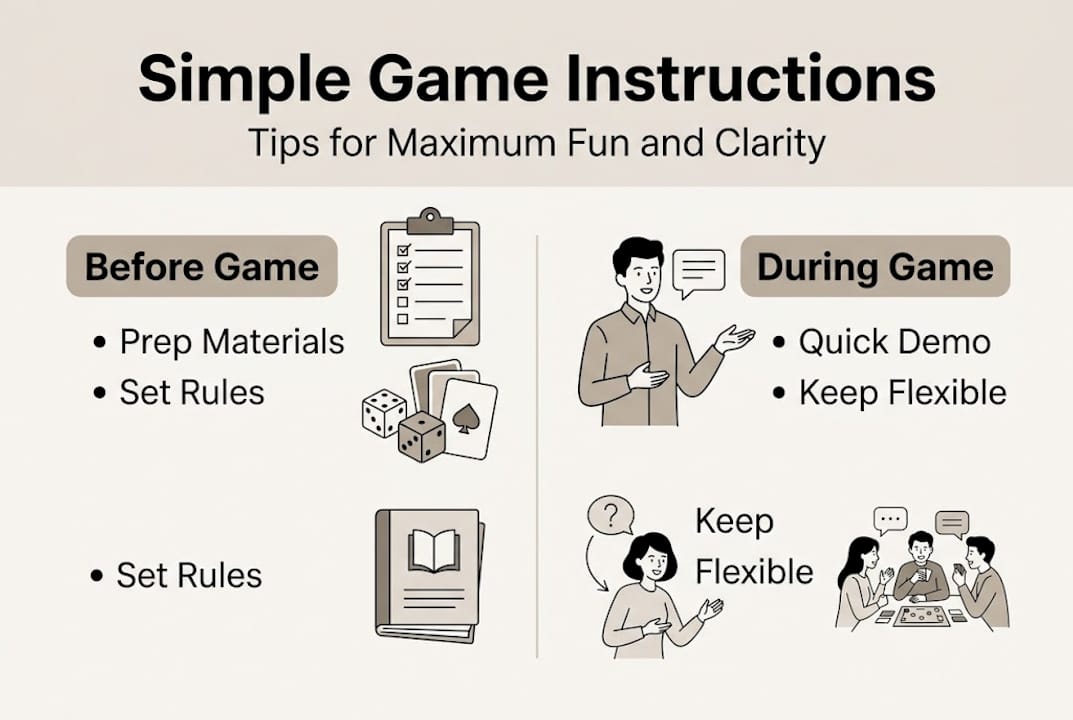
Pro Tip: If confusion keeps popping up in the same game, rotate the “explainer” role to a different player. Sometimes a peer explaining a rule to another player clicks way faster than the host saying the same thing.
With troubleshooting in your toolkit, let’s check how this approach plays out in real-world hosting.
A seasoned host’s take: What really works (and what doesn’t)
Here’s our honest take after hosting more game nights than we can count: the conventional wisdom of “read the rules carefully before you start” is mostly wrong for party settings. The players who try to explain everything upfront almost always lose the room.
What actually works? Flexibility and reading your group. The hosts we’ve seen pull off truly memorable nights are the ones who start a round with maybe 80% of the rules covered, then fill in the gaps as they come up. It sounds chaotic, but it keeps energy high because people are PLAYING, not listening.
Here’s the part nobody says out loud: it’s okay to let a round play out imperfectly. One messy practice round is worth more than five minutes of explanation. Players figure things out fast when they’re actually doing it.
Game night joy comes from connection and laughter, not from running a flawless rulebook session. As real-world hosting lessons show, the best nights are the ones where you adapted, laughed off the chaos, and kept everyone in the game.
Fuel your next game night with even more great games
Now that you’ve got a solid framework for delivering instructions that actually work, the next step is making sure you have games worth explaining. Simple, social, fast-to-learn games make everything easier, for you and your guests.

At Playworldgame.com, we curate more party game ideas built specifically for real game nights. Whether you want a quick icebreaker, a hilarious couples game, a food-themed challenge, or a music guessing game that gets everyone singing, we’ve got options that are fast to learn and even faster to love. Browse the collection and find your next crowd-pleaser, because the best game night is always the next one.
Frequently asked questions
What’s the best way to explain party game rules to a group?
Start with the game’s main goal, explain the core actions in under two minutes, show a demo round, and answer questions as they arise. Explaining rules in two minutes or less, then letting people watch a round first, keeps energy high and confusion low.
How do you keep people engaged if they get bored during a game?
Pivot to a lighter or more active game, switch roles, or adjust the rules to simplify gameplay on the fly. Starting easy and pivoting quickly when engagement drops is one of the most effective moves a host can make.
What should I prepare before guests arrive for game night?
Have all materials, rules cards, snacks, and 2 to 3 game options ready, and assign someone to track time and help with explaining rules. A 2 to 3 hour session with 2 to 3 games, breaks, and variety across rounds is the sweet spot for most groups.
What’s a good quick icebreaker game with simple instructions?
Two Truths and a Lie is a fast icebreaker requiring no materials, with each player sharing three statements for others to guess the lie. Two true statements and one lie per player keeps it simple and surprisingly personal, making it perfect for warming up a crowd.