


Physical games do more than tire kids out. Research shows they boost executive function by up to 30%, transforming playtime into a powerful developmental tool. Many parents miss this connection, viewing physical games as simple exercise when they’re actually cognitive workouts. This guide reveals how to choose and facilitate physical games that enhance your child’s growth across cognitive, social, emotional, and motor domains during family game nights.
Table of Contents
- Introduction: Why Physical Games Matter For Child Development
- Cognitive Benefits Of Physical Games
- Social And Emotional Development Through Play
- Motor Skill Enhancement Via Physical Games
- Common Misconceptions About Physical Games And Child Development
- A Framework To Choose Developmentally Beneficial Physical Games
- Practical Tips For Integrating Physical Games Into Family Game Nights
- Conclusion: Maximizing Child Development With Playful Family Engagement
- Level Up Your Family Game Nights With Skill-Building Physical Games
- FAQ
Key Takeaways
| Point | Details |
|---|---|
| Physical games enhance multiple skills | They boost cognitive, social, emotional, and motor development simultaneously. |
| Executive function gains are significant | Physical play increases executive function test scores by 20 to 30 percent. |
| Cooperative games reduce aggression | Teamwork-based play fosters empathy better than purely competitive formats. |
| Use a four-dimension framework | Evaluate games by cognitive, motor, social, and emotional engagement for balance. |
| Regular family game nights sustain growth | Consistent play sessions support ongoing developmental benefits. |
Introduction: Why Physical Games Matter for Child Development
Physical games engage kids in active play that stimulates growth far beyond fitness. Think tag, relay races, cooperative card games, or obstacle courses. These activities activate multiple brain regions, accelerating cognitive development while building social and motor skills.
Unlike passive screen time, physical games demand real-time decision making, social negotiation, and bodily coordination. This multi-layered engagement makes them uniquely effective for holistic development. Children learn to regulate emotions during competitive moments, solve problems on the fly, and coordinate movements with precision.
Developmental domains engaged include:
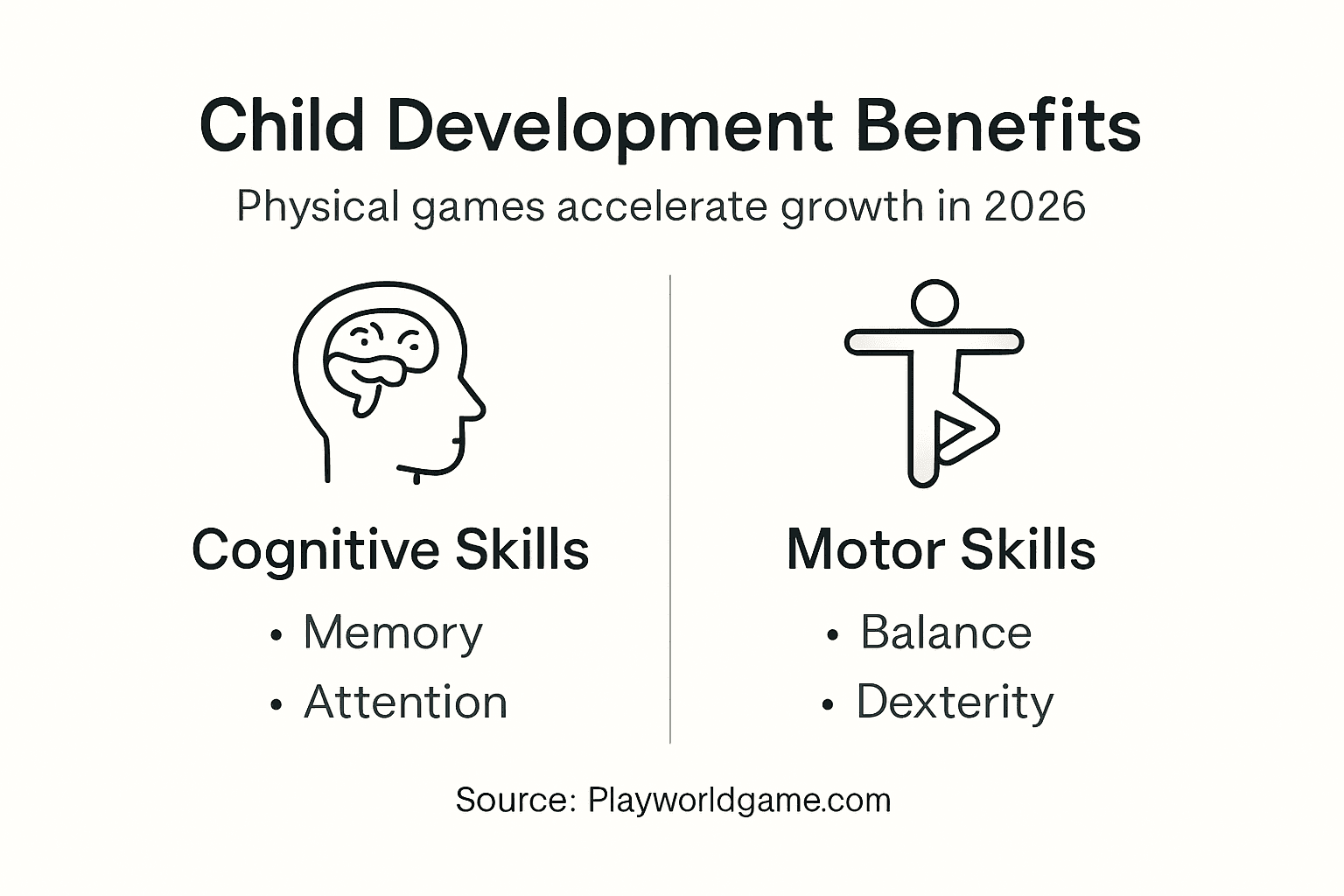
- Cognitive skills: Memory, attention, problem solving, and language
- Social abilities: Turn-taking, cooperation, empathy, and communication
- Emotional growth: Impulse control, emotional regulation, and resilience
- Motor development: Gross motor coordination, fine motor skills, and balance
Scientific evidence confirms that physical games stimulate multiple brain regions accelerating cognitive development. The key is choosing games that challenge both body and mind, creating rich learning opportunities disguised as family fun.
Cognitive Benefits of Physical Games
Physical games act as brain training sessions, strengthening executive functions essential for academic success and daily life. Executive functions include working memory, sustained attention, and problem solving. When kids play trivia relay races or memory tag games, they’re simultaneously processing information, holding rules in mind, and adapting strategies.
Research shows that physical play is linked to 20 to 30 percent increases in executive function test scores. The mechanism is straightforward: movement increases blood flow to the brain, particularly the prefrontal cortex where executive functions live. Games requiring both physical coordination and mental challenge deliver maximum cognitive benefit.
Consider these cognitive skill-building games:
- Trivia relay races: Teams run to answer stations, combining cardiovascular activity with information recall
- Memory obstacle courses: Kids navigate physical challenges while remembering sequences or instructions
- Strategy chase games: Players must plan escape routes while dodging opponents, engaging spatial reasoning
- Problem-solving scavenger hunts: Clues require logic and teamwork while kids move through space
Pro Tip: Select games demanding simultaneous physical and mental engagement. A simple relay becomes a cognitive workout when you add trivia questions or memory challenges at each checkpoint. This dual demand maximizes brain activation and skill development.
The cognitive benefits of physical games extend to language development too. Cooperative games require communication, negotiation, and explanation. Kids practice articulating strategies, describing actions, and understanding complex instructions. These linguistic demands complement the physical challenge, creating comprehensive brain development opportunities.
Social and Emotional Development through Play
Physical games create natural opportunities for social learning that structured lessons can’t replicate. Turn-taking during relay races teaches impulse control. Cooperative challenges require working memory as kids hold their role in mind while tracking teammates’ progress. These social interactions build emotional intelligence through real-time practice.
Cooperative physical games foster empathy by requiring players to consider others’ perspectives and feelings. When a team member struggles with a physical challenge, children learn to encourage rather than criticize. They develop emotional regulation skills by managing frustration when games don’t go their way and excitement when they succeed.
Research confirms that cooperative games reduce aggression and foster social bonds better than purely competitive play. The data shows children who regularly participate in cooperative physical games demonstrate higher empathy scores and better conflict resolution skills than those who only play competitive games.
Examples of cooperative physical games include:
- Partner relay races: Teams succeed only when both partners coordinate timing and effort
- Group balance challenges: Everyone must work together to maintain stability or complete tasks
- Cooperative tag variations: Players protect each other rather than compete individually
- Team obstacle courses: Success depends on communication and mutual support
The social-emotional benefits of cooperative games multiply during family game nights. Parents model positive social behaviors, demonstrate good sportsmanship, and guide emotional regulation. Kids observe and practice these skills in a safe, supportive environment. Regular family play sessions normalize emotional expression and teach healthy competition.
Motor Skill Enhancement via Physical Games
Physical games directly improve both fine and gross motor skills essential for daily activities and future athletic pursuits. Gross motor skills involve large muscle movements like running, jumping, and throwing. Fine motor skills require precise hand-eye coordination for tasks like catching, manipulating objects, or balancing.
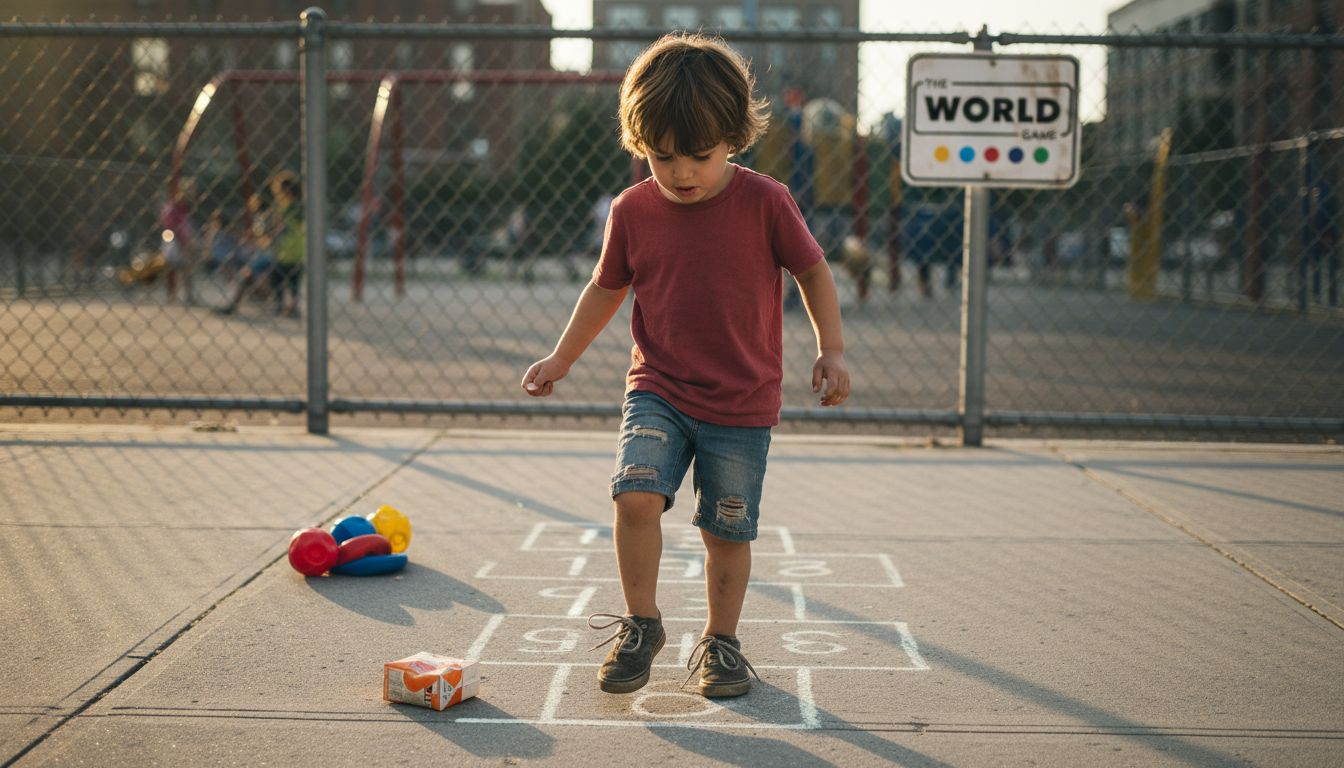
Children who regularly participate in physical games show measurably better motor proficiency. Studies demonstrate that physical games outperform screen games by 45 percent in motor skill tests. The tactile, three-dimensional nature of physical play provides sensory feedback that screens can’t match, accelerating motor learning.
Game examples focusing on motor development:
- Balance beam challenges: Improve core strength, coordination, and spatial awareness
- Ball toss variations: Develop hand-eye coordination, depth perception, and timing
- Relay races with objects: Combine cardiovascular activity with object manipulation skills
- Jumping games: Build leg strength, rhythm, and body control
To integrate motor skill development through physical games effectively:
- Start with age-appropriate challenges: Match game difficulty to current skill level, gradually increasing complexity
- Mix gross and fine motor activities: Alternate between large movement games and precision tasks
- Create progression paths: Design games that naturally advance in difficulty as skills improve
- Celebrate effort over perfection: Focus on improvement and persistence rather than flawless execution
- Incorporate daily practice: Short, frequent sessions build skills faster than occasional long practices
Motor skill development through play feels effortless to children because it’s fun. Unlike formal exercise, games provide immediate feedback and natural motivation to improve. Kids want to catch the ball better next time or balance longer on the beam because success feels rewarding, not because adults tell them to practice.
Common Misconceptions About Physical Games and Child Development
Many parents undervalue physical games as developmental tools due to widespread misconceptions. Understanding these myths helps families fully leverage play for child growth.
The biggest misconception positions physical games as purely exercise. Survey data reveals that 60 percent of parents undervalue mental and social benefits of physical games. They recognize the cardiovascular advantage but miss the cognitive, social, and emotional growth happening simultaneously. Physical games aren’t just burning energy; they’re building brains.
Myths about physical games:
- Myth: Competitive games increase aggression and poor sportsmanship
- Reality: Research shows cooperative game structures reduce aggression while competition teaches resilience when properly facilitated
- Myth: Screen-based games offer equivalent developmental benefits with less effort
- Reality: Physical games provide unique sensory, social, and motor advantages that digital alternatives can’t replicate
- Myth: Physical play is only valuable for athletic children
- Reality: All children benefit cognitively and socially regardless of athletic ability or interest
The competitive games controversy deserves special attention. While poorly facilitated competition can foster negative behaviors, appropriate competitive play teaches valuable life skills. Children learn to handle disappointment, celebrate others’ success, and persist through challenges. The key is balancing competitive and cooperative formats while adults model positive attitudes.
Regarding screen alternatives, studies contrasting physical and screen games consistently show physical play’s superiority for motor development, social interaction quality, and emotional regulation practice. Digital games have their place, but they can’t replace the comprehensive developmental benefits of physical activity.
A Framework to Choose Developmentally Beneficial Physical Games
Selecting games that promote balanced development requires evaluating multiple dimensions. This framework helps parents assess game potential across four key areas: cognitive challenge, motor engagement, social interaction, and emotional support.
Each dimension contributes uniquely to child development:
- Cognitive challenge: Does the game require memory, problem solving, strategy, or decision making beyond simple rule following?
- Motor engagement: What physical skills does the game develop? Does it involve gross motor movements, fine motor precision, or both?
- Social interaction: Does the game create opportunities for communication, cooperation, negotiation, or perspective-taking?
- Emotional support: Can the game be adapted to different skill levels? Does it allow practice in managing excitement, frustration, or disappointment?
| Game Type | Cognitive Challenge | Motor Engagement | Social Interaction | Emotional Support |
|---|---|---|---|---|
| Trivia relay races | High (recall, processing) | Moderate (running, coordination) | Moderate (team communication) | High (adjustable difficulty) |
| Cooperative obstacle courses | Moderate (problem solving) | High (full body coordination) | High (teamwork, planning) | High (mutual encouragement) |
| Competitive tag variations | Low to Moderate (strategy) | High (agility, speed) | Moderate (social awareness) | Moderate (winning/losing practice) |
| Memory card games with movement | High (memory, matching) | Low to Moderate (reaching, manipulation) | Low (turn-taking) | Moderate (patience practice) |
Balancing game features based on your child’s needs:
- For kids needing cognitive growth, prioritize games with strategy, memory, or problem-solving elements
- For motor skill development, choose activities demanding varied physical challenges
- For social skills, select cooperative formats requiring communication and teamwork
- For emotional regulation, pick games allowing controlled practice with frustration and excitement
Pro Tip: Regularly reassess game choices as your child develops. A game perfect for a five-year-old may become too simple at seven. Evolving game complexity maintains engagement and ensures continued developmental benefits. The game selection framework for development should flex with your child’s growing capabilities.
Practical Tips for Integrating Physical Games into Family Game Nights
Transforming knowledge into action requires concrete strategies for incorporating physical games into regular family routines. Consistency matters more than duration. Short, frequent game sessions deliver better developmental results than occasional marathon play periods.
Schedule weekly family game nights at consistent times. Sunday afternoons or Friday evenings work well for many families. Block 30 to 60 minutes, enough time for meaningful play without exhausting young children. Consistency builds anticipation and makes game night a valued family tradition.
Strategies to encourage cooperative play:
- Rotate game selection so each family member chooses periodically
- Mix competitive and cooperative games within each session
- Model positive reactions to both winning and losing
- Celebrate creative problem solving and teamwork as much as victory
- Adapt rules to ensure everyone can participate meaningfully
Playworldgame.com offers diverse game types suited to various developmental goals. Trivia games build knowledge and recall. Skill-based challenge games develop problem-solving and coordination. Cooperative conversation games strengthen communication and empathy. The key is matching game types to your family’s developmental priorities and interests.
Common pitfalls and solutions:
- Pitfall: Games become too competitive, causing conflict
- Solution: Introduce more cooperative formats and emphasize team goals over individual winning
- Pitfall: Children lose interest quickly
- Solution: Rotate games frequently and involve kids in selection decisions
- Pitfall: Younger siblings can’t participate fully
- Solution: Modify rules to level the playing field or assign age-appropriate roles
- Pitfall: Parents dominate play or check phones during games
- Solution: Commit to full engagement; kids model adult behavior
Get more tips for family game nights with physical games that emphasize developmental benefits while maintaining fun. The goal is creating positive associations with active play that last into adulthood.
Conclusion: Maximizing Child Development with Playful Family Engagement
Physical games deliver remarkable developmental benefits across cognitive, social, emotional, and motor domains. The evidence is clear: regular physical play boosts executive function, reduces aggression through cooperation, improves motor skills dramatically, and creates bonding opportunities that strengthen family relationships.
Play isn’t frivolous; it’s purposeful learning disguised as fun. Every relay race strengthens working memory. Every cooperative challenge builds empathy. Every balanced obstacle improves coordination. Parents who intentionally choose and facilitate physical games give their children advantages that extend far beyond game night.
Explore curated skill-based physical games on Playworldgame.com designed for developmental growth and family enjoyment. Your next family game night could be the start of a powerful tradition that shapes your child’s cognitive, social, and physical capabilities for years to come.
Level Up Your Family Game Nights with Skill-Building Physical Games
Ready to transform family time into developmental powerhouse sessions? Playworldgame.com curates fast, social games perfect for building skills while everyone laughs together. Our lineup spans trivia challenges, cooperative card games, and skill-based activities designed for real family game nights.

Discover how easy integrating developmentally beneficial games into your routine can be. Visit our site for tailored recommendations matching your family’s interests and your children’s developmental needs. Get expert family game night tips, explore the best play with friends games, and grab our ultimate family game night tips to make every session unforgettable. Your kids’ developing brains will thank you.
FAQ
What are the key developmental benefits of physical games for children?
Physical games promote cognitive skills like memory and attention, social skills like cooperation and empathy, emotional regulation, and both fine and gross motor coordination. They foster holistic growth through active, engaging play that stimulates multiple brain regions simultaneously. Research shows improvements of 20 to 30 percent in executive function tests.
How can parents choose physical games that best support their child’s development?
Use the four-dimensional framework assessing cognitive challenge, motor engagement, social interaction, and emotional support aspects of each game. Balance these features to fit your child’s current age, skill level, and developmental priorities. The game selection framework for parents provides detailed guidance on matching games to needs.
What are common myths about physical games and child development?
Myths include beliefs that physical games only provide exercise or that competitive play increases aggression. Research shows physical games also improve cognitive and social-emotional skills significantly. Cooperative play formats actually reduce aggression while building empathy and teamwork abilities.
How often should families include physical games in their routine?
Aim for regular short sessions, such as weekly family game nights lasting 30 to 60 minutes. Consistency supports sustained developmental benefits more effectively than occasional longer sessions. Frequent exposure helps children internalize skills and builds positive family interaction patterns. Check these frequency recommendations for family game nights for scheduling strategies.