


TL;DR:
- Family learning games boost social skills, emotional regulation, and cognitive growth across all ages.
- A structured, flexible workflow with suitable games enhances enjoyment and developmental benefits.
- Physical games foster real social interaction and are most effective when combined with improvisation.
Picture this: it’s Friday night, everyone’s finally home, and someone suggests game night. The box comes out. It’s the same one from last month. And the month before that. Cue the groans. We’ve been there too, and we know that a stale game night can feel like homework with dice. But here’s what we’ve figured out after way too many rounds of the same old standby games: having a smart, repeatable workflow makes all the difference. The right games, played in the right order, with just a little intention, can turn a flat Friday into something your family actually talks about the next morning.
Table of Contents
- How family learning games benefit everyone
- What you need to start: Tools and game selection
- Step-by-step workflow for running family learning games
- Troubleshooting and adapting your workflow
- Why the best family learning moments come from improvisation
- Try more tools and ideas for unforgettable family game nights
- Frequently asked questions
Key Takeaways
| Point | Details |
|---|---|
| Boosts social skills | Learning games improve family communication, empathy, and collaboration in fun ways. |
| Easy, effective setup | A clear workflow and game selection make game nights enjoyable and stress-free. |
| Learning meets play | These games teach math, language, and critical thinking while entertaining all ages. |
| Adapt and improvise | Stay flexible—adapting your approach boosts engagement and family connection. |
How family learning games benefit everyone
Let’s be real, family game night isn’t just about filling time. When you pick games with some learning baked in, you’re quietly doing something pretty powerful for your household. We’ve watched kids who struggle to sit still become completely absorbed in a cooperative card game. We’ve seen grandparents and seven-year-olds debate strategy as equals. That kind of connection is genuinely hard to manufacture any other way.
The research backs this up, too. Empirical data confirms that board games improve conceptual understanding, knowledge transfer, and social skills across age groups. That’s not just classroom talk. It plays out right at your kitchen table. Kids get better at reading the room, processing information quickly, and expressing themselves clearly.
“Games that involve mild competition and shared challenges teach children how to manage emotions, handle setbacks, and celebrate others’ wins.” This kind of emotional practice is genuinely hard to replicate anywhere else.
Studies also show that board games reduce the intergenerational gap and teach emotional regulation by putting players of all ages in the same situation together. Nobody gets a pass. Everyone wins some, loses some, and figures out how to feel about it together.
Here’s a quick look at what learning games actually give your family:
- Social skills: Taking turns, reading expressions, practicing patience
- Cognitive growth: Strategic thinking, memory, pattern recognition, and vocabulary
- Emotional development: Handling losses gracefully, celebrating others’ wins, managing excitement
- Communication: Giving clear instructions, listening actively, negotiating with teammates
- Connection: Bridging age gaps and creating shared memories that stick
And if your household includes someone who melts down during competitive play, don’t worry. Cooperative games like Outfoxed! or Forbidden Island let everyone win or lose together, which takes a huge amount of pressure off sensitive players. We’ve found games that build teamwork are often the best entry point for families who are new to this whole learning game thing.
What you need to start: Tools and game selection
Understanding the value of family learning games, let’s get practical about what you need to set up your own workflow. The good news is that you don’t need a huge collection or a lot of money. You need a handful of well-chosen games, a clear surface, and snacks (always snacks).
Easy-to-learn family card and board games include standouts like Codenames Family, Apples to Apples Junior, Sleeping Queens, Zeus on the Loose, Prime Climb, and cooperative options like Outfoxed! and Forbidden Island. Each one is easy to teach but still genuinely fun for adults.
Here’s a quick comparison to help you choose what fits your crew:
| Game | Age range | Players | Skills targeted | Cooperative? |
|---|---|---|---|---|
| Codenames Family | 8 and up | 4 to 8 | Vocabulary, teamwork | Partial |
| Apples to Apples Junior | 7 and up | 4 to 10 | Creativity, language | No |
| Sleeping Queens | 5 and up | 2 to 5 | Math, memory | No |
| Zeus on the Loose | 8 and up | 2 to 5 | Mental math, strategy | No |
| Prime Climb | 10 and up | 2 to 4 | Math reasoning | No |
| Outfoxed! | 5 and up | 2 to 4 | Deduction, cooperation | Yes |
| Forbidden Island | 10 and up | 2 to 4 | Strategy, teamwork | Yes |
We also want to mention the benefits of physical games because this is something people overlook. Physical games create tactile, face-to-face interaction that digital versions rarely replicate. Shuffling cards, passing tokens, pointing at the board, these small physical acts actually reinforce attention and engagement.
Essential supplies for a smooth game session:
- A clear, well-lit tabletop (seriously, lighting matters)
- A simple kitchen timer or phone timer
- Paper and pencil for scorekeeping
- A printed or laminated rules summary for complex games
- Snacks that don’t leave greasy fingerprints on the cards (this is hard-won wisdom)
Pro Tip: When checking out a new game in a store or online, look for three things fast: the minimum age, the average play time, and whether rules can be explained in under two minutes. If all three check out, it’s probably worth trying.
Step-by-step workflow for running family learning games
Once you have the right tools, here’s how to structure a session for both fun and growth. We’ve tested this workflow more times than we can count, and it works whether you’ve got 45 minutes or a full evening.
Game mechanics foster learning through intrinsic motivation, immediate feedback, and safe failure opportunities. The workflow below maps those mechanics to what actually happens at your table.
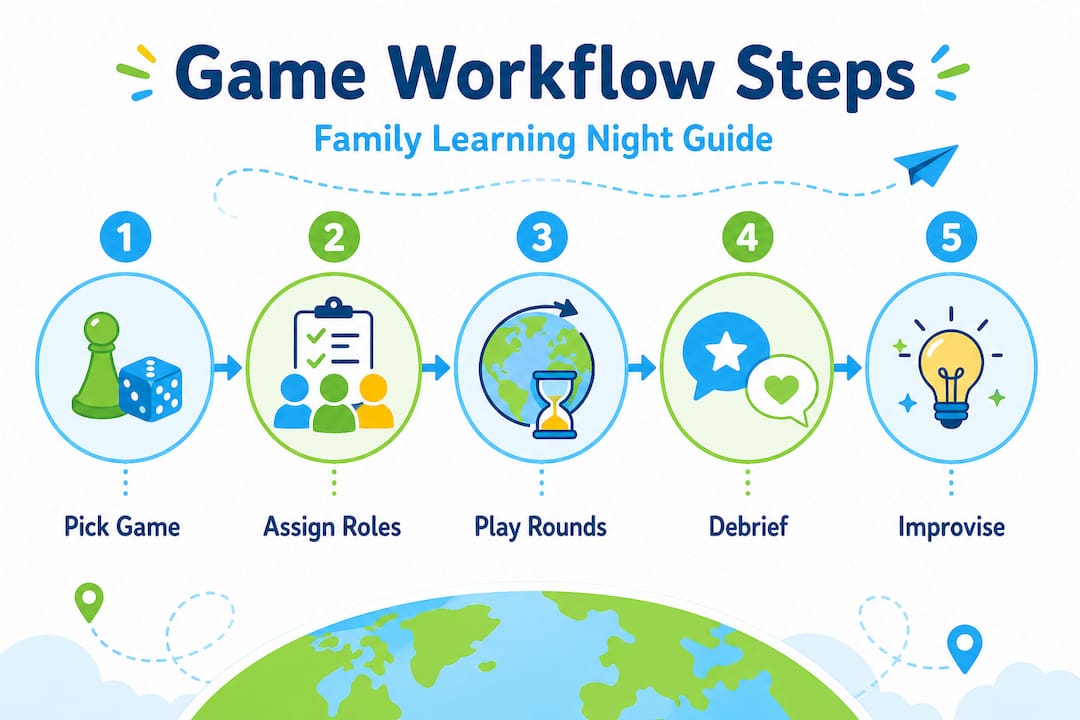
Here’s the step-by-step breakdown:
- Pre-game prep (5 to 10 minutes): Choose the game based on who’s playing and what energy level the room has. Set up the board or cards, and assign someone to be the rules reader. Keep it casual, not like a classroom.
- Opening round (5 minutes): Run a quick practice round with no stakes. This is especially helpful when new players join. State the learning goal lightly (“Tonight we’re working on teamwork” or “Let’s see who can do mental math the fastest”).
- Active play (20 to 40 minutes): Rotate who leads each round if the game allows it. Adjust the pace for younger players by giving gentle prompts. Encourage everyone to talk through their thinking out loud.
- Snack and stretch break (5 minutes): This is not optional in our house. Breaks reset attention and give quieter players a chance to speak up without the pressure of an active turn.
- Debrief (5 to 10 minutes): Ask two or three simple questions after the game: What was the hardest decision you made? Did anyone change their strategy mid-game? What would you do differently? This is where a lot of the actual learning gets locked in.
Here’s a quick reference table for your session:
| Stage | Key action | Tools needed | Time |
|---|---|---|---|
| Pre-game prep | Choose game, assign roles | Game box, rules sheet | 5 to 10 min |
| Opening round | Practice round, set goals | Timer | 5 min |
| Active play | Play with reflection prompts | Game components | 20 to 40 min |
| Break | Snack, stretch, casual chat | Snacks | 5 min |
| Debrief | Reflect, discuss, celebrate | Paper for notes (optional) | 5 to 10 min |
Pro Tip: Build your debrief questions into a small index card you keep with the game box. After a few sessions, your kids will start asking the questions themselves without any prompting. That’s when you know it’s really working.
Mapping game mechanics to your goals is also worth thinking about. If you want to boost verbal communication, pick word games. If you’re working on emotional regulation, cooperative games with shared wins and losses are your best bet. Strategy games sharpen planning and patience. You get to be intentional without making it feel academic.
Troubleshooting and adapting your workflow
With a workflow in place, it’s important to stay flexible and prepared. Even the best-planned game night hits a wall sometimes. Someone’s tired, someone’s frustrated, someone keeps checking their phone. Here’s how to troubleshoot without derailing the whole night.
Common friction points and quick fixes:
- Boredom with a game: Switch to a shorter, faster game mid-session. Keep one “emergency game” (something under 15 minutes) in your rotation for exactly this situation.
- Competitive meltdowns: Temporarily switch to a cooperative game, or create mixed-age teams so older players mentor younger ones.
- Age gap problems: Assign older kids as “coaches” for younger siblings. This actually deepens learning for both parties.
- Low engagement: Introduce a silly house rule for one round. Bonus points if someone has to play in a funny accent or perform a mini-challenge.
- Space issues: Many card games work at a coffee table, a picnic blanket, or even on the floor. Don’t let a small space be a reason to skip game night.
One thing that’s worth saying clearly: physical games excel in social learning and skill transfer in a way that screen-based games rarely match. There’s something about handing someone a card, making eye contact, and reacting in real time that digital games can’t replicate.
Research from HAL-Science also found that instructional framing boosts recall more than pure gaming alone, while physical formats outperform digital ones in social and skill transfer outcomes. In other words, how you frame the session matters almost as much as what you play.
“Physical games are uniquely effective at bridging age gaps and encouraging real social interaction, particularly when compared to solo or screen-based alternatives.”
So if engagement is dropping, your first fix shouldn’t be a screen. Try a rule change, a team reshuffle, or a fresh game before you give up on the physical format.
Why the best family learning moments come from improvisation
Here’s something most guides won’t tell you: the workflow is a starting point, not a finish line. We’ve had some of our absolute best game nights happen when something went sideways and we rolled with it.
We once ran out of time to finish a game properly, so we invented a lightning round where everyone had 30 seconds to make their final moves. It became a thing. Now we do it on purpose. That kind of spontaneous creativity is where real family culture gets built.
When engagement drops, don’t panic. Improvise. Let a kid make up a new rule for one round. Switch who’s running the debrief. Invent a silly consequence for last place. These little detours often produce the moments everyone remembers months later. We talk about insights on family teamwork a lot, and the pattern we keep seeing is that the most connected families treat their game nights as living, flexible events, not scripted performances.
Structure is a foundation, not a cage. Use the workflow to get started and stay organized, but give yourself full permission to go off script when the energy in the room calls for it. The best learning happens when everyone’s having fun, not when everyone’s following the rules to the letter.
Try more tools and ideas for unforgettable family game nights
Ready to put these strategies into action? We’ve got plenty more where this came from. Whether you’re hunting for the perfect cooperative starter game, a fast card game for shorter sessions, or something that works across a wide age range, we have curated collections and guides built for real families and real game nights.

At Playworldgame.com, we hand-pick games that are genuinely fun and easy to pull out on a Tuesday evening without a rulebook tutorial. From skill-based challenge games to trivia, couples conversation games, music guessing games, and more, our whole lineup is designed for the kind of game nights people actually look forward to. Browse our collection, grab something new, and make your next family night one worth repeating.
Frequently asked questions
What are the best family learning games for beginners?
Codenames Family, Apples to Apples Junior, and Sleeping Queens are top picks because they’re fast to learn, fun for multiple age groups, and packed with skill-building moments right from the first round.
How often should families play learning games for best results?
Once or twice a week is the sweet spot. Research shows a 10 to 15% improvement in math skills in just four weeks of regular game-based learning, so consistency really pays off fast.
Are digital learning games as effective as physical ones for families?
They each have strengths. Physical excel in transfer and social learning while digital games tend to perform better for factual retention and solo engagement, so mixing both can work well depending on your goals.
How can game night help with emotional regulation for kids?
Competitive and cooperative games put kids in real emotional situations, wins, losses, and close calls, and help them practice managing those feelings in a safe, supportive setting. Research shows board games teach emotional regulation and reduce friction between generations.
What if my family has a wide age range?
Go for games with flexible rules or team-based mechanics so everyone can participate meaningfully. Pairing older and younger players as a team is one of the easiest ways to level the playing field and keep things fun for all ages.