


TL;DR:
- Tabletop games foster real conversations, shared memories, and social bonding at parties.
- They promote prosocial behaviors across all ages, including competitiveness that encourages encouragement and cheerleading.
- Choosing the right game involves matching complexity, size, and inclusivity features to your event’s vibe.
Most party hosts pour energy into the playlist, the food spread, and maybe a photo booth — and guests still leave without remembering a single real conversation. Technology-powered entertainment is everywhere, but it tends to keep people in their own bubbles, scrolling or passively watching. Tabletop games flip that completely. They pull people into the same moment, force them to laugh together, and create shared stories that stick. In this article, we break down why tabletop games work so well socially, which games suit which crowds, and exactly how to run them at your next gathering.
Table of Contents
- Why tabletop games amplify party connection
- Key social benefits for every age group
- Choosing the right tabletop game for your party
- How to introduce and maximize tabletop games at your party
- A host’s wisdom: Getting tabletop games right
- Ready to transform your party with tabletop games?
- Frequently asked questions
Key Takeaways
| Point | Details |
|---|---|
| Social connections | Tabletop games build deeper, lasting bonds at parties by encouraging face-to-face interaction. |
| All ages benefit | Both kids and adults show more prosocial behaviors and positive emotions during tabletop play. |
| Game selection matters | Choosing the right game for your group size and mood ensures an engaging party experience. |
| Competition can help | Competitive games often create more supportive behaviors than purely cooperative options, especially in mixed-age groups. |
| Structure enhances fun | Well-facilitated games transform casual gatherings into memorable, inclusive events. |
Why tabletop games amplify party connection
Now that we’ve set aside the entertainment myth, let’s clarify what tabletop games uniquely contribute to a gathering.
When you put a board game or card game on the table, something almost immediate happens. People lean in. They start talking. They start rooting for each other (or plotting against each other, which is honestly just as fun). That’s not an accident — it’s built into the format.
Research backs this up strongly. Studies show that analog tabletop RPGs provide more meaningful social support than virtual alternatives, with game masters actively giving players more support throughout sessions. Regular, consistent attendance at these sessions makes those bonds even stronger over time. That’s powerful evidence for what experienced party hosts already feel intuitively.
Here’s what tabletop games do that a movie night or a playlist simply can’t:
- They create natural conversation starters. Rules, strategies, and in-game moments all spark real dialogue, not small talk.
- They give everyone a role. Nobody is just standing around. Every player has something to do, decide, or react to.
- They build shared memories in real time. “Remember when Jamie flipped the table?” is a story people tell for years.
- They reduce social pressure. Having a game to focus on makes interactions feel lower-stakes and more comfortable for shy guests.
“The game becomes the social glue — it gives people permission to interact in ways they normally wouldn’t at a party.”
One clever move we’ve seen work beautifully: rotating the role of game master (the player who facilitates and explains the game) throughout the night. This is especially powerful in tabletop RPG-style games.
Pro Tip: Rotating the facilitator role isn’t just practical — it’s deeply inclusive. Every player gets a moment to lead, which builds confidence and deepens everyone’s investment in the experience.
Learning more about party games and social skills can help you understand exactly why this structured social interaction is so valuable beyond just being fun.
Key social benefits for every age group
With social connection established as central, let’s look at how these games affect players of every age.
One of the most exciting discoveries in recent tabletop research involves intergenerational play — when kids, parents, grandparents, and everyone in between sit down at the same table. It turns out the benefits flow in every direction.
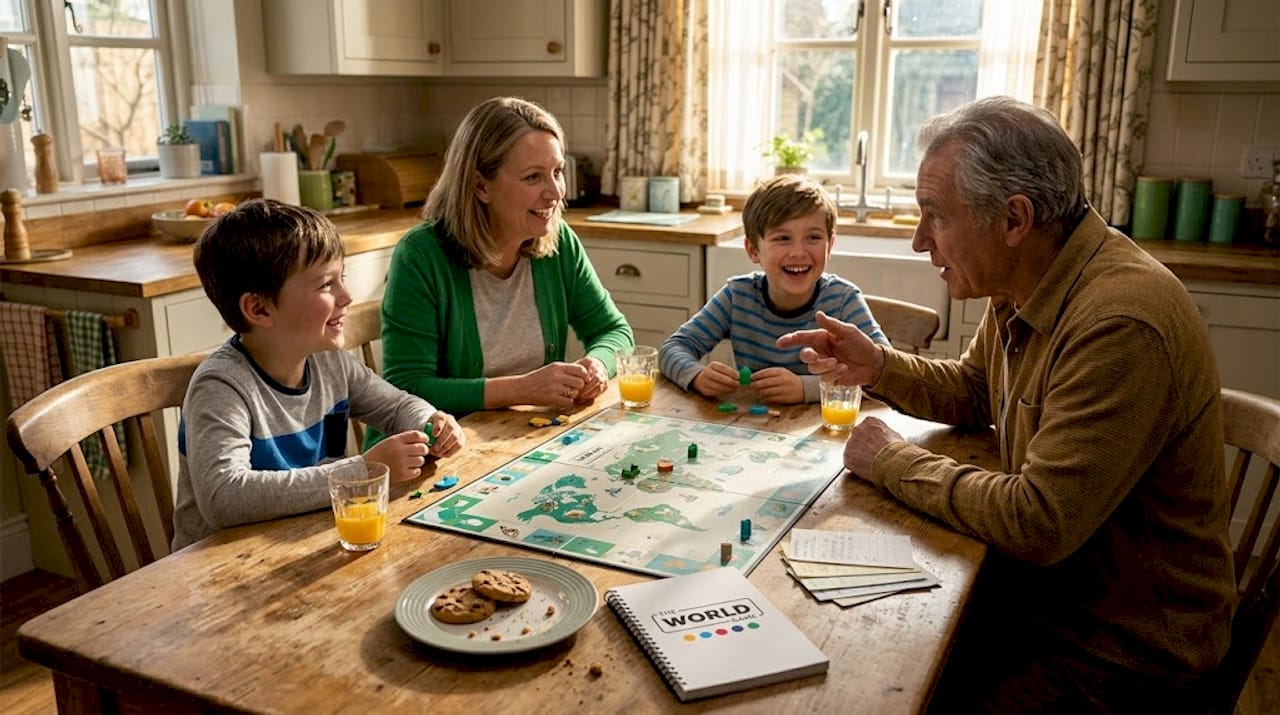
Research on mixed-age tabletop play found that in intergenerational play, competitive games elicit more prosocial behaviors than cooperative ones — and both age groups experience elevated positive affect (meaning everyone’s mood actually improves). Interestingly, older adults tend to model more prosocial behaviors like sharing encouragement and cheering others on, which younger players absorb naturally.
Here’s what that looks like across different ages at a real game night:
- Children: Practice taking turns, managing emotions, and responding to wins and losses with grace.
- Teens: Engage in strategic thinking and feel genuinely included in adult-level conversations.
- Adults: Reconnect with playfulness and build lateral relationships with people they barely know.
- Older adults: Demonstrate patience and generosity of spirit, often becoming the unsung MVPs of the table.
“Grandma absolutely crushing everyone at Coyote while cheering on the grandkids is not an exception — research says it’s the norm.”
Here’s a quick look at how tabletop sessions typically play out across age dynamics:
| Age group | Key prosocial behaviors observed | Response to competitive play |
|---|---|---|
| Children (6-12) | Turn-taking, celebrating others’ wins | High engagement, emotional learning |
| Teens (13-17) | Strategy sharing, humor and banter | Strong engagement, competitive focus |
| Adults (18-55) | Encouragement, inclusive behavior | Positive affect, increased bonding |
| Older adults (55+) | Modeling patience, emotional support | High prosocial behavior, warmth |
The table makes it clear: nobody is just “along for the ride.” Every age group actively contributes to the social fabric of the session. That’s why games like trivia, word games, and quick-play card games tend to work so well across generations — they level the playing field just enough.
We’ve seen firsthand how a simple card game can bridge a generation gap faster than any dinner table conversation. If you want to go deeper on this, kids’ social skills and bonding through structured play is a topic worth exploring before your next family gathering.
Choosing the right tabletop game for your party
Knowing tabletop games suit all ages, the next question is how to pick the best one for your event.
Not every game fits every crowd. A two-hour strategy game might be perfect for a dedicated game night with close friends, but it can tank the energy at a casual birthday party. The key is matching the game’s format, length, and complexity to the vibe you want to create.
For casual get-togethers, quick scalable games are the move. Best party games for large groups include options like Exploding Kittens, Coyote, and Just One — games that prioritize laughter and accessible chaos over deep strategy. These work for four players or forty, and nobody needs a PhD to understand the rules.
It’s also worth knowing your audience beyond just age. Research shows that board gamers prefer 3-4 players, shorter competitive sessions, and in-person play — and around 25% of board gamers identify as neurodivergent. That last number matters a lot. Choosing structured, clearly explained games with simple turn order isn’t just nice — it’s genuinely inclusive for a significant portion of your guests.
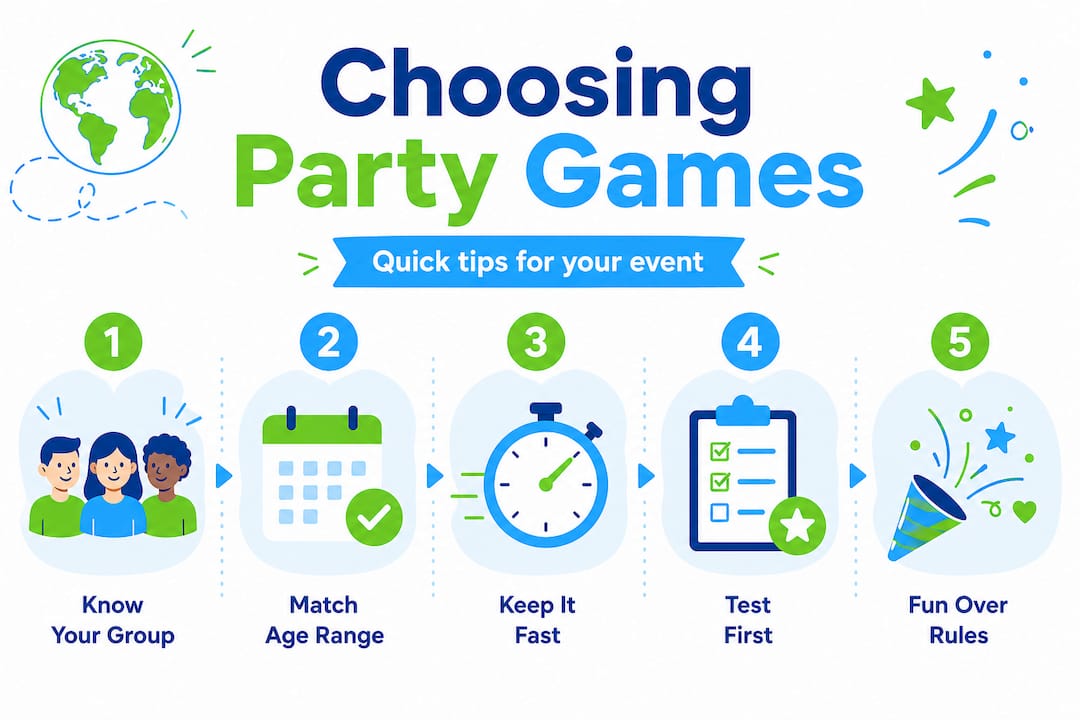
Here’s a comparison table to make the decision easier:
| Game type | Ideal group size | Competitive or co-op | Typical length | Inclusive features |
|---|---|---|---|---|
| Quick card games | 4-10 players | Competitive | 10-20 minutes | Simple rules, fast to learn |
| Party trivia | 4-12 players | Team-based | 20-40 minutes | Team play reduces individual pressure |
| Word/social games | 4-8 players | Mixed | 15-30 minutes | Language-based, minimal equipment |
| Co-op board games | 3-6 players | Cooperative | 45-90 minutes | No elimination, everyone wins together |
| Tabletop RPG-lite | 3-6 players | Collaborative | 60+ minutes | Rich storytelling, creative freedom |
Now, here’s a simple process to pick the right game:
- Define your group size. Smaller groups of 3-4 players can handle deeper, more intimate games. Larger groups need games with quick rounds and room for spectators to join in on the fun.
- Gauge the energy level you want. High energy and loud laughs? Go competitive and quick. Chill, cozy vibes? Try something cooperative or conversation-based.
- Check the rule complexity. If you’re mixing experienced gamers with total newcomers, simpler is always better. You can layer in complexity in future sessions.
- Think about your occasion. Date night calls for something different than a birthday blowout. Couples conversation games and trivia feel intimate; food-themed card games and music guessing games feel like a party.
- Account for neurodiverse guests. Choose games with clear structure, visible turn order, and predictable mechanics. Everyone benefits from clarity, not just neurodivergent players.
Pro Tip: Always test a new game with a small trusted group before debuting it at a big party. Rules that seem obvious to you can totally stall the vibe when thirty people are standing around confused.
If you want a solid framework for making this call, reading more about choosing party games for gatherings is a great place to start building your personal game selection strategy.
How to introduce and maximize tabletop games at your party
Once you’ve chosen your games, the real test is launching them smoothly during your party. Here’s how to maximize the impact.
Even the best game can fall flat if the introduction is clunky. We’ve been there. You pull out the box, start reading the rulebook, and watch people’s eyes glaze over. The setup is everything.
Here are some key things to do before guests even arrive:
- Pre-set the table. Cards shuffled, pieces sorted, instructions ready but not out. Visible setup signals that games are happening without making it feel mandatory.
- Create a dedicated game zone. Even just a cleared table with good lighting tells guests “this is where the fun happens.”
- Choose your opener wisely. Start with something fast and easy. A quick round of a simple card game warms people up better than launching straight into something complex.
- Have two or three options ready. Let guests have a small say in what you play. That ownership immediately boosts buy-in.
When it’s time to actually introduce the game, keep the rules brief. Like, really brief. Nobody wants a lecture. Instead:
- Give the one-sentence premise. “You’re trying to not explode.” Done. People are curious now.
- Show, don’t just tell. Run a quick demo round in real time, even if it means “wasting” a turn or two. Seeing is understanding.
- Ask for a volunteer. A willing participant takes pressure off the rest of the group and makes the demo feel organic, not forced.
- Handle reluctant players graciously. Never pressure anyone. Let them watch the first round and they’ll almost always ask to join by round two.
- Remind everyone that losing is part of the fun. Seriously, some of the best party moments come from spectacular failures.
Research actually confirms that you don’t need to avoid competitive formats to keep the peace. Studies show that competitive games elicit more prosocial behaviors in mixed-age groups than cooperative games, which is wildly counterintuitive. A little rivalry sparks more encouragement, more cheering, and more genuine interaction than you’d expect.
The using party games for group bonding playbook is full of practical ways to frame competition as connection, not conflict.
Pro Tip: A small prize pile — candy, silly trophies, or even just bragging rights written on a napkin — adds motivation without pressure. People play harder and laugh more when there’s something (silly) on the line.
A host’s wisdom: Getting tabletop games right
Stepping back, here’s what years of party-hosting with tabletop games have made clear.
Here’s an honest take: most conventional party advice is actually pretty passive. Get good food. Play good music. Hope people talk. That’s fine, but it’s not memorable. The parties people genuinely remember — the ones that get brought up years later — almost always had some kind of structure at the center. A game. A shared challenge. A moment where everyone was in it together.
We’ve seen it over and over again. A casual Friday night becomes legendary because someone pulled out a fast card game and suddenly everyone was howling with laughter and making inside jokes that lasted for months. That doesn’t happen with a Spotify playlist.
What we’ve also learned (sometimes the hard way) is that structured games beat open-ended “mingle” time for creating real connections. When guests are just told to “hang out,” the extroverts dominate and the introverts check their phones. A game gives everyone a role. It levels things out.
The other thing we used to get wrong: we avoided competitive games because we didn’t want conflict. Turns out, that instinct is backwards. A bit of rivalry is actually a social catalyst. People cheer. People tease each other playfully. People high-five strangers. The structured tension of a competitive game creates more warmth than you’d ever predict. Reading more about insights on group game dynamics really drove this home for us.
As a host, the real job isn’t just to provide food and a venue. It’s to facilitate joy. Tabletop games are one of the best tools you have for that. Embrace the facilitator role. Own it. Your guests will leave happier, more connected, and already asking when the next game night is.
Ready to transform your party with tabletop games?
Inspired to host your next unforgettable gathering? Here’s your next step.
We put a lot of thought into finding games that actually work at real parties — not just ones that look good in a box. Whether you’re hosting a girls’ night, a family game night, a couples’ date night, or a casual get-together with coworkers, the right game makes all the difference.

At PlayWorldGame, you’ll find a curated lineup of fast, social card and board games built specifically for the moments we’ve been talking about throughout this article. From music guessing games to food-themed party hits to couples’ conversation starters, we’ve got options for every vibe and every crowd. Head over to discover tabletop games and find the perfect fit for your next event. Your guests are going to talk about it for a long time.
Frequently asked questions
What are the best tabletop games for large casual parties?
Quick, scalable games like Exploding Kittens, Coyote, and Just One work best for large groups because they’re easy to learn and built around laughter. As highlighted in the best party games roundup, these titles emphasize chaos and fun over strategy, making them perfect for mixed crowds.
Do competitive tabletop games cause conflict at parties?
Actually, the opposite tends to happen. Research confirms that competitive games elicit more prosocial behaviors than cooperative ones in mixed-age groups, meaning guests cheer each other on, engage more, and bond more deeply than you’d expect from a competitive format.
How do tabletop games help guests who are strangers connect?
Tabletop games create built-in structure and shared focus, which lowers social anxiety and makes conversation feel natural and easy. Studies show that analog tabletop RPGs provide more meaningful social support than virtual alternatives, partly because the in-person interaction gives everyone a safe, shared context to connect within.
Are tabletop games inclusive for neurodiverse guests?
Yes, especially when you choose games with clear rules and predictable turn structure. Research notes that 25% of board gamers are neurodivergent, which means well-structured games aren’t just a nice-to-have — they’re genuinely essential for making everyone at the table feel welcome and included.