


TL;DR:
- Cooperative play enhances children’s social skills, empathy, and teamwork, benefiting emotional development.
- Team games promote sharing, patience, and communication, strengthening family bonds and connection.
- Choosing age-appropriate, scalable, and simple cooperative games maximizes inclusivity and engagement.
Most of us think of game night as a way to unwind, laugh a little, and maybe argue about the rules. But there’s something bigger happening around that table. Research shows that cooperative play actively shapes how kids (and adults) communicate, empathize, and work together. It’s not just fun. It’s functional. In this article, we’re breaking down the real science behind team play in games, what it means for your family’s social and emotional growth, and how to choose the right games to make every gathering count.
Table of Contents
- Why teamwork matters: The science behind cooperative play
- How team play shapes kids’ social and emotional growth
- Comparing cooperative and competitive games: What’s best for connection?
- Choosing the best team-based games for families and friends
- The overlooked magic of family team play: What most experts miss
- Ready to boost teamwork with unforgettable game nights?
- Frequently asked questions
Key Takeaways
| Point | Details |
|---|---|
| Cooperative play builds skills | Team-based games help children and adults develop communication, empathy, and sharing abilities. |
| Choose the right games | Selecting inclusive, quick-to-learn cooperative games leads to deeper connections and more fun for all ages. |
| Teamwork starts at home | Regular family game nights serve as a foundation for strong relationships and lifelong social skills. |
| Mix play styles | Blending cooperative and competitive games can keep family gatherings engaging while maximizing learning. |
Why teamwork matters: The science behind cooperative play
To understand how game nights can truly benefit your family, let’s look at the science.
Cooperative play isn’t just a nice idea. It’s backed by solid research. Cooperative games significantly enhance children’s social skills, including teamwork, communication, empathy, and peer relationships. That means the time your kids spend playing together isn’t wasted. It’s actually doing the heavy lifting that classrooms and structured activities sometimes miss.
And it goes beyond just kids feeling good. Structured cooperative play interventions show measurable improvements in group work behavior among young pupils. When children are given clear team goals and the tools to work toward them together, they become better collaborators, not just in the game but in real life too.
For adults, the benefits are just as real. Playing team games together builds family bonds with games in ways that casual conversation often can’t. You’re problem-solving together, celebrating shared wins, and navigating friendly disagreements. That’s relationship-building in action.
Here’s a quick look at what the research tells us:
| Benefit | Who it helps | Evidence strength |
|---|---|---|
| Improved communication | Kids and adults | Strong (multiple studies) |
| Greater empathy | Children especially | Strong |
| Better peer relationships | School-age kids | Strong |
| Increased sharing behavior | Young children | Moderate to strong |
| Positive group behavior | Kids in structured settings | Strong |
“Cooperative play gives children a safe space to practice the very skills they’ll rely on for the rest of their lives, from listening to leading.”
The truth is, building teamwork with games is one of the most natural and enjoyable ways to develop these skills. You don’t need a curriculum or a coach. You just need a good game and a willing group.
How team play shapes kids’ social and emotional growth
Knowing the science, what does this look like for children’s social development?
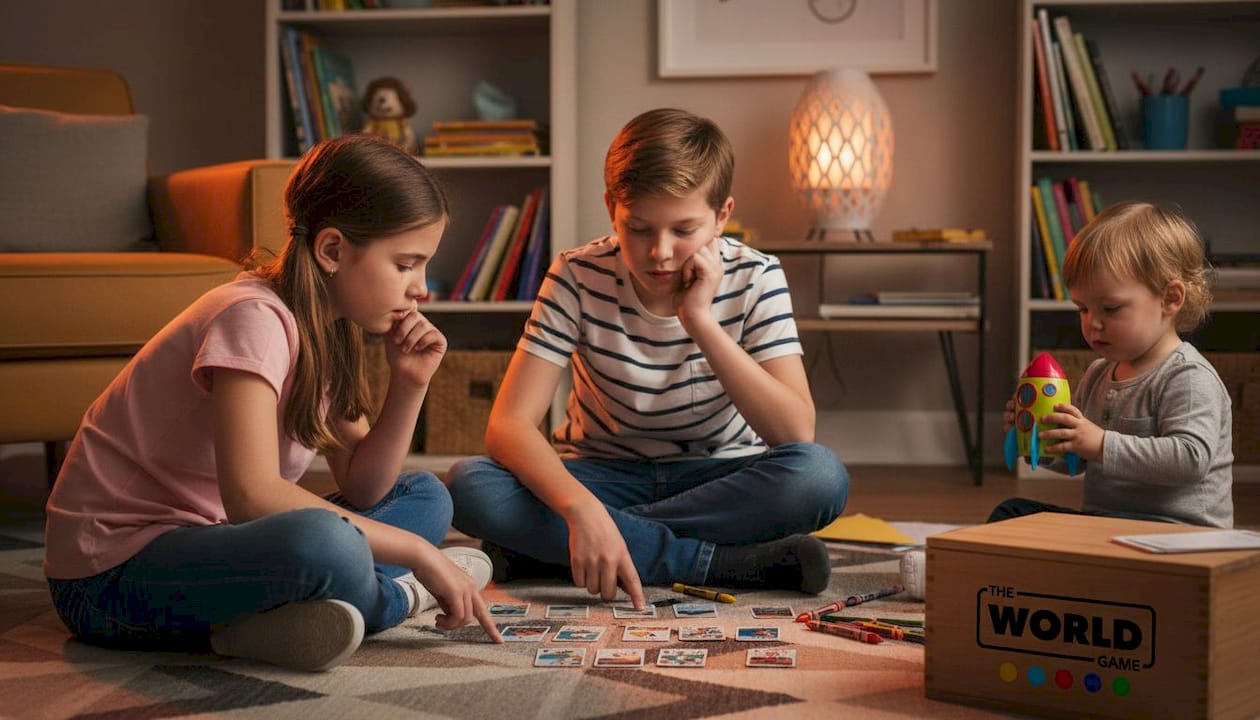
When kids play cooperatively, they’re practicing empathy in real time. They have to listen to teammates, wait for their turn, share resources, and make decisions together. These aren’t abstract lessons. They’re lived experiences that stick.
The research gets even more specific. A study on music game interventions found that an 8-week program of group music games significantly improved cooperative behavior in 5 and 6 year olds, with the effects lasting well after the program ended. That’s a big deal. It means the benefits aren’t just in the moment. They carry forward.
And when it comes to sharing, cooperative games increase sharing behavior in young children compared to competitive games, with girls showing an even stronger positive response. So if you’ve got a mixed group of kids at the table, a cooperative game is likely your best bet for a genuinely inclusive experience.
Here’s what games and teamwork for children actually look like in practice:
- Empathy building: Kids learn to consider teammates’ feelings and perspectives during play
- Active listening: Team games require kids to actually hear and respond to each other
- Patience and turn-taking: Waiting your turn in a game is great low-stakes practice for real-world patience
- Shared decision-making: Choosing a team strategy teaches kids how to negotiate and compromise
- Leadership skills: Rotating who leads a round helps kids try on different roles safely
Pro Tip: If you’re playing with kids under 6 or mixed reading levels, go for music-based or picture-based games. These level the playing field and keep everyone engaged, no reading required.
The bottom line? Team play isn’t just wholesome. It’s genuinely effective at building the social and emotional toolkit kids will use for years.
Comparing cooperative and competitive games: What’s best for connection?
With social skills in mind, let’s compare how different types of games affect connection and growth.
Both cooperative and competitive games have a place on your shelf. But they don’t do the same thing. Understanding the difference helps you choose the right game for the right moment.
In competitive games, the goal is individual or team victory over opponents. In cooperative games, everyone wins or loses together. That shift changes everything about how players interact.
| Factor | Cooperative games | Competitive games |
|---|---|---|
| Teamwork focus | High | Low to moderate |
| Empathy development | High | Moderate |
| Sharing behavior | Strongly encouraged | Less emphasized |
| Inclusion of all players | High | Can vary |
| Communication required | Constant | Situational |
| Risk of conflict | Low | Moderate to high |
Research backs this up clearly. Cooperative games boost sharing in young children significantly more than competitive formats. And for girls in particular, the effect is even more pronounced. That’s worth knowing when you’re picking a game for a group that includes younger kids or mixed personalities.
There’s also an interesting nuance around group size. Smaller groups enhance engagement, and boys may need more deliberate exposure to cooperative formats to get the same benefits girls naturally gravitate toward. So if you’ve got a big group of rowdy boys, don’t give up on cooperative games. Just be intentional about it.
Here’s how to blend both types for maximum connection:
- Start the night with a cooperative warm-up game to set a team-first tone
- Use competitive games with clear, simple rules to keep energy high mid-night
- End with a cooperative game so everyone finishes on a shared win
- Rotate teams in competitive games so no one feels left out or consistently loses
For more ideas on family connection through games, or if you want to go deeper into collaborative board gaming, we’ve got you covered with more resources.
The stat that matters: Cooperative play produces measurably more sharing behavior than competitive play. If connection is your goal, cooperative games are the smarter starting point.
Choosing the best team-based games for families and friends
Now that you know the benefits and differences, here’s how to choose games that truly fit your friends and family.
Not all cooperative games are created equal. Some are too complex for younger kids, others are too simple for adults, and a few are just right for everyone. Here’s how to find your sweet spot.
Step-by-step guide to picking your game:
- Know your group. Consider the ages, attention spans, and reading levels of everyone playing. A game that works for teens might frustrate a 5 year old.
- Check setup time. For game nights with younger kids, aim for games that set up in under 5 minutes. Nobody wants to lose the room before the game even starts.
- Look for scalable difficulty. Great cooperative games let you adjust the challenge level so the game grows with your family.
- Prioritize non-reading-required options for groups with young kids. Picture-based or verbal games keep everyone on equal footing.
- Try before you commit. Borrow from a friend or library before buying. The best game is the one your family will actually play.
Expert-recommended cooperative games for families include some real crowd-pleasers:
- Forbidden Island: A race against time where players work together to collect treasures before the island sinks. Great for ages 10 and up.
- Pandemic: Players team up to stop global disease outbreaks. Challenging, strategic, and deeply satisfying when you win.
- Hoot Owl Hoot: A color-matching game designed for young kids (ages 4 and up) with zero reading required.
- Outfoxed: A cooperative whodunit for ages 5 and up. Kids LOVE the process of elimination mechanic.
- Castle Panic: Defend your castle together against waves of monsters. Fast, fun, and great for ages 8 and up.
- The Crew: A trick-taking card game with cooperative missions. Perfect for older kids and adults who want something with a little more depth.
For tips for family game night that go beyond just picking a game, think about how you structure the experience too.
Pro Tip: Rotate who acts as “team captain” each round. It gives quieter players a chance to lead and keeps the more dominant personalities from running the show every time. It’s a small change that makes a big difference in how connected everyone feels.
The overlooked magic of family team play: What most experts miss
Most articles about cooperative games focus on the games themselves. Which ones are best, how long they take, what age they’re rated for. That’s useful, but it misses the bigger picture.
The real transformation happens in the spaces between the turns. It’s the moment your 7 year old says “wait, let’s hear what my sister thinks” before making a move. Or when your teenager actually listens to a younger sibling’s idea instead of dismissing it. That’s not the game working. That’s strengthening family bonds in real time.
We believe the living room floor is one of the best classrooms there is. When families play together as equals, with no grades, no pressure, and no real stakes, something shifts. Mistakes become funny instead of shameful. Losing becomes a reason to try again, not a reason to shut down.
Games create a safe trial zone for life skills. And those skills don’t stay in the box when the game ends.
Ready to boost teamwork with unforgettable game nights?
Taking your next step toward thriving, connected game nights is easy.
You’ve seen the research. You know cooperative play builds real skills. Now it’s time to put that into action. At Playworldgame.com, we’ve curated a collection of fast, social games designed exactly for moments like these. Whether you’re after a music guessing game that levels the playing field for all ages, a food-themed party game for your next get-together, or a couples conversation game for a quieter night in, we’ve got something that fits.

Discover more cooperative games and find the perfect match for your crew. And if you want to keep building on what you’ve learned today, our family teamwork resources are packed with practical tips to make every game night count.
Frequently asked questions
What are the top benefits of team play games for kids?
Team play games improve social skills, cooperation, communication, and empathy, helping children form stronger peer relationships and practice real-world collaboration in a low-stakes setting.
How do cooperative games differ from competitive games in building social skills?
Cooperative games focus on shared goals and mutual support, which increases sharing and empathy more effectively than competitive formats where individual winning takes priority.
Which board games are best for building teamwork?
Top picks for teamwork include Forbidden Island, Pandemic, Hoot Owl Hoot, Outfoxed, Castle Panic, and The Crew, all of which require players to work together toward a shared goal.
How can parents support teamwork skill development during family game nights?
Parents can model collaborative behavior, celebrate shared wins out loud, and rotate leadership roles during play to give every player a chance to contribute and feel valued.